
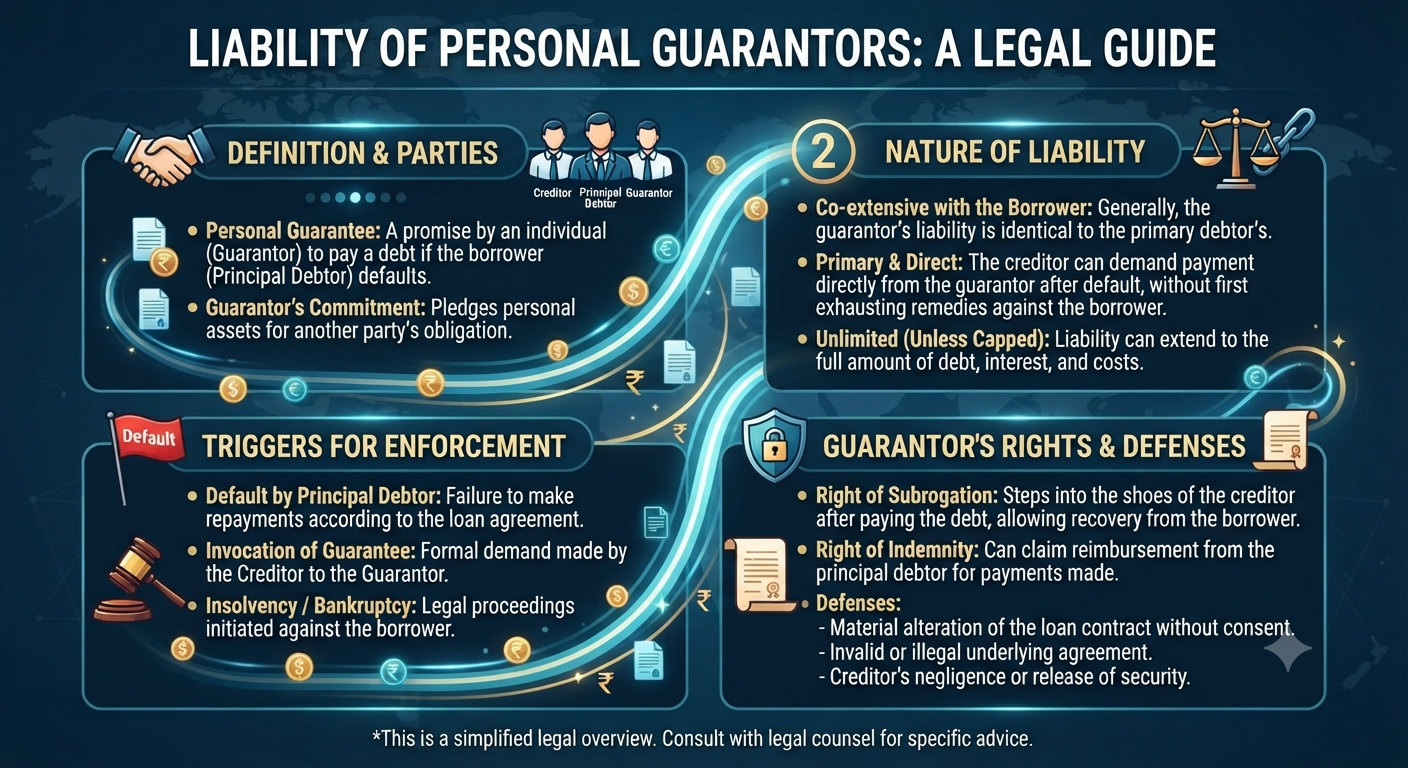
Liability of Personal Guarantors Under the Insolvency and Bankruptcy Code, 2016
Liability of Personal Guarantors Under the Insolvency and Bankruptcy Code, 2016.
A practical guide to Sections 95 & 96 of IBC, 2016 for promoters, directors, HNIs and creditors
Introduction
Almost every substantial business loan in India carries a hidden second signature. Behind the company’s stamp sits a promoter or director who has signed a personal guarantee — a promise to repay from their own pocket if the company defaults. For years, that promise felt largely theoretical. That era is over.
Since the Central Government notified the personal-guarantor provisions of the Insolvency and Bankruptcy Code (IBC), 2016 in November 2019, creditors have a fast, tribunal-driven route to pursue guarantors personally — often at the very same time they are chasing the company. A single default can now put a promoter’s home, savings, and reputation on the line. This article explains where the law stands, how the process works, and why the moment a demand notice arrives is the moment to act.
The Legal Position: Co-Extensive Liability, Upheld by the Supreme Court
The foundation is deceptively simple. Under Section 128 of the Indian Contract Act, 1872, a guarantor’s liability is co-extensive with that of the principal borrower — meaning the creditor can proceed against the guarantor to the same extent as against the company, and need not exhaust remedies against the company first.
Two Supreme Court decisions have hardened this into settled law:
- Lalit Kumar Jain v. Union of India (2021): The Court upheld the November 2019 notification and made a point promoters routinely misunderstand — the liability of a guarantor is not discharged merely on the discharge of the corporate debtor. In practice, even if a resolution plan for the company is approved and the company’s debt is written down, the guarantor’s exposure can survive intact.
- Dilip B. Jiwrajka v. Union of India (2024): A three-judge bench upheld the constitutional validity of Sections 95 to 100 of IBC, 2016. The Court held there is no violation of natural justice, since the guarantor is not deprived of an opportunity to participate, and that no judicial determination takes place until the adjudicating authority decides admission or rejection under Section 100. The resolution professional’s early role is examination and recommendation — not adjudication.
The tribunals have continued to sharpen the edges through 2025. A recurring theme: valid invocation of the guarantee is a genuine precondition. In State Bank of India v. Deepak Kumar Singhania (NCLAT, February 2025) and Asha Basantilal Surana v. SBI (NCLAT, May 2025), the Appellate Tribunal scrutinised whether the creditor had actually invoked the guarantee and demanded payment from the guarantor. A notice under Section 13(2) of SARFAESI can amount to valid invocation, but only if it actually demands payment from the guarantor in language that lines up with the guarantee agreement. A defaulted loan alone is not enough.
Which Tribunal Hears Your Case — and the Threshold
For a personal guarantor to a corporate debtor, the adjudicating authority is the National Company Law Tribunal (NCLT), not the Debt Recovery Tribunal — courtesy of Section 60(1), which keeps the guarantor’s proceedings in the same forum as the company’s. This is precisely why guarantors in the capital so often need experienced NCLT lawyers in Delhi who practise before the Principal Bench regularly; the procedure, benches, and filing conventions differ meaningfully from ordinary civil or recovery litigation.
The default threshold has also been clarified. In Anita Goyal v. Vistra ITCL and related 2025 rulings, the NCLAT held that where the Section 95 application is filed before the NCLT, the threshold under Part II — INR 1 crore — governs the proceedings, and not the lower threshold under Part III.
The Step-by-Step Insolvency Resolution Process (IRP)
Against a personal guarantor, the process runs on a tight statutory timeline:
- Application (Section 95): A creditor files to initiate the IRP against the guarantor, routed through a resolution professional. (A guarantor may also file on their own under Section 94.)
- Interim Moratorium (Section 96): Protection begins automatically on filing — before any admission (explained in detail below).
- Appointment of RP (Section 97): The NCLT directs the Board to confirm or nominate a resolution professional.
- RP’s Report (Section 99): The RP examines the application — typically within 10 days of appointment — and recommends admission or rejection, seeking documents as needed.
- Admission or Rejection (Section 100): The NCLT decides, ordinarily within 14 days of the report. This is the stage of genuine judicial determination, where the guarantor’s objections are heard.
- Moratorium on Admission (Section 101): If admitted, a fresh moratorium runs for up to 180 days while a repayment plan is negotiated.
- Repayment Plan (Sections 105–114): The guarantor, with the RP, proposes a plan; creditors vote; the NCLT may approve it. Failure can lead to bankruptcy proceedings.
The Section 96 Moratorium vs. the Section 14 CIRP Moratorium
Guarantors often assume the protection they get mirrors the company’s. It does not. The distinction is one of the most important — and most misunderstood — features of this framework.
Section 96 — Interim Moratorium (the guarantor)
- Triggers on filing, automatically, before the tribunal admits anything.
- Is debt-specific, not entity-wide. As the Supreme Court clarified, the interim moratorium under Section 96 protects the debt, not the debtor as a whole.
- Any legal action or proceeding pending in respect of any debt is deemed stayed, and no fresh action in respect of that debt may be commenced or continued. Courts have read this broadly enough to cover even cheque-bounce proceedings under Section 138 of the NI Act.
- Lasts until the NCLT decides admission or rejection under Section 100.
Section 14 — CIRP Moratorium (the company)
- Triggers on admission of the company into CIRP — not on mere filing.
- Is asset- and entity-wide: it stays all suits against the corporate debtor, bars transfer of its assets, halts enforcement of security interests, and prevents recovery of property — all to preserve the company as a going concern.
In short: Section 96 shields a debt; Section 14 shields an entire company. Recognising which protection actually applies to you — and its limits — is central to any defence strategy.
One practical benefit for guarantors: once Section 96 is triggered, the tribunals have curbed duplicate actions. Following Indian Bank v. T. Prabhakar (2025), the NCLAT has held that no subsequent application under Section 95 is maintainable once proceedings are already underway — even by a different creditor — discouraging a pile-on for the same liability.
Navigating NCLT Proceedings: Why Strategy Is Everything
On paper, the timeline looks mechanical. In practice, it is a minefield of jurisdictional objections, invocation disputes, limitation arguments (typically three years from default), and threshold challenges — each capable of ending or delaying a case at the threshold. Because Jiwrajka confines the guarantor’s substantive hearing largely to the Section 100 stage, the quality of the case built before that hearing is decisive.
This is where seasoned NCLT lawyers in Delhi earn their keep. The right counsel will pressure-test whether the guarantee was validly invoked, whether the demand notice satisfies the SARFAESI and guarantee-agreement standards the NCLAT now insists on, whether limitation has expired, and whether the correct threshold and forum have been observed. Small procedural failures by a creditor frequently become a guarantor’s strongest shield.
The Severe Implications for Promoters
If your personal guarantee is invoked, the consequences reach well beyond the company’s balance sheet:
- Simultaneous pursuit: A creditor can proceed against you and the company at the same time — you may be defending CIRP as a promoter and IRP as a guarantor in parallel.
- No automatic escape via the company’s plan: Approval of the company’s resolution plan does not, by itself, wipe out your guarantee (Lalit Kumar Jain).
- Personal assets exposed: Homes, deposits, and investments can be drawn into a repayment plan.
- Bankruptcy risk: A failed repayment plan can lead to formal bankruptcy, with lasting financial and reputational fallout.
Conclusion & Call to Action
The legal landscape for personal guarantors has shifted decisively toward creditors, and the courts have repeatedly upheld that direction. Yet the same jurisprudence has handed guarantors real, technical defences — on invocation, limitation, threshold, and forum — that must be raised early and correctly.
If you have received a demand notice or believe your personal guarantee may be invoked, do not wait for the Section 95 application to land. The interim moratorium, your objections, and your negotiating position are all shaped in the earliest days. Speak to specialised counsel — experienced NCLT lawyers in Delhi who handle personal-guarantor matters before the tribunal — the moment that notice arrives.
Disclaimer: This article is for information purpose only and should not be taken as legal advice. To know further details, clarification, assistance or any advice on Insolvency & Bankruptcy Code or any action committed by the companies to personal guarantee, or any legal issues on insolvency, claims against fraudulent transactions or any disputes among the shareholders/promoters/ investors etc., you may connect with us at admin@equicorplegal.com / 08448824659 and visit www.equicorplegal.com