Technology Law in India: A Comprehensive Guide for Businesses and Startups
Technology Law in India: A Comprehensive Guide for Businesses and Startups
A. Introduction
Most technology businesses do not fail because their product is weak. They run into trouble because a data breach was mishandled, a customer contract allocated risk badly, IP was never properly assigned by a founder who left, or a regulator asked a question the company could not answer. By the time these problems surface, the cost of fixing them is a multiple of what prevention would have cost.
India’s technology legal landscape has changed more in the last two years than in the previous decade. The Digital Personal Data Protection Rules were finally notified in November 2025, putting the country’s first comprehensive data protection law on a firm implementation clock. Around the same time, the government released its AI Governance Guidelines. For any company that builds, sells, or invests in technology, the compliance baseline has shifted, and it is no longer optional.
This guide sets out the framework in plain terms: what technology law covers, where the real risks sit, and where experienced Technology Lawyers in Delhi add value to a growing business.
B. What is Technology Law?
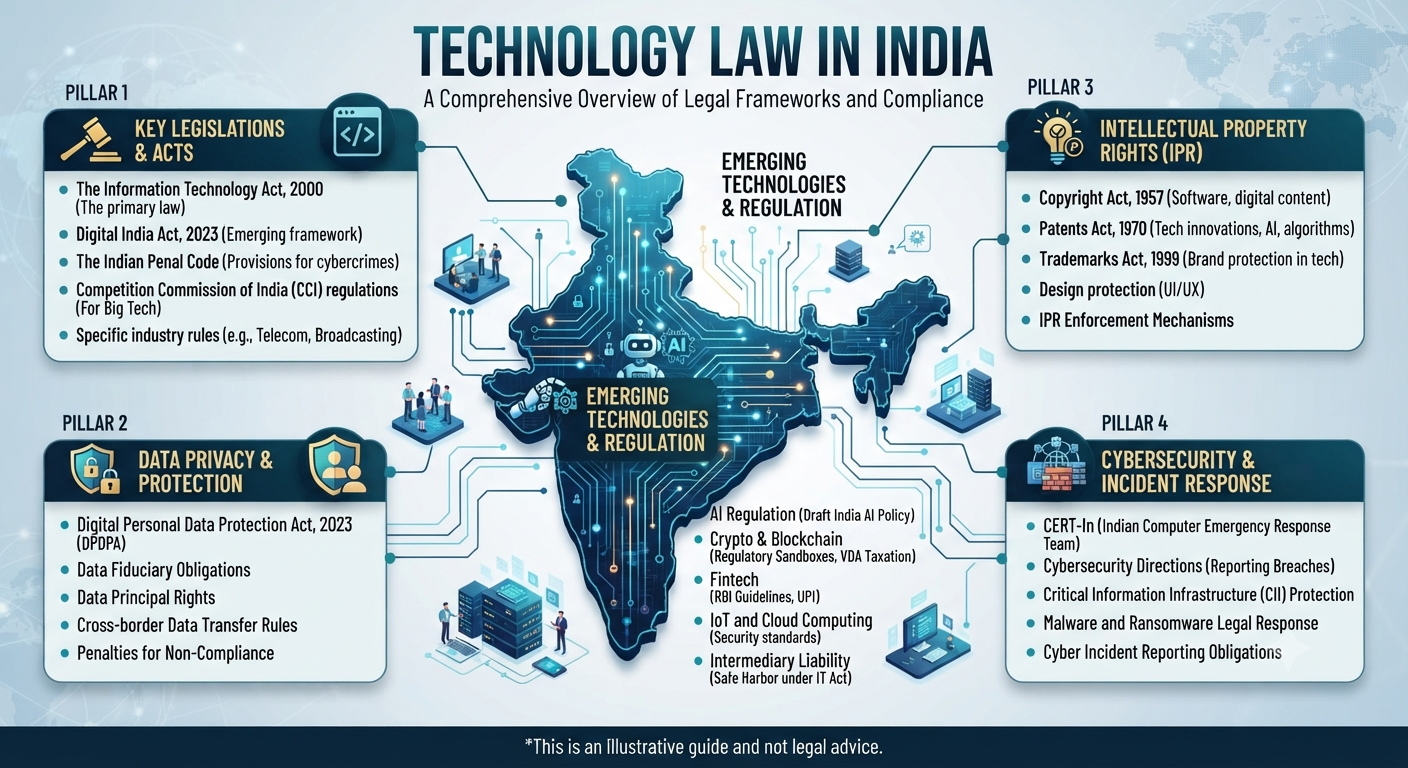
Technology law is not a single statute. It is the body of rules, contracts, and regulatory practice that governs how technology is created, licensed, deployed, and disputed. In practice it sits at the intersection of several disciplines: data protection and privacy, cybersecurity, intellectual property, contract law, competition and consumer law, and sector-specific regulation such as fintech and health-tech.
For a business, technology law answers questions like: Who owns the code? What can we do with customer data? What happens when a cloud provider goes down? Are our online terms enforceable? Can we be held liable for content on our platform or output from our AI model? These are commercial questions with legal consequences, which is exactly why they benefit from advice that understands both.
C. Evolution of Technology Law in India
India’s digital legal framework has moved through three broad phases.
- Recognition (2000 onwards). The Information Technology Act, 2000 gave legal validity to electronic records and digital signatures and created the first offences for computer misuse.
- Regulation (2011–2021). Data protection rules under Section 43A, the intermediary guidelines, and a series of RBI and sectoral norms brought structure to online business, culminating in the IT (Intermediary Guidelines and Digital Media Ethics Code) Rules, 2021.
- Rights and accountability (2023 onwards). The Digital Personal Data Protection Act, 2023 and its 2025 Rules mark a decisive shift toward a consent-driven, rights-based regime, backed by a dedicated enforcement body and serious financial penalties.
The direction of travel is clear. India is building a mature, globally aligned digital governance system, and enforcement is catching up with legislation.
D. Key Areas of Technology Law
The sections below cover the areas that come up most often in our work with technology companies, startups, SaaS providers, e-commerce platforms, and fintech businesses. Each carries its own compliance obligations and its own failure modes.
D.1. Information Technology Act, 2000
The IT Act remains the backbone of Indian cyber law. Its most useful features for business are the legal recognition of electronic contracts and electronic and digital signatures, which is what makes online commerce enforceable in the first place.
The Act also creates the offences that matter in practice: unauthorised access and data theft (Sections 43 and 66), identity theft (66C), cheating by impersonation (66D), and publication of obscene material (67). Section 69 gives the government interception and monitoring powers, and Section 79 provides the “safe harbour” that protects intermediaries from liability for third-party content, provided they follow due diligence and the 2021 Intermediary Rules.
Any platform that hosts user content, processes payments, or stores personal data should treat compliance with the IT Act and the Intermediary Rules as foundational rather than aspirational. Loss of safe harbour is an existential risk for a marketplace or social platform.
D.2. Digital Personal Data Protection Act (DPDP Act)
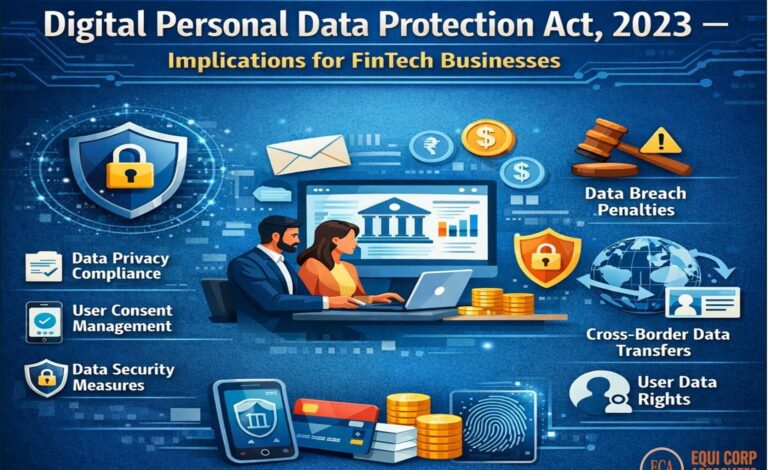
The DPDP Act is the single most important development for Indian technology businesses. The government notified the DPDP Rules through a series of notifications dated 13 November 2025, operationalising India’s data protection framework through a phased implementation over the next 18 months.
The Act works through a few core concepts:
- Data Fiduciary — the entity that decides why and how personal data is processed (most businesses).
- Data Processor — a vendor processing data on the fiduciary’s behalf.
- Data Principal — the individual whose data is processed.
- Significant Data Fiduciary — a class of high-volume or high-risk fiduciaries subject to heavier obligations, including data protection impact assessments and appointment of a Data Protection Officer.
Businesses must obtain clear, specific, informed consent supported by a plain-language notice, limit processing to stated purposes, minimise the data they collect, and honour Data Principal rights of access, correction, erasure, grievance redressal, and nomination. Children’s data attracts special protection, including verifiable parental consent and restrictions on tracking and targeted advertising directed at minors.
Two points deserve emphasis. First, the penalties are substantial: the framework allows penalties reaching up to ₹250 crore per violation. Second, the compliance runway is real but short. Phase 1 from November 2025 established the Data Protection Board of India; the consent manager framework activates from November 2026; and the remaining substantive obligations come into force in May 2027. Companies that begin their data mapping and consent redesign now will be comfortable. Those that wait will not.
E. Cybersecurity and Data Protection Compliance
Cybersecurity obligations in India now run on two parallel tracks, and businesses must satisfy both.
E.1. CERT-In Directions (2022). Under the IT Act, CERT-In requires reporting of specified cyber incidents within six hours of detection, retention of logs for 180 days within India, and clock synchronisation to NPL/NIC. Cloud, VPN, and data centre providers face additional KYC and record-keeping duties.
E.2. DPDP breach obligations. Separately, on becoming aware of a personal data breach, a Data Fiduciary must notify each affected Data Principal and the Data Protection Board without delay, and furnish a detailed report to the Board within a short window. The two regimes overlap but are not identical, and a single incident can trigger both.
A workable cybersecurity programme therefore combines technical controls with a legal incident-response plan: a written playbook, pre-drafted notification templates, clear internal escalation, and contractual breach-cooperation clauses with vendors. In our experience, the companies that handle breaches well are the ones that decided who does what before the breach happened.
F. Legal Issues in Artificial Intelligence and Emerging Technologies
India has, so far, chosen not to enact a standalone AI statute. On 5 November 2025, MeitY unveiled the India AI Governance Guidelines, advocating a lightweight, adaptive approach that leverages existing laws rather than imposing a new AI-specific law, anchored in a “Do No Harm” principle. The government’s stated preference is to adjust definitions in existing laws to cover AI contexts and introduce targeted amendments rather than draft an overarching AI Act.
That does not mean AI is unregulated. The practical legal exposure for AI-driven businesses includes:
- Training data and IP. Whether data was lawfully sourced, and whether outputs infringe third-party copyright.
- Data protection. DPDP consent and purpose-limitation rules apply squarely to AI training and profiling.
- Liability and bias. Who is responsible when an automated decision causes harm or discriminates.
- Content authenticity. Amendments to the intermediary rules now require labelling and provenance metadata for synthetically generated information, including deepfakes.
For founders building AI products, contracts and internal governance are the practical tools available today: clear allocation of liability, data-use warranties, human-oversight commitments, and documentation of how models are trained and tested.
G. Software Licensing and Technology Agreements
Technology contracts are where risk is either allocated sensibly or left to chance. The agreements we draft and negotiate most often include:
- Software development agreements — with clean IP assignment to the client, acceptance testing, milestone payments, and source code escrow for critical builds.
- SaaS agreements — covering service levels and uptime, data ownership, security commitments, a DPDP-compliant data processing addendum, and exit and data-portability rights.
- Cloud computing agreements — addressing sub-processors, data location, audit rights, and continuity on termination.
- Licensing arrangements — perpetual versus subscription, scope, territory, and open-source compliance.
- Technology transfer agreements — assignment or licensing of know-how, often with cross-border and FEMA implications.
The recurring mistake is treating the contract as paperwork to be signed after the deal is agreed. The contract is the deal. A well-drafted limitation of liability or IP clause can be worth more than the fee for the entire engagement.
H. E-commerce and Digital Business Regulations
E-commerce businesses sit under a layered regime. The Consumer Protection Act, 2019 and the Consumer Protection (E-Commerce) Rules, 2020 impose disclosure, grievance-redressal, and fair-trade obligations, and they distinguish between marketplace and inventory models. Foreign investment in e-commerce is tightly regulated, and the marketplace-versus-inventory distinction has direct FDI consequences.
Depending on the sector, additional rules apply: legal metrology for packaged goods, FSSAI for food, drug and cosmetic rules for pharma, and GST across the board. Online terms, return and refund policies, and platform seller agreements should be drafted to match the actual business model, not copied from a template that describes a different one.
I. Intellectual Property Protection for Technology Businesses
For a technology company, IP is usually the most valuable asset on the balance sheet and the one most often neglected in the early years.
- Copyright protects source code as a literary work automatically, but registration strengthens enforcement.
- Patents are available for inventions with a technical effect; computer programmes “per se” are not patentable under Section 3(k), so claims must be framed carefully.
- Trademarks protect brand and product names and should be filed early, in the right classes.
- Trade secrets have no dedicated statute in India and are protected through confidentiality contracts and common law, which makes NDAs and access controls essential.
The single most important IP step for a startup is ensuring that every founder, employee, and contractor has assigned their work to the company in writing. Investors will check this in diligence, and a gap here can delay or derail a funding round.
J. Technology Due Diligence in Investments and M&A Transactions
When capital changes hands, technology and legal diligence run together. Buyers and investors will scrutinise:
- IP chain of title — clean assignments from all contributors.
- Open-source exposure — whether restrictive licences contaminate proprietary code.
- Data protection compliance — DPDP readiness, consent records, and breach history.
- Cybersecurity posture — controls, past incidents, and vendor risk.
- Material contracts — change-of-control, assignment, and termination triggers.
- Regulatory and litigation status — pending disputes and licences.
For cross-border deals, FEMA and FDI pricing and reporting requirements add a further layer. Sellers who prepare a diligence-ready data room in advance consistently achieve better valuations and smoother closings than those who scramble during the transaction.
K. Regulatory Compliance Challenges for Startups
Early-stage companies face a familiar tension: limited resources and expanding obligations. The compliance areas that most often catch startups off guard are DPDP consent and data handling, RBI norms for anything touching payments or lending, e-commerce and consumer rules, and employment and IP assignment hygiene.
The answer is not to do everything at once. It is to sequence compliance sensibly, starting with the items that are cheap to fix early and expensive to fix late: IP assignment, a defensible privacy policy and consent flow, and clean customer contracts. This is precisely where a relationship with Technology Lawyers in Delhi pays for itself, because prioritisation is a matter of judgment, not a checklist.
L. Common Technology Law Disputes
The disputes we see most frequently fall into a handful of categories:
- IP infringement and software piracy claims.
- Data breach and privacy liability, now with a statutory adjudication route before the Data Protection Board.
- SaaS and services disputes over performance, downtime, and payment.
- Domain name and brand disputes, resolved through INDRP or UDRP proceedings.
- Employment and confidentiality disputes, including departing employees taking code or clients.
Most well-drafted technology contracts route disputes to arbitration under the Arbitration and Conciliation Act, 1996, which offers speed and confidentiality. Where court proceedings are unavoidable, Delhi is a strong forum: the Delhi High Court operates a dedicated Intellectual Property Division that has become a leading venue for technology and IP litigation in India.
M. Role of Technology Lawyers in Delhi
Technology Lawyers in Delhi do far more than draft documents. In a mature engagement, the lawyer functions as a commercial partner who translates regulatory risk into business decisions.
The core functions include structuring technology transactions, negotiating licensing and SaaS agreements, building DPDP and cybersecurity compliance programmes, protecting and enforcing IP, conducting and defending diligence in fundraising and M&A, advising on AI and product governance, and representing the business in disputes and before regulators. The value lies in connecting these threads, because a data clause in a customer contract, a DPDP obligation, and a cybersecurity control are all the same risk viewed from different angles.
N. Why Businesses Need Technology Lawyers in Delhi
Delhi is not only a commercial centre; it is India’s regulatory capital. MeitY, CERT-In, and the ministries that shape technology policy are based here, and the Data Protection Board of India has been established in the National Capital Region. The Delhi High Court’s IP Division sits here, as do the RBI’s regional presence and a deep concentration of investors and technology counsel.
For a technology business, that proximity matters. Engaging Technology Lawyers in Delhi means working with advisers who are close to the institutions that regulate them, who track policy as it develops, and who appear before the forums where technology disputes are decided. Whether a company is negotiating its first enterprise SaaS contract, responding to a breach, closing a Series B, or facing an IP claim, experienced Technology Lawyers in Delhi bring both technical fluency and local regulatory reach.
O. Best Practices for Technology Risk Management
A practical, low-drama risk programme rests on a few habits:
- Map your data. You cannot comply with the DPDP Act until you know what personal data you hold, where it sits, and why.
- Fix IP assignments early. Get written assignments from every founder, employee, and contractor.
- Standardise contracts. Use vetted templates for SaaS, NDAs, and vendor agreements, and negotiate the risk clauses that matter.
- Build an incident-response plan. Decide roles, timelines, and notification templates before a breach occurs.
- Review before you scale. New markets, products, and funding rounds each create new obligations; a periodic legal review catches problems while they are still cheap.
- Keep records. Consent logs, security policies, and diligence documents are your defence if a regulator or investor asks.
P. Key Takeaways
- Technology law in India spans data protection, cybersecurity, IP, contracts, AI governance, and sectoral regulation, and these areas overlap constantly.
- The DPDP Act and its 2025 Rules are now operational on a phased timeline running to May 2027, with penalties up to ₹250 crore. Start compliance work now.
- Cybersecurity carries dual obligations under CERT-In and the DPDP framework; both must be satisfied.
- India is regulating AI through existing laws and guidelines rather than a standalone Act, but data, IP, liability, and content-authenticity risks are live today.
- IP assignment and clean contracts are the cheapest risks to fix early and the most expensive to fix late.
- Delhi’s status as India’s regulatory and judicial hub makes local technology counsel a strategic advantage.
Q. Frequently Asked Questions (FAQs)
- When does the DPDP Act actually apply to my business?
It already governs how you handle personal data, and its obligations are being phased in through May 2027. Any business processing the personal data of individuals in India should begin compliance now rather than wait for the final deadline.
- Do I need a Data Protection Officer?
A DPO is mandatory only for entities classified as Significant Data Fiduciaries. Even so, most growing companies benefit from designating a responsible person and a clear grievance-redressal contact.
- My startup uses open-source software. Is that a legal risk?
It can be. Some open-source licences impose conditions that, if ignored, can affect your proprietary code or surface during investor diligence. A licence review before fundraising is a sensible precaution.
- Are online terms and clickwrap agreements enforceable in India?
Yes, generally. Electronic contracts are recognised under the IT Act and the Indian Contract Act. Enforceability depends on how consent is captured and how clearly terms are presented, which is why the design of the consent flow matters.
- What should I do first if we suffer a data breach?
Contain the incident, preserve evidence, and follow your response plan. You will likely have reporting obligations to CERT-In and, for personal data, to the Data Protection Board and affected individuals. Engage counsel early; the first 24 hours shape everything that follows.
- How do Technology Lawyers in Delhi help with fundraising?
They prepare the company for legal and technology diligence: confirming IP ownership, tightening contracts, closing DPDP gaps, and organising a data room. Preparation improves both valuation and closing speed.
- Is a separate AI law coming to India?
Not immediately. The current policy direction favours governing AI through existing laws and sectoral guidelines, so businesses should focus on data protection, IP, liability, and content-authenticity compliance now.
Conclusion
Technology moves faster than legislation, and Indian regulation is now moving faster than it ever has. The businesses that thrive in this environment are not the ones with the most lawyers; they are the ones that treat legal risk as a design input rather than an afterthought. Getting data protection, IP, contracts, and cybersecurity right early is what lets a company scale, raise capital, and defend itself with confidence.
If you are building, funding, or running a technology business, this is the moment to put your legal foundation in order. Our team advises technology companies, startups, SaaS and e-commerce platforms, fintech businesses, and investors on the full range of technology transactions and disputes: DPDP and privacy compliance, cybersecurity and breach response, software and SaaS agreements, intellectual property, AI and product governance, technology due diligence, and litigation and arbitration.
Talk to our Technology Law team
To discuss your requirements with experienced Technology Lawyers in Delhi, contact Equicorp Associates LLP for a confidential consultation on technology transactions, DPDP and cybersecurity compliance, privacy, intellectual property, and dispute resolution. Whether you need a single contract reviewed or a complete compliance programme built, we can help you move quickly and safely. You may connect with us at admin@equicorplegal.com / 08448824659 and visit www.equicorplegal.com
Disclaimer: This article is intended for general informational purposes only and does not constitute legal advice or create an attorney-client relationship. Laws and regulations change, and their application depends on specific facts. Readers should seek professional legal advice tailored to their circumstances before acting on any information contained here.