
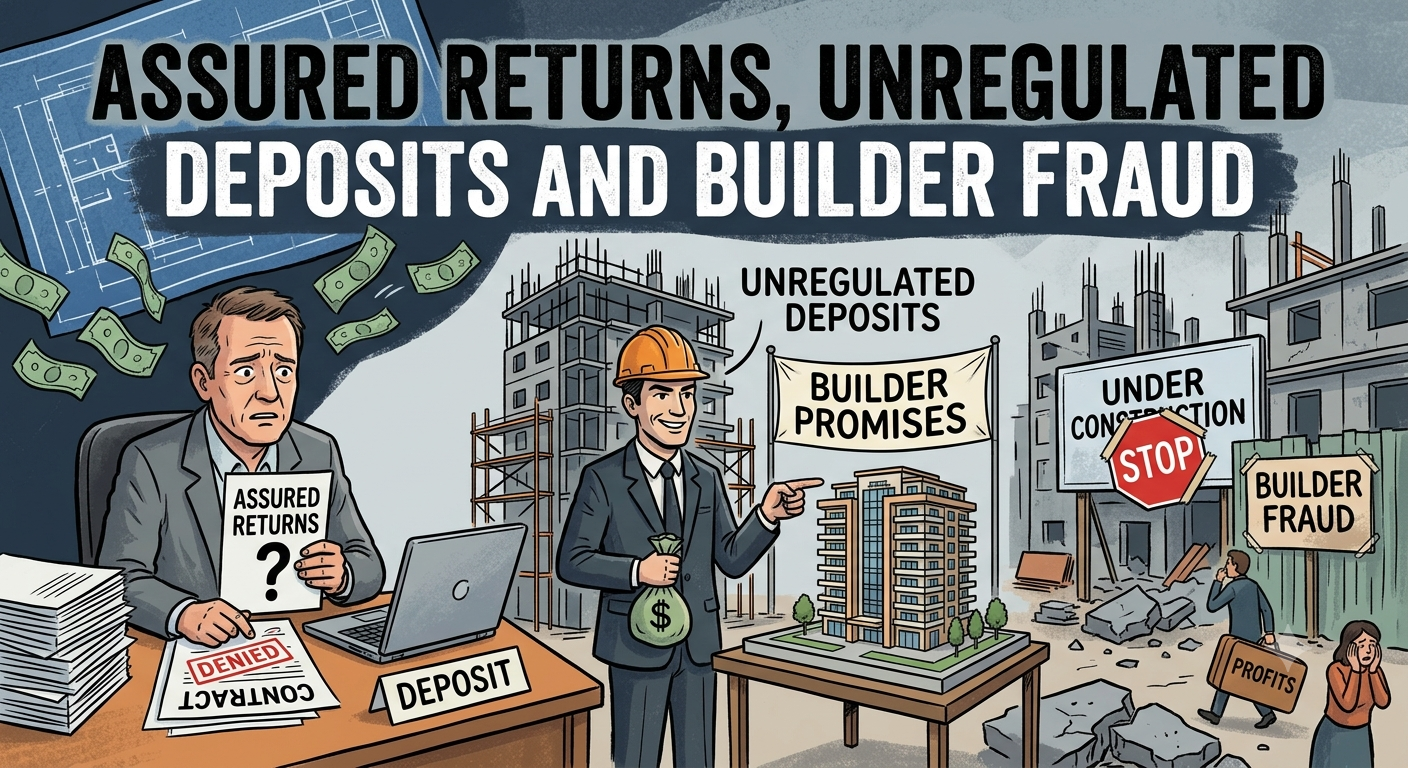
Assured Returns, Unregulated Deposits and Builder Fraud: Investor Remedies under the BUDS Act, 2019 and the Delhi Depositors Act, 2001
Assured Returns, Unregulated Deposits and Builder Fraud: Investor Remedies under the BUDS Act, 2019 and the Delhi Depositors Act, 2001
For over a decade, “assured return” schemes have been a fixture of the Delhi-NCR property market[cite: 11]. The developer sells a commercial unit, studio or retail space and also promises a fixed monthly payment until possession, often followed by a lease guarantee or a buy-back at a premium[cite: 11]. When the project stalls, the payments stop, the post-dated cheques bounce, and the investor finds that the unit is unbuilt, sold more than once, or mortgaged[cite: 11].
Two statutes give such investors far stronger tools than an ordinary civil suit: the central Banning of Unregulated Deposit Schemes Act, 2019 (BUDS Act) and the Delhi Protection of Interests of Depositors (in Financial Establishments) Act, 2001 (Delhi PID Act)[cite: 11]. Both treat money collected on a promise of return as a “deposit”, both criminalise fraudulent default, and both allow the State to attach the assets of the company and, in defined cases, of its promoters for distribution to depositors[cite: 11].
Why an Assured Return Is a Legal Problem
A typical scheme has three features: (i) payment of most of the price long before construction is complete; (ii) a fixed monthly or quarterly return until possession or leasing; and (iii) in some cases, a buy-back at a guaranteed premium[cite: 11]. Commercially, the developer is borrowing from the public with the unit as cover[cite: 11]. Legally, if the money is in substance a loan carrying a return, it may be a “deposit”[cite: 11]. Developers are not authorised deposit-takers, so the scheme risks being a prohibited unregulated deposit scheme, and a default on an unviable promise may be presumed fraudulent[cite: 11].
The BUDS Act: When Does a Builder’s Money Become a Deposit?
Section 2(4) defines “deposit” widely: any money received by a deposit taker by way of advance, loan or otherwise, with a promise to return it, in cash, in kind or as a specified service, with or without any benefit by way of interest, bonus or profit[cite: 11]. “Deposit taker” (s. 2(6)) covers individuals, firms, LLPs and companies[cite: 11]. Any scheme accepting deposits by way of business that is not listed as a Regulated Deposit Scheme in the First Schedule is an “Unregulated Deposit Scheme” (s. 2(17)), and Section 3 bans it outright[cite: 11].
The real estate exclusion and its limits. Section 2(4)(l)(ii) excludes an advance received towards the price of immovable property, provided it is adjusted against that property under the agreement[cite: 11]. The exclusion is narrowed by two provisos: an amount that becomes refundable is deemed a deposit fifteen days after it falls due for refund; and an amount refundable because the developer lacked the necessary permission or approval to deal in the property is deemed a deposit[cite: 11]. For companies, the Explanation to Section 2(4) imports the Companies Act, 2013 meaning, and Rule 2(1)(c)(xii)(b) of the Companies (Acceptance of Deposits) Rules, 2014 carries a parallel exclusion with similar provisos[cite: 11].
The unsettled question. Is the scheme a genuine sale with a payment incentive, or money-raising with a unit attached?[cite: 11] Forums are divided[cite: 11]. The Haryana RERA, Gurugram has repeatedly held that the BUDS Act does not bar assured returns because the allottee’s payment is an advance against property, and has directed arrears to be paid (more recently allowing the higher of the assured return or delayed-possession interest)[cite: 11]. Developers argue the opposite: that assured-return clauses became unenforceable once the BUDS Act came into force[cite: 11]. That argument is double-edged[cite: 11]. A developer who says its own scheme was an unregulated deposit is conceding that it accepted money in breach of Section 3, which may defeat a civil claim but invites prosecution and attachment[cite: 11].
Offences, Liability and Recovery under the BUDS Act
Chapter VI creates a graded set of offences[cite: 11]:
| Provision | Offence | Imprisonment | Fine |
|---|---|---|---|
| s. 21(1) | Soliciting deposits for an unregulated scheme[cite: 11] | 1 to 5 years[cite: 11] | ₹2 lakh to ₹10 lakh[cite: 11] |
| s. 21(2) | Accepting deposits under an unregulated scheme[cite: 11] | 2 to 7 years[cite: 11] | ₹3 lakh to ₹10 lakh[cite: 11] |
| s. 21(3) | Accepting unregulated deposits and fraudulently defaulting in repayment or promised service[cite: 11] | 3 to 10 years[cite: 11] | ₹5 lakh up to twice the aggregate funds collected[cite: 11] |
| s. 23 | Wrongful inducement by false or misleading statements[cite: 11] | 1 to 5 years[cite: 11] | Up to ₹10 lakh[cite: 11] |
| s. 24 | Repeat offender[cite: 11] | 5 to 10 years[cite: 11] | ₹10 lakh to ₹50 crore[cite: 11] |
Unviable terms are evidence of fraud. Under the Explanation to Section 21, wholly impracticable or unviable terms are relevant facts showing intent to defraud[cite: 11]. A 12–25% annual “assured” return on an unbuilt commercial unit is routinely attacked on this ground[cite: 11].
Personal liability. Section 25 deems every person in charge of and responsible for the business guilty, subject to proof of lack of knowledge or due diligence; directors and officers whose consent, connivance or neglect is proved are also liable[cite: 11].
Cognizable and non-bailable. Section 28 makes every offence cognizable and non-bailable, except those under Sections 22 and 26[cite: 11].
Attachment and priority. The Competent Authority appointed by the appropriate Government (for Delhi, the GNCTD) may provisionally attach deposits and property, including property held by others on the deposit taker’s behalf (s. 7), and must seek confirmation from the Designated Court within thirty days, extendable to sixty (s. 14)[cite: 11]. Depositors’ dues rank ahead of other debts and government dues, subject to SARFAESI, the RDB Act and the IBC (s. 12)[cite: 11]. Property transferred to mala fide transferees can be followed, and wrongful gains disgorged[cite: 11].
CBI and appeal. Multi-State schemes of public-interest magnitude must be referred for CBI investigation (s. 30)[cite: 11]. Final orders are appealable to the High Court within sixty days (s. 19)[cite: 11].
The Delhi PID Act: A Wider Net in Delhi
The Delhi PID Act remains fully in force and is in some respects wider[cite: 11]. A “financial establishment” is any person or group of persons accepting deposits under any scheme or arrangement, excluding only government-owned corporations, co-operatives and banking companies[cite: 11]. “Deposit” covers any money received to be returned later in cash, in kind or as a service, with or without any benefit[cite: 11]. Crucially, there is no specific exclusion for advances adjusted against immovable property[cite: 11]. The ordinary-course exclusions cover security and dealership deposits, earnest money and advances against orders, while Explanation II excludes only credit given by a seller to a buyer, the reverse of an assured-return arrangement[cite: 11]. Whether a builder’s receipts fall within these exclusions is a question of fact and drafting, and the burden of making that case usually falls on the developer[cite: 11].
Fraudulent default (s. 3). Every promoter, partner, director, manager or other person responsible for management is punishable with imprisonment up to six years and fine up to ₹1 lakh; absent special and adequate reasons, the minimum is six months and ₹20,000[cite: 11]. The establishment is liable to a fine up to ₹1 lakh or twice the amount involved, whichever is higher[cite: 11]. The Explanation deems a default fraudulent where it stems from intent to cause wrongful gain or loss, from impracticable or commercially non-viable promises made while accepting the deposit, or from deploying deposits with inherent risk of non-recovery[cite: 11]. Returns payable only from fresh collections, or diversion of buyers’ money to land banks and group companies, fall squarely within this deeming fiction[cite: 11].
Attachment of personal assets (s. 4). On depositors’ complaints or otherwise, the GNCTD may attach money and property acquired from deposits, in whoever’s name held, and, if insufficient, other property of the establishment and the personal assets of its promoters, directors, partners and managers[cite: 11]. The Competent Authority must apply to the Designated Court within forty-five days (s. 5) and invite depositors’ claims (s. 7)[cite: 11]. The Court may make the attachment absolute, reach mala fide transferees and order payment to depositors, with appeal to the Delhi High Court within sixty days (s. 15)[cite: 11]. The Supreme Court upheld a materially similar Tamil Nadu statute in K.K. Baskaran v. State of Tamil Nadu (2011)[cite: 11].
How the Remedies Fit Together
Investors need not choose between the two Acts[cite: 11]. The BUDS Act overrides inconsistent laws (s. 34) but operates in addition to, and not in derogation of, other laws[cite: 11]. In Delhi, both Acts are administered by the GNCTD, and complaints are typically investigated by the Economic Offences Wing alongside cheating (s. 318 BNS), criminal breach of trust (s. 316 BNS) and criminal conspiracy (s. 61 BNS), or their IPC equivalents for pre-July 2024 transactions[cite: 11]. Other remedies serve distinct ends[cite: 11]:
- RERA for possession, refund with interest or delay compensation (its power to enforce assured-return clauses remains contested)[cite: 11];
- Order XXXVII CPC summary suits on written contracts or acknowledgments, and Section 138, NI Act for dishonoured post-dated cheques[cite: 11];
- Consumer Commissions, although investors who bought for returns may be met with the objection that they are not “consumers”[cite: 11]; and
- IBC, now largely closed to this class: in Mansi Brar Fernandes v. Shubha Sharma, 2025 INSC 1110 (decided 12 September 2025), the Supreme Court held that buyers under assured-return or buy-back arrangements are speculative investors who cannot invoke Section 7[cite: 11]. The deposit statutes have become correspondingly more important[cite: 11].
Roadmap for Investors
- Secure the paper trail: application form, allotment letter, MoU or buyer agreement, the assured-return clause or side letter, receipts, bank statements, brochures, post-dated cheques, dishonour memos and correspondence[cite: 11].
- Map the entities and individuals through MCA and RERA records, including group companies and related parties whose assets may be attached[cite: 11].
- Protect limitation: a Section 138 demand notice must issue within thirty days of the dishonour memo[cite: 11].
- Act collectively: a joint complaint carries more weight with the EOW and supports a request for attachment under Section 4 of the Delhi PID Act and Section 7 of the BUDS Act[cite: 11].
- Plead precisely: the deposit character of the money, the unviability of the promised return, the default and any diversion, so that the deeming provisions of both Acts are engaged[cite: 11].
- Run civil and regulatory remedies in parallel only where they add value, and avoid admissions that weaken the criminal case[cite: 11].
- File claims on time once a Competent Authority is appointed, to share in the distribution[cite: 11].
For Developers and Their Directors
Exposure is personal as well as corporate[cite: 11]. Developers should tie any rental guarantee or buy-back to genuine possession and leasing, and document how it is funded; ensure every receipt is adjusted against the unit under a RERA-compliant agreement with all approvals in place (a refund triggered by missing approvals is deemed a deposit); maintain clean, project-wise fund flows; and, where default has occurred, engage early on settlement, since restitution weighs heavily on bail and on the Designated Court’s discretion[cite: 11].
Conclusion
An assured-return scheme is not unlawful merely because it promises a return; the question is whether, in substance, the developer raised money from the public under cover of a sale[cite: 11]. Where it did, and defaulted, the BUDS Act and the Delhi PID Act convert a contractual grievance into a criminal and asset-recovery proceeding that reaches the promoters personally[cite: 11]. With the IBC route now largely closed to such investors, these statutes are their most potent remedy[cite: 11].
For assistance on real estate and financial fraud, unregulated deposits, complaint drafting, FIRs and investigation, quashing petitions or director liability, contact Equicorp Associates LLP at admin@equicorplegal.com | +91 84488 24659 | www.equicorplegal.com[cite: 11]