
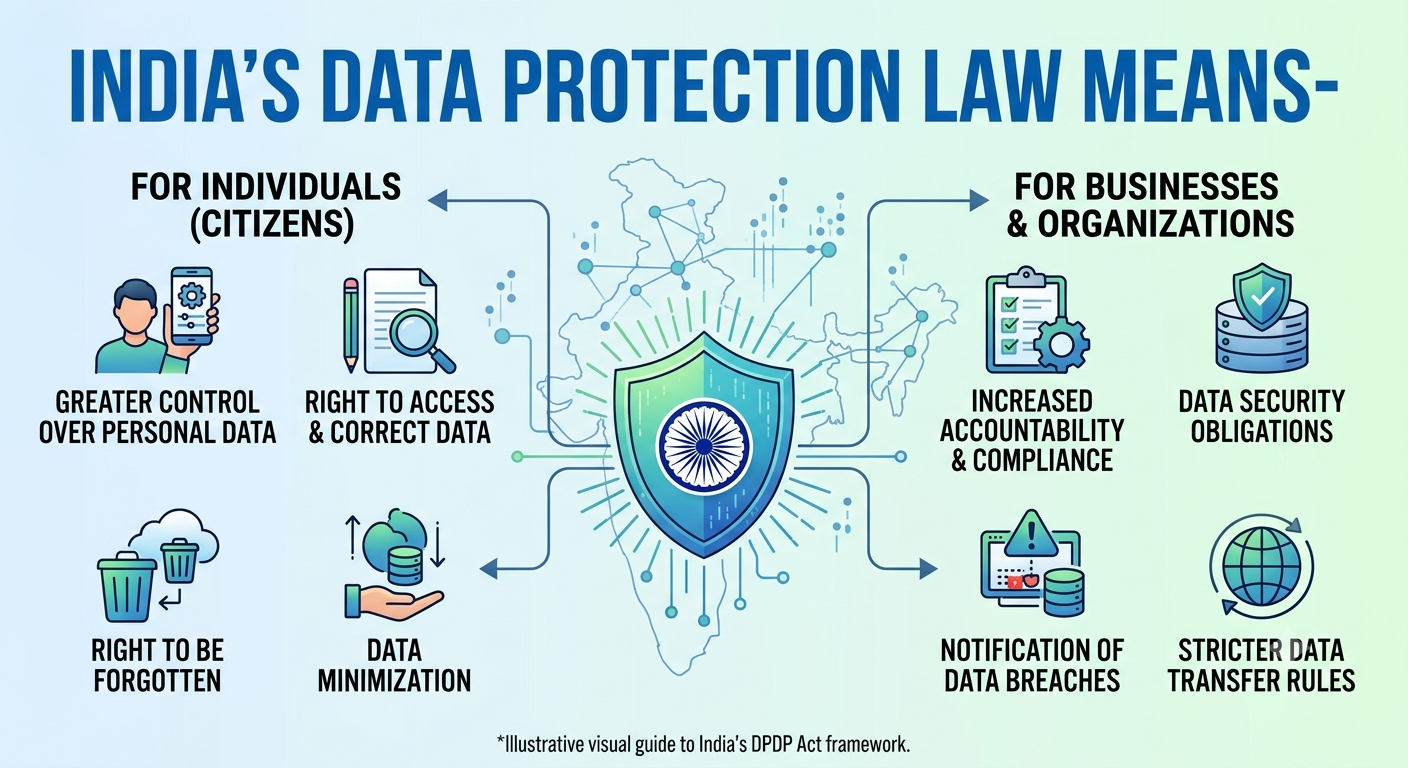
The 180-Day Countdown: What India’s Data Protection Law Means for Your Business
The 180-Day Countdown: What India’s Data Protection Law Means for Your Business
On May 13th, 2027, the core of the Digital Personal Data Protection Act, 2023 (“DPDP Act”) comes into force, with penalties of up to INR 250 crore for a single breach[cite: 10]. Fewer than 180 days remain, and most businesses have not yet worked out what they must change[cite: 10].
Every time a business collects a mobile number (a delivery app confirming an order, a factory gate logging a contract worker’s thumbprint, a salon sending a birthday offer on WhatsApp), it processes personal data[cite: 10]. From May 13th, 2027, each of those ordinary moments becomes a regulated act[cite: 10].
Where things stand
The Ministry of Electronics and Information Technology (MeitY) notified the DPDP Rules, 2025 on November 13th, 2025 and brought the Act into force in three phases[cite: 10]:
- November 13th, 2025: provisions constituting the Data Protection Board of India (“Board”)[cite: 10].
- November 13th, 2026: registration and oversight of Consent Managers, now in force[cite: 10].
- May 13th, 2027: everything else, including notice and consent, security safeguards, breach reporting, children’s data, individual rights, retention, cross-border transfers, Significant Data Fiduciaries and penalties[cite: 10].
In January 2026, MeitY floated a proposal to shorten the 18-month window[cite: 10]. It has not been notified, so May 13th, 2027 remains the operative date[cite: 10]. Businesses should plan to that date, not hope for an extension[cite: 10].
This is not GDPR with an Indian accent
Groups with European operations often assume their GDPR work will carry over[cite: 10]. Some will, but the DPDP Act differs in ways that catch experienced compliance teams[cite: 10].
- No “legitimate interests” ground. Processing needs either consent (section 6) or one of the narrow “legitimate uses” in section 7, such as data the person provided voluntarily for a stated purpose, legal obligations, medical emergencies and employment[cite: 10]. Fraud analytics, product improvement and much marketing will need a fresh legal basis[cite: 10].
- Consent has a high bar. It must be free, specific, informed, unconditional and unambiguous, given by clear affirmative action, and as easy to withdraw as to give[cite: 10]. Pre-ticked boxes and bundled consents do not meet that bar[cite: 10].
- One tier of data. The separate “sensitive” category under the IT Act’s SPDI Rules falls away[cite: 10]. Safeguards must be reasonable for whatever data is held[cite: 10].
- Every breach is reportable. There is no threshold of harm[cite: 10]. The Board and each affected person must be told without delay, and a detailed report must reach the Board within 72 hours[cite: 10].
- A child is anyone under 18. Verifiable parental consent is required, and tracking, behavioural monitoring and targeted advertising directed at children are prohibited[cite: 10].
- Penalties are steep, and the Board imposes them. Up to ₹250 crore for failing to take reasonable security safeguards; ₹200 crore each for failing to notify a breach or breaching children’s safeguards; ₹150 crore for Significant Data Fiduciary defaults; and ₹50 crore for any other breach[cite: 10]. Appeals lie to TDSAT[cite: 10]. The Act offers no compensation to individuals and bars civil court jurisdiction[cite: 10].
- Sector law still applies. The Act operates in addition to RBI, SEBI, IRDAI and CERT-In requirements (section 38)[cite: 10]. Obligations stack, and in a direct conflict the DPDP Act prevails[cite: 10].
Where it bites, by sector
| Sector | Typical role | Biggest exposure | First move |
|---|---|---|---|
| Technology (SaaS, apps) | Processor for client data; Fiduciary for its own users[cite: 10] | Undocumented role split; hidden SDKs and trackers; personal data used to train AI models[cite: 10] | Document the processor/fiduciary split; audit every SDK[cite: 10]. Section 17(1)(d) relief covers only non-residents’ data processed under foreign contracts[cite: 10] |
| Manufacturing | Fiduciary for workforce, dealer and product-user data[cite: 10] | Over-reaching biometric and CCTV monitoring; telemetry from connected products[cite: 10] | Employee privacy notice; proportionality review[cite: 10]. Section 7(i) covers employment purposes, not unlimited surveillance[cite: 10] |
| Financial services and healthcare | Fiduciary under two or more regulators; likely SDF candidates[cite: 10] | Overlapping breach clocks and localisation rules across RBI, SEBI, IRDAI and CERT-In[cite: 10] | One regulatory map showing the strictest requirement for each data flow[cite: 10] |
| Consumer and D2C | Fiduciary; possibly an SDF at scale[cite: 10] | Bundled or pre-ticked consent; dark patterns; users under 18[cite: 10] | Purpose-wise consent; one-click withdrawal; a clear age-gating decision[cite: 10] |
Six traps businesses are walking into
- Treating it as a privacy policy rewrite. Rule 3 requires a standalone, itemised notice listing each data item and its purpose, available in English or any Eighth Schedule language[cite: 10]. A new notice changes nothing if the consent flow, CRM and deletion scripts behind it stay the same[cite: 10].
- Forgetting the vendors. The Data Fiduciary is liable for its processors (section 8(1)) and may engage them only under a valid contract (section 8(2))[cite: 10]. Most vendor contracts say nothing on breach-notice timing, sub-processing or deletion[cite: 10].
- Missing the clocks. One incident can trigger a six-hour report to CERT-In, immediate notices to affected persons and the Board, a 72-hour detailed report and any sector regulator’s own deadline[cite: 10]. Without a rehearsed plan, these deadlines pass while the team is still on its first call[cite: 10].
- Keeping everything forever. Data must be erased once its purpose is served[cite: 10]. Large e-commerce, social media and online gaming platforms must erase data of users inactive for three years, after 48 hours’ notice[cite: 10]. Processing logs, however, must be kept for at least one year[cite: 10]. The retention schedule has to reconcile both[cite: 10].
- Ignoring existing customers. People who consented before commencement must receive a fresh notice as soon as reasonably practicable (section 5(2))[cite: 10]. For a large user base, that is a campaign in its own right[cite: 10].
- Waiting to be told you are “significant”. No Significant Data Fiduciary has yet been notified[cite: 10]. Once designated, a business needs an India-based Data Protection Officer, an independent data auditor, an annual impact assessment and audit, algorithmic due diligence and possibly data localisation[cite: 10]. Large platforms should build to that standard now[cite: 10].
A six-month roadmap
We recommend an internal deadline of 28 February 2027, leaving ten weeks to test before the legal one[cite: 10].
- November–December 2026: mobilise. Approval from the board of directors, a budget and one accountable executive[cite: 10]. A Data Protection Officer or grievance contact named[cite: 10]. A gap assessment against the Act, the Rules and sector regulations[cite: 10]. Two strategic calls made early: whether to build to “significant” standards, and whether to allow under-18 users at all[cite: 10].
- January 2027: map and design. An inventory of every processing activity: what data, whose, why, on what legal ground, where it is stored, who accesses it and how long it is kept[cite: 10]. Notices drafted and translated, consent journeys redesigned, a retention schedule approved, and breach and rights-handling procedures written[cite: 10].
- February–April 2027: build and test. Consent management wired into web, app, stores and call centre[cite: 10]. A rights-request workflow that closes grievances within the 90-day limit[cite: 10]. Security raised to the Rule 6 baseline (encryption or masking, access controls, logs, tested backups)[cite: 10]. Vendor contracts re-papered, riskiest first[cite: 10]. A breach simulation run with senior management in the room[cite: 10].
- From 13 May 2027: go live and keep going. Notices published, existing users re-notified, quarterly reports to the board of directors, and a watch on MeitY notifications and the Board’s first orders[cite: 10].
The defence that matters most is evidence[cite: 10]. In fixing a penalty, the Board must weigh the gravity and duration of the breach, the data involved, whether it was repeated, and how quickly and effectively the business mitigated it (section 33(2))[cite: 10]. A documented programme and a timely voluntary undertaking under section 32 can be worth crores[cite: 10].
The real opportunity
It is tempting to see the DPDP Act as one more compliance cost[cite: 10]. But Indian consumers are increasingly alert to spam calls, leaked numbers and apps that ask for too much[cite: 10]. Businesses that explain clearly what they collect, ask honestly and delete on time will earn something hard to buy: trust[cite: 10]. The law will reward those who start now and expose those who wait[cite: 10]. The countdown has already begun[cite: 10].
For further details, clarification or advice on DPDP and cybersecurity compliance, data privacy, technology transactions, intellectual property and dispute resolution, write to us at admin@equicorplegal.com or call 08448824659, and visit www.equicorplegal.com[cite: 10].