Inside Fintech Law: What Founders and Investors Need to know
Inside Fintech Law: What Founders and Investors Need to know
Inside Fintech Law: What Founders and Investors Need to Know
In practice of two decades, I have watched India’s financial technology sector move from a curiosity to the beating heart of the economy. Payments, lending, wealth management, insurance, cross-border remittance — almost none of it now happens without code. What has not changed is that every one of these products still sits inside a dense, and frequently unforgiving, regulatory structure. That gap — between how fast a fintech can build and how carefully the law expects it to behave — is where most of the trouble I am asked to fix begins.
If you are building or backing a fintech business out of the capital, you will, sooner rather than later, need fintech lawyers who understand both the technology and the regulator’s mind. This is not a matter of keeping a lawyer on retainer to paper over contracts after the fact. In this sector, legal architecture is product architecture. Get the licence, the data flows and the money movement wrong at the design stage, and no amount of later drafting will save you.
Let me explain, plainly, what specialist fintech counsel actually does — and why the choice of adviser matters.
A. Why Fintech Is a Different Kind of Legal Problem
Most businesses answer to one or two regulators. A fintech routinely answers to several at once, and the boundaries between them are not always obvious.
Consider a company that lets users invest spare change from their UPI transactions into mutual funds. That single feature touches the Reserve Bank of India’s payments and outsourcing norms, the Securities and Exchange Board of India’s rules on distribution and advice, the data-protection regime, anti-money-laundering law, and consumer-protection standards on how the offer is displayed. Each of those bodies has its own registrations, its own reporting cadence and its own view of what “fair” looks like.
The founder sees one clean user journey. The regulator sees five separate obligations. A good fintech lawyer’s first job is to translate between the two — to look at a wireframe and tell you, before a line of production code is written, exactly which permissions you need and which activities you are simply not allowed to do without a licence. I have seen promising companies burn eighteen months and a funding round because nobody asked that question early enough.
B. The Regulators You Will Actually Deal With
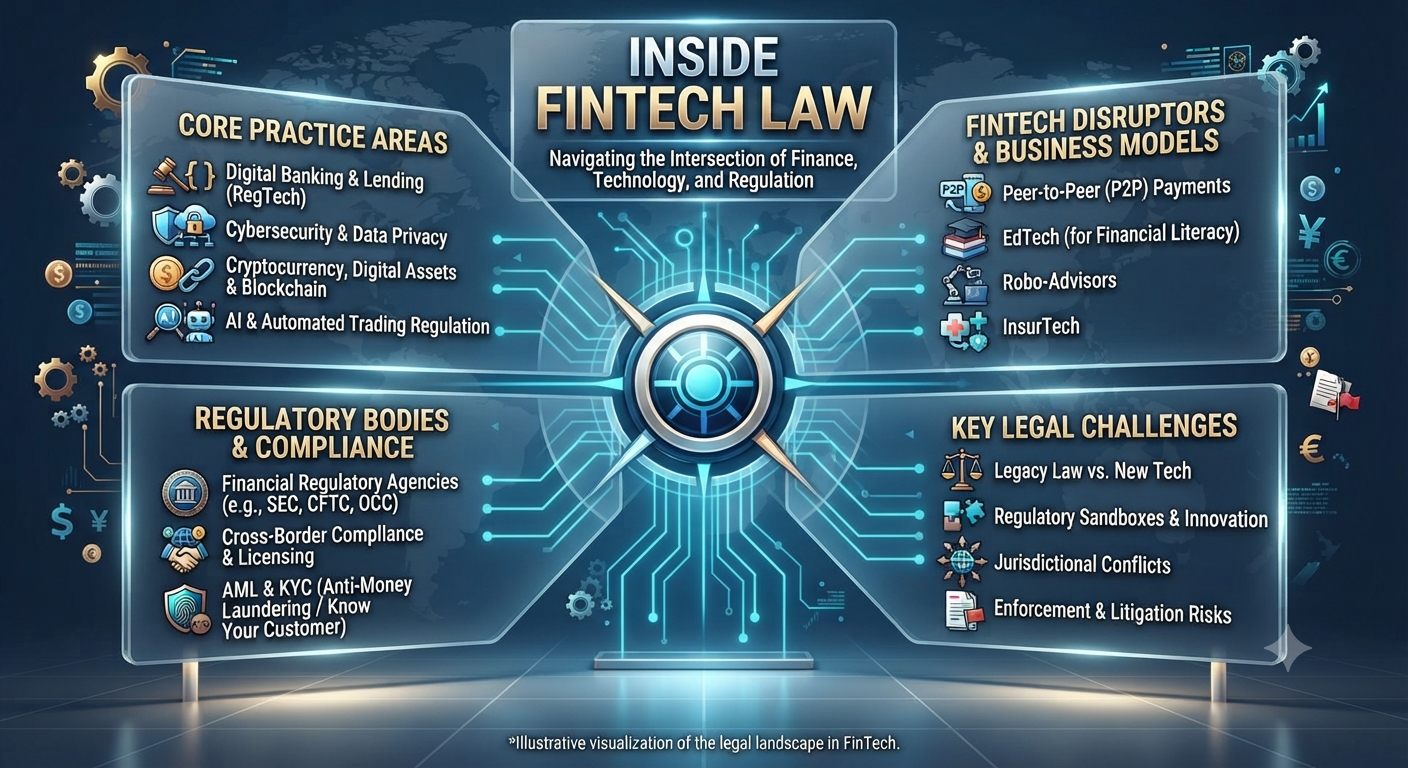
Effective fintech legal advisory in India rests on knowing who governs what. In practice, the bodies that shape a fintech’s life are:
- The Reserve Bank of India (RBI) — the central authority for payments, prepaid instruments, digital lending, NBFC registration, the Account Aggregator framework and cross-border payment flows.
- The Securities and Exchange Board of India (SEBI) — for anything touching securities, investment advice, research analysts, online bond platforms and wealth-tech.
- The Insurance Regulatory and Development Authority of India (IRDAI) — for insurtech, web aggregation and embedded insurance.
- MeitY and the Data Protection Board — for data, privacy and platform conduct.
- The Financial Intelligence Unit and the PMLA machinery — for KYC, suspicious-transaction reporting and virtual digital assets.
A founder does not need to memorise this map. A specialist adviser does — because the value lies in seeing, early, where a product straddles two regulators and might fall between them.
C. Where a Fintech Lawyer Earns Their Keep
Clients often ask what, concretely, they are paying for. Here is the honest answer, drawn from the matters that cross my desk most often.
i. Licensing, Structuring and Regulatory Approvals
Deciding how to be regulated is the most consequential decision a fintech makes. Should you register as an NBFC, or partner with a lending entity? Do you need authorisation as a Payment Aggregator or Payment Gateway? Is your wallet a Prepaid Payment Instrument requiring RBI approval? Would an Account Aggregator or a technology-service-provider model serve you better? Each route carries a different capital requirement, a different compliance burden and a different exit profile that your investors will scrutinise. Choosing the wrong entry point is expensive and slow to unwind.
ii. Digital Lending Compliance
This is now one of the busiest corners of our practice. The RBI (Digital Lending) Directions, 2025, which took effect on May 8th, 2025, consolidated the earlier 2022 guidelines and the 2023 rules on Default Loss Guarantee into a single enforceable instrument. The Directions reach every regulated entity that lends through a digital channel and, crucially, hold that entity fully accountable for the lending service providers acting on its behalf.
If you run or partner with a lending app, you must now issue a Key Fact Statement disclosing the true cost of credit before disbursal, obtain purpose-specific consent before touching a borrower’s device data, keep borrower data on servers in India, report every digital lending app on the RBI’s CIMS portal, and structure any Default Loss Guarantee within the prescribed caps. These are not cosmetic requirements. They dictate how your loan journey, your consent screens and your partner contracts are built. Retrofitting them after launch is painful; designing for them is not.
iii. Data Protection and Privacy
For years, Indian data law lived in a state of anticipation. That period is over. The Digital Personal Data Protection Rules, 2025 were notified on November 14th, 2025, giving full effect to the DPDP Act, 2023. Compliance is being phased in over roughly the next twelve to eighteen months, but the direction is unmistakable.
Fintechs are, almost by definition, heavy processors of personal and financial data — which puts many of them squarely within the framework, and some within the enhanced obligations that fall on Significant Data Fiduciaries, including annual data-protection impact assessments and independent audits. You will need lawful consent architecture, clear notices, breach-notification protocols, defensible retention and erasure practices, and vendor contracts that pass the data obligations down your chain. With penalties running to ₹250 crore for the gravest failures, this has moved from a “policy page” exercise to a board-level risk.
iv. Payments, KYC and Anti-Money-Laundering
Money movement invites the closest scrutiny of all. Sound counsel here means building KYC and customer-due-diligence flows that satisfy RBI and PMLA expectations, calibrating transaction monitoring, and preparing for the reporting duties that attach the moment you handle regulated payments or virtual digital assets.
v. Fundraising, FEMA and Cross-Border Investment
Most fintechs are venture-funded, and much of that capital is foreign. That brings the Foreign Exchange Management Act and India’s foreign-investment rules into every term sheet. Sectoral caps, pricing guidelines, reporting filings, and the structure of your shareholders’ agreement all have to line up. I spend a good deal of time on term sheets, SHAs, share-subscription documents and the FEMA compliance that surrounds them — because a mispriced or misreported round can haunt a company through its next diligence.
vi. Virtual Digital Assets, Contracts and Consumer Conduct
Beyond these, specialist counsel handles the tax and reporting treatment of crypto and virtual digital assets, watertight user agreements and platform terms, and — increasingly — the regulator’s growing intolerance for “dark patterns” and manipulative design. How you present a fee, a default option or a consent toggle is now a legal question, not merely a design one.
vii. Disputes and Regulatory Enforcement
When a show-cause notice, an inspection or a consumer action does arrive, you want an adviser who already knows your business and can respond with authority before the appellate tribunals, the National Company Law Tribunal or the High Court, as the matter demands.
D. Why Delhi, Specifically
There is a reason so many fintechs seek fintech lawyers in Delhi rather than treating location as an afterthought.
Delhi is where the institutions are. The RBI has a significant presence, MeitY and the central ministries sit here, and the appellate and constitutional forums that matter most to a regulated business — the High Court of Delhi, the tribunals, the enforcement authorities — are all within reach. Proximity is not everything, but in a sector where a great deal turns on how a regulator interprets a grey area, having counsel who works within that ecosystem, who understands its rhythms and who can appear where decisions are made is a genuine advantage. Delhi and the wider National Capital Region are also home to a dense cluster of financial-services and startup activity, which means local counsel tends to see the same regulatory questions again and again — and learns from every one.
E. How to Choose the Right Fintech Lawyer
Not every commercial lawyer is a fintech lawyer, and the difference shows quickly. A few things I would look for if I were on the other side of the table:
- Genuine regulatory depth, not a general commercial practice with a fintech page. Ask what the adviser thinks of the 2025 Digital Lending Directions or the DPDP Rules. The answer will tell you everything.
- The ability to advise at the design stage, not just the drafting stage. The best value is in preventing problems, not litigating them.
- A grasp of both regulatory and transactional work — because the same company that needs a payments licence today will need a FEMA-compliant funding round tomorrow.
- Straight talk. You want someone who will tell you when an idea is not permissible, clearly and early, rather than someone who bills you to discover it later.
Frequently Asked Questions
- When should a fintech startup engage a lawyer?
Before you build, not after. The moment your product concept touches payments, lending, data or investment, a short structuring conversation can save you a licence you did not know you needed — or one you did not need at all.
- Do I need an RBI licence for my fintech?
It depends entirely on what your product does. Wallets, payment aggregation, digital lending and certain remittance activities are regulated; a pure technology-service model may not be. This is precisely the kind of question worth resolving early with specialist counsel.
- Is my fintech covered by the DPDP Act?
Almost certainly, if you process personal data of individuals in India — which most fintechs do. With the DPDP Rules notified in November 2025, the obligations are now concrete, and compliance is being phased in.
- What does fintech legal advisory typically cost?
It varies with the complexity and stage of the business. Most founders find that early advisory is modest against the cost of a licensing error or a regulatory action — which is the true comparison to make.
A Closing Word
Fintech is one of the few areas of Indian law where good counsel is not a cost centre but a competitive edge. The companies that treat compliance as something to design around, rather than bolt on, are the ones that raise more easily, launch faster and survive scrutiny. That has been true throughout my practice, and the tightening regulatory environment of the past two years has only made it truer.
If you are a founder, an investor or a financial institution weighing your options in this space, the right fintech lawyers in Delhi will do more than keep you out of trouble — they will help you build something that lasts.
This article is for information purposes only and should not be taken as legal advice.
To know further details, clarification, assistance or any advice on Fintech Laws, including regulations, compliances, advisory or any other legal issues on Fintech, you may connect with us at admin@equicorplegal.com / 08448824659 and visit www.equicorplegal.com