Dematerialization of Shares for Foreign Shareholders
Dematerialization of Shares for Foreign Shareholders: A Legal Guide
Dematerialization of Shares for Foreign Shareholders: A Legal Guide
A practitioner’s guide for NRIs, overseas corporates, and foreign investors in Indian private companies.
For years, a share certificate in an Indian private company was a piece of paper — signed, stamped, sealed, and locked in a drawer or a lawyer’s file somewhere in Delhi, Mumbai, or a family office in Dubai or Singapore. That era has quietly ended. India now expects most private companies to hold and move their shares electronically, and foreign shareholders sit squarely inside this shift, often with the least clarity on what it demands of them.
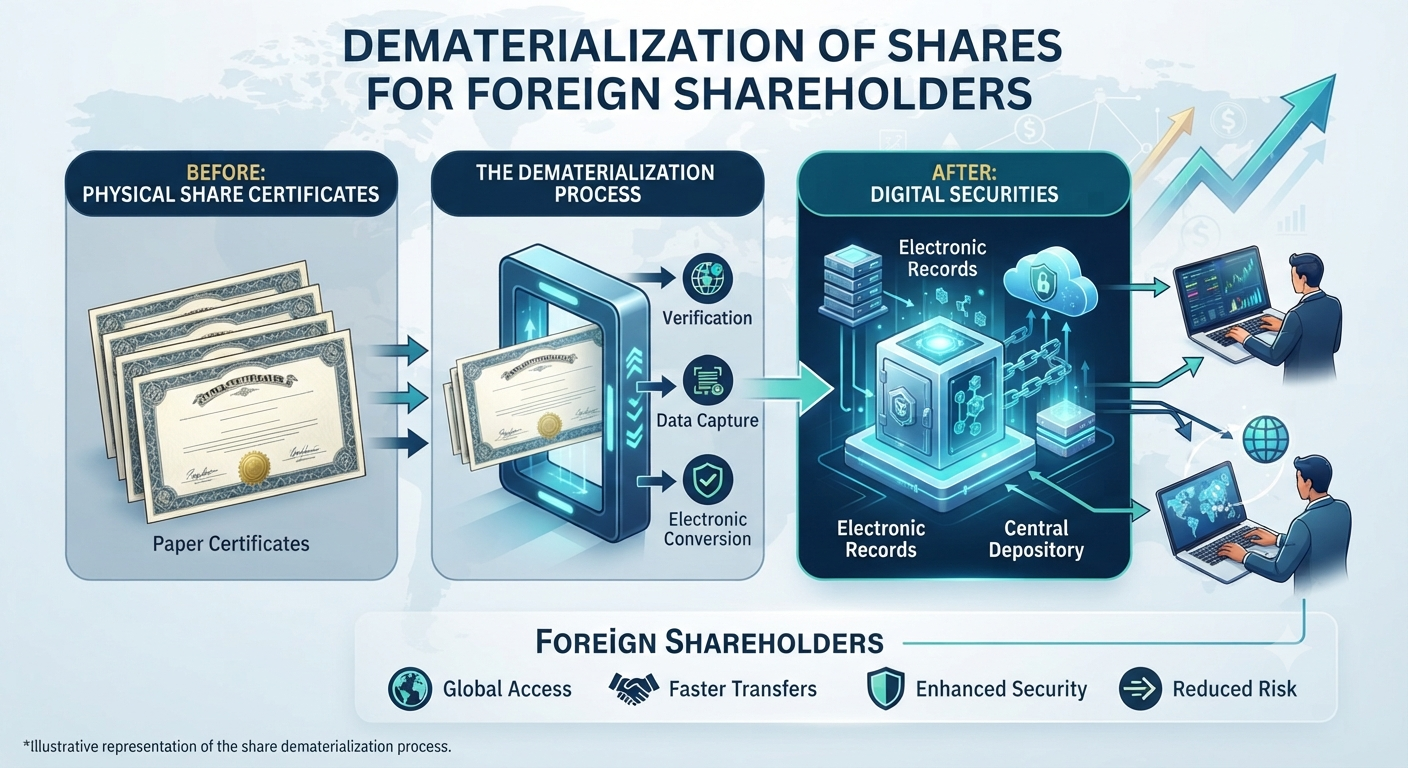
Dematerialization — converting physical share certificates into electronic form held in a demat account — is no longer a listed-company formality. Since October 2023, it has become a live compliance obligation for a large class of private companies, and it interacts directly with India’s foreign exchange regime. That intersection is where most foreign investors get caught out. This is also why so many overseas clients now begin the process by speaking to experienced Corporate Lawyers in Delhi before they touch a single depository form.
This guide explains what the law requires, how the process actually works for a non-resident, and where the Companies Act quietly hands over to FEMA.
- The Legal Backbone: What the Law Now Requires
Dematerialization draws its authority from Section 29 of the Companies Act, 2013, read with the Depositories Act, 1996, and the Companies (Prospectus and Allotment of Securities) Rules, 2014.
The rollout has been phased:
- Rule 9A (effective 2 October 2018) brought unlisted public companies into mandatory demat.
- Rule 9B, inserted on 27 October 2023 through the Companies (Prospectus and Allotment of Securities) Second Amendment Rules, 2023, extended the obligation to private companies — excluding small companies and government companies.
The compliance date for private companies has moved more than once. It was originally 30 September 2024, then pushed to 30 June 2025 by an amendment notified in February 2025, after depositories were overwhelmed with ISIN applications. Producer companies received a longer runway, until 31 March 2028.
There is a further development that many foreign shareholders have not registered. With effect from 1 December 2025, the Ministry of Corporate Affairs raised the “small company” thresholds through G.S.R. 880(E). A private company now qualifies as a small company — and stays outside Rule 9B — only if its paid-up share capital does not exceed ₹10 crore and its turnover does not exceed ₹100 crore. The earlier limits were ₹4 crore and ₹40 crore.
A word of caution here, because this is precisely the point where advice matters. The small-company exemption is not available to a company that is a holding or subsidiary company, regardless of how modest its numbers look. Most Indian companies with foreign parentage are subsidiaries. In practice, that means an Indian company held by an overseas parent is very likely caught by Rule 9B even if its balance sheet is small — a trap that good Corporate Lawyers in Delhi flag at the very first meeting.
B. Why Dematerialization Matters More for a Foreign Shareholder
For a domestic promoter, going electronic is largely administrative convenience. For a foreign shareholder, the stakes are higher and more concrete.
- You cannot transfer or exit cleanly without it. Once Rule 9B applies, a shareholder who wants to sell must dematerialize the shares before the transfer. A foreign investor planning a secondary sale, a buyback, or an exit to a strategic acquirer will find the transaction stalled if the holding is still on paper.
- New issuances must be electronic. A covered company can issue securities — including to an incoming foreign investor — only in demat form. Physical allotment is no longer an option.
- It reduces fraud and disputes. Electronic holdings remove the risks of lost, forged, or duplicated certificates, which historically plagued cross-border shareholding where the investor is thousands of miles from the register.
- Stamp duty on transfers is streamlined, as depository-based transfers fall under a uniform, centrally collected regime rather than physical instruments of transfer.
In short, demat is now the gateway to almost every meaningful corporate action a foreign shareholder might want to take.
C. The Process, Step by Step
The mechanics are the same for residents and non-residents at the company level, but the shareholder-side onboarding is where the difference bites.
- The company appoints a Registrar and Transfer Agent (RTA). The RTA coordinates with the depositories and handles the mechanics.
- The company obtains an International Securities Identification Number (ISIN) from NSDL or CDSL. This is the electronic identity of the company’s securities. Allotment can take several weeks, so early filing is wise.
- Each shareholder opens a demat account with a Depository Participant (DP) — typically a bank or broker.
- Shareholders submit a Demat Request Form (DRF) along with the physical certificates, which are then verified, defaced, and converted into electronic credits.
For a non-resident, step three is not a formality. An NRI generally opens either a repatriable demat account, linked to an NRE account, or a non-repatriable demat account, linked to an NRO account. The choice is not cosmetic — it determines whether sale proceeds can later be moved out of India. Foreign body corporates, private equity funds, and foreign portfolio investors hold through their own designated accounts, each with its own documentation trail.
D. The FEMA Overlay Every Foreign Investor Must Respect
Here is the part that catches investors who treat demat as a pure Companies Act exercise. A foreign shareholder is simultaneously governed by the Foreign Exchange Management Act, 1999, and the Foreign Exchange Management (Non-Debt Instruments) Rules, 2019 (the “NDI Rules”). Dematerialization does not switch these off; it runs alongside them.
The key touchpoints where foreign investors regularly need Corporate Lawyers in Delhi to keep the two regimes aligned are:
- Form FC-GPR on issuance. When shares are issued to a foreign investor on a repatriable basis, the Indian company must report the allotment in Form FC-GPR on the RBI’s FIRMS portal, generally within 30 days. Where the company is under Rule 9B, that allotment is in demat form, and the reporting should reflect this. NRI investment made on a non-repatriable basis from NRO funds is treated as domestic and typically does not require FC-GPR — a distinction that must be captured correctly from the outset.
- Form FC-TRS on transfer. A transfer of shares between a resident and a non-resident is reported in Form FC-TRS, usually within 60 days. Because the shares must be in demat form before transfer under Rule 9B, the demat step becomes a precondition to a clean FEMA filing.
- Pricing and sectoral caps. The NDI Rules impose pricing guidelines, entry routes, and sectoral limits. The valuation supporting an issue or transfer must satisfy these — dematerialization does nothing to relax them.
- The annual FLA return. Companies with foreign investment must file the Foreign Liabilities and Assets return each year, generally by 15 July.
A single misclassification — repatriable treated as non-repatriable, or a valuation that does not hold up — can turn a routine transaction into a FEMA contravention requiring compounding before the Reserve Bank. Aligning the demat mechanics with the FEMA paperwork is not clerical work; it is the substance of the mandate.
E. The Practical Gap for Foreign Body Corporates
There is an uncomfortable truth that seasoned practitioners have started to write about openly: the demat onboarding process was, in effect, designed for Indian shareholders.
An Indian individual walks into a bank with a PAN card and Aadhaar and opens a demat account in a day. A foreign body corporate holding a majority stake in an Indian company has no such clean path. There is limited standardized guidance for onboarding overseas entities, and RTAs and DPs are often left to devise their own documentation requirements. The result is inconsistency — one participant asks for apostilled constitutional documents, another for notarized board resolutions, a third for a specific certification of the authorized signatory.
Practical friction points for foreign shareholders include:
- PAN. A demat account requires an Indian PAN. A foreign entity or individual without one must obtain it first, which itself takes planning.
- Document legalization. Constitutional documents, board resolutions, and KYC papers of a foreign entity usually need to be apostilled (for Hague Convention countries) or consularized, and sometimes translated.
- Signatory verification. Establishing who is authorized to act for the foreign entity, to the DP’s satisfaction, frequently causes delay.
- Time-zone and turnaround lag. Every clarification adds a round-trip across borders.
None of this is insurmountable, but it rewards preparation. Building the document set correctly the first time — rather than reacting to each participant’s ad hoc list — is where the involvement of Corporate Lawyers in Delhi familiar with cross-border onboarding saves weeks and avoids a transaction slipping past a deadline.
F. What Happens If You Do Nothing
Non-compliance is not a quiet risk. It has teeth on both sides of the regime.
Under the Companies Act framework, a covered company that has not dematerialized cannot issue fresh securities, and its shareholders cannot transfer their holdings. It must also file Form PAS-6, a half-yearly reconciliation of its share capital, within 60 days of the end of each half-year — with due dates typically falling around 30 May and 29 November. Delays in dematerialization can attract penal consequences, including under Section 19D of the Depositories Act.
On the FEMA side, missed or incorrect FC-GPR and FC-TRS filings are contraventions. They are usually procedural rather than deliberate, but they still require remediation through the RBI’s compounding mechanism, with fees scaling by amount and delay. For a foreign investor, the more painful cost is often commercial: a delayed exit, a renegotiated deal, or a buyer’s due diligence team flagging the gap.
G. Choosing the Right Corporate Lawyers in Delhi for Cross-Border Demat
Dematerialization for a foreign shareholder is a two-regime problem wearing the disguise of a one-form task. The company law step is visible; the FEMA and onboarding steps are where value is lost or protected. Getting it right calls for advisers who work at that intersection every day — reading the NDI Rules and the PAS Rules in the same breath, coordinating with RTAs and depository participants, and sequencing the demat, the valuation, and the RBI reporting so they fit together.
That combination of company-secretarial precision and foreign-exchange fluency is what distinguishes genuinely experienced Corporate Lawyers in Delhi from a purely transactional filing service. For an NRI, an overseas fund, or a foreign parent holding an Indian subsidiary, that difference decides whether an investment stays clean, transferable, and exit-ready.
H. Frequently Asked Questions
- Is dematerialization mandatory for a foreign shareholder in an Indian private company?
If the company is covered by Rule 9B — that is, a private company other than a small, government, or (until 2028) producer company — then yes. All shareholders, including NRIs, foreign nationals, and overseas entities, must hold their shares in demat form. Note that a subsidiary of a foreign company generally cannot claim the small-company exemption.
- Can a non-resident open a demat account in India?
Yes. NRIs can open a repatriable demat account (linked to an NRE account) or a non-repatriable one (linked to an NRO account). Foreign entities and funds hold through designated accounts. An Indian PAN and legalized KYC documents are required, so plan for lead time.
- How does dematerialization affect FEMA reporting?
It does not replace it. Share issuances to foreign investors still require FC-GPR reporting, and transfers between residents and non-residents require FC-TRS — with demat now being a precondition to a valid transfer. Pricing and sectoral rules under the NDI Rules continue to apply.
- What is the current deadline and small-company threshold?
The Rule 9B compliance date for private companies was extended to 30 June 2025. Separately, from 1 December 2025, the small-company thresholds rose to ₹10 crore paid-up capital and ₹100 crore turnover, both conditions to be met together.
- What are the risks of not dematerializing?
The company cannot issue or transfer shares, must still file PAS-6, and may face penalties under the Depositories Act. Foreign shareholders additionally risk FEMA contraventions and stalled exits. Advice from Corporate Lawyers in Delhi at the outset usually prevents these.
Speak to Our Corporate Team
Planning a demat exercise, a foreign investment, or an exit from an Indian company? The regime rewards those who sequence the company law, valuation, and RBI reporting correctly — and penalizes those who treat them as separate errands. If you are an NRI, an overseas corporate, or a founder with foreign investors on the cap table, speak to experienced Corporate Lawyers in Delhi for end-to-end support on dematerialization, FEMA compliance, foreign investment structuring, and corporate regulatory matters. A short conversation now is far cheaper than remediation later. You may connect with us at admin@equicorplegal.com / 08448824659 and visit www.equicorplegal.com
Disclaimer: This article is intended for general informational purposes only and does not constitute legal advice or create an attorney-client relationship. Laws, rules, and deadlines referred to here are subject to change and to specific facts. Readers should obtain professional advice tailored to their circumstances before acting.