Ponzi Schemes in India:- A Case Law Analysis
Ponzi Schemes in India: A Case Law Analysis
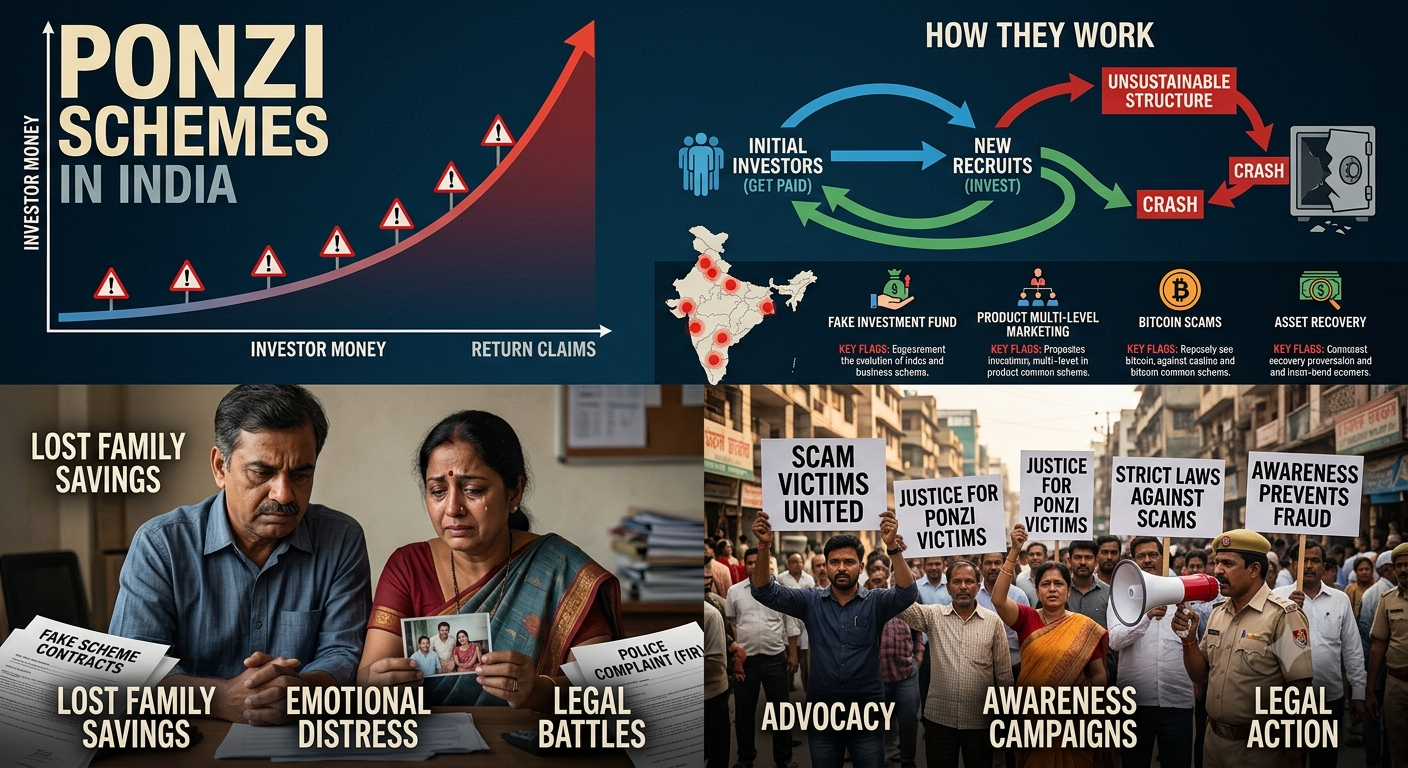
A Ponzi scheme is a fraud with the shape of an investment. Money is collected from the public on a promise of returns that no genuine business could generate, and the returns paid to the early entrants come not from profit but from the capital of those who join later. For a while it looks like success; then enrolment slows, the pyramid cannot pay, and it collapses on the people at the bottom. Indian law meets the scheme not through one statute but through many — the deposit rules of the Reserve Bank, the collective-investment-scheme jurisdiction of SEBI, the State Acts banning prize chits and money circulation, the criminal law of cheating, the money-laundering law, and now the umbrella ban of the Banning of Unregulated Deposit Schemes Act, 2019. The practitioner’s task is to see which of these a given collection engages, because a single scheme usually engages several at once.
The case law is spread across those regimes. Swapan Kumar Guha and Kuriachan Chacko explain what an illegal money-circulation scheme is and why its promise cannot be kept; the two Peerless decisions and Shriram Chits map the deposit and chit-fund framework; Sahara and PGF fix SEBI’s reach over collective investment schemes and the hybrid instrument; K.K. Baskaran upholds the State’s power to protect its depositors; Subrata Roy Sahara and Skipper Construction show how the money is refunded and traced; and the cheating, company-liability and money-laundering authorities supply the criminal dimension. What follows reads these decisions together, as a single account of how the law catches, prosecutes and unwinds a scheme built to deceive.
The case law is spread across those regimes. Swapan Kumar Guha and Kuriachan Chacko explain what an illegal money-circulation scheme is and why its promise cannot be kept; the two Peerless decisions and Shriram Chits map the deposit and chit-fund framework; Sahara and PGF fix SEBI’s reach over collective investment schemes and the hybrid instrument; K.K. Baskaran upholds the State’s power to protect its depositors; Subrata Roy Sahara and Skipper Construction show how the money is refunded and traced; and the cheating, company-liability and money-laundering authorities supply the criminal dimension. What follows reads these decisions together, as a single account of how the law catches, prosecutes and unwinds a scheme built to deceive.
The court is not to be deceived by the form of the documents; it must look to the substance of the transaction and the reality of what is being done — the approach that runs through every decision on a scheme built to collect the public’s money.
One Ponzi collection engages at least seven distinct enquiries: what in law makes it a scheme, into which regulatory bucket it falls, whether it is a collective investment scheme within SEBI’s reach, whether it is a banned money-circulation scheme, which authority governs it, what criminal offences it attracts, and how the money is recovered for those defrauded. Each has its own gatekeeper and its own standard, and the practitioner’s first task is to know which enquiry a given set of facts opens. Statutory references give the Indian Penal Code, 1860 provision with its Bharatiya Nyaya Sanhita, 2023 successor where relevant.
The anatomy of a Ponzi scheme
Before the regulator is chosen the scheme must be seen for what it is. The law looks past the documents to the substance: money collected from the public on a promise sustained only by fresh money, with collapse a mathematical certainty and the loss falling on the last to join.
THE ANATOMY OF A PONZI SCHEME
How money paid in by new investors is used to pay the old — and why the law looks at substance, not the label
The promise
guaranteed, abnormally high returns · low or no risk
→
The collection
money is gathered from the public against that promise
→
The rotation
early investors are paid out of later investors’ money
→
The illusion
no genuine business generates the returns · fresh money sustains it
→
The collapse
enrolment slows, the pyramid cannot pay, the scheme fails
The defining feature · returns are paid not from profit but from the capital of new entrants — collapse is a mathematical certainty
THE SCHEME IS JUDGED BY ITS SUBSTANCE
Whether an arrangement is an illegal money-circulation or deposit scheme is decided on its real nature and not the name given to it; a court looks through the form of the documents to the true character of the transaction.
State of West Bengal v. Swapan Kumar Guha, (1982) 1 SCC 561
THE PROMISE IS ONE THAT CANNOT BE KEPT
A scheme that promises returns to every entrant on enrolling further members is, by its arithmetic, impossible to sustain; the very impossibility of the promised chain is the badge of the fraud on the later investors.
Kuriachan Chacko v. State of Kerala, (2008) 8 SCC 747
COLLECTING PUBLIC MONEY ATTRACTS THE FULL REMEDY
Where money is collected from the public on a false promise, the persons in control are liable to refund it, and the court may lift the veil, trace the funds and direct their restitution to those deprived.
DDA v. Skipper Construction, (1996) 4 SCC 622 · Subrata Roy Sahara v. Union of India, (2014) 8 SCC 470
| Authority | Ratio decidendi | Practice insight |
|---|---|---|
|
State of West Bengal v. Swapan Kumar Guha
(1982) 1 SCC 561 · SC (3J) · what is a money-circulation scheme
|
Whether an arrangement is an illegal money-circulation scheme is to be judged on its real character and not the label given to it; where the first information does not disclose the ingredients of the offence, the investigation may be quashed, but the court looks to the substance of what is being done. | The foundational anatomy authority. Test the scheme against the statutory ingredients on its true working, not the promoter’s description of it. |
|
Kuriachan Chacko v. State of Kerala
(2008) 8 SCC 747 · SC (2J) · the impossible promise
|
A scheme that promises a return to every participant on the enrolment of further members is, by its very arithmetic, impossible to sustain; the promise is one that can never be fulfilled for all, and the making of such a promise to collect money is the fraud the law strikes at. | The clearest judicial statement of the Ponzi arithmetic. Use the impossibility of the promised chain to establish the dishonest character of the scheme from the outset. |
|
Sahara India Real Estate Corpn. Ltd. v. SEBI
(2012) 10 SCC 603 · SC (2J) · substance over form
|
An instrument dressed as an optionally convertible debenture, but in substance a device to raise money from the public without the protections of a public issue, is amenable to regulation; the true character of the arrangement, not its label, decides the applicable regime. | The leading substance-over-form authority. A scheme mis-labelled to escape a regulator is judged by what it really does, and the refund consequences follow. |
|
Subrata Roy Sahara v. Union of India
(2014) 8 SCC 470 · SC (3J) · enforcement of refund
|
Orders directing the refund of monies unlawfully mobilised from the public will be enforced with the full coercive power of the court, including against the individuals in control; the corporate form is no shield where the public has been deprived of its money. | The enforcement teeth behind a refund order. Personal liberty and personal assets of those in control are exposed when a public collection must be refunded. |
|
Reserve Bank of India v. Peerless General Finance & Investment Co. Ltd.
(1987) 1 SCC 424 · SC (3J) · the scheme construed
|
A savings or endowment scheme collecting money from the public on terms of eventual repayment is to be construed on its real substance; the regulator’s directions to protect depositors are valid, and a scheme is not saved by the ingenuity of its drafting. | The early authority reading a public-collection scheme on its substance. It anchors the principle that the label does not defeat the regulator. |
Deposits, chit funds and the depositor-protection framework
Where the collection is, in substance, the taking of repayable money, the deposit regime is engaged. A lawful chit fund is a regulated and distinct animal; a State may protect its depositors by attaching a defaulter’s assets; and the BUDS Act now bans the unregulated deposit outright.
THE FOUR LEGAL BUCKETS · AND THEIR REGULATORS
How a scheme to collect public money is classified — and which authority governs each kind
Deposit
regulator · RBI
money received with a promise to repay, with or without interest · the RBI deposit-acceptance regime
money received with a promise to repay, with or without interest · the RBI deposit-acceptance regime
Collective investment
regulator · SEBI
pooled contributions managed for a return the investor does not control · s. 11AA of the SEBI Act
pooled contributions managed for a return the investor does not control · s. 11AA of the SEBI Act
Money circulation / prize chit
regulator · State
easy money on enrolment of others · the Prize Chits and Money Circulation Schemes (Banning) Act, 1978
easy money on enrolment of others · the Prize Chits and Money Circulation Schemes (Banning) Act, 1978
Unregulated deposit
regulator · BUDS
any deposit scheme not registered with a regulator · banned by the BUDS Act, 2019
any deposit scheme not registered with a regulator · banned by the BUDS Act, 2019
One collection can fall into several buckets at once — and be pursued by RBI, SEBI, the State and the BUDS authority together
A DEPOSIT IS MONEY TAKEN WITH A PROMISE TO REPAY
The character of a deposit is that money is received with an obligation to return it; the moment repayable money is taken from the public, the deposit-regulation regime is engaged, whatever the scheme is called.
Peerless General Finance v. RBI, (1992) 2 SCC 343 · RBI v. Peerless, (1987) 1 SCC 424
AN INVESTMENT SCHEME FALLS TO SEBI
A pooled arrangement in which the contributors part with money for a return generated and managed by the promoter, with no day-to-day control, is a collective investment scheme within SEBI’s jurisdiction.
PGF Ltd. v. Union of India, (2013) 13 SCC 340 · Sahara v. SEBI, (2012) 10 SCC 603
THE STATE BANS MONEY CIRCULATION
A scheme for the making of quick or easy money on the enrolment of further members is an illegal money-circulation scheme, prohibited by the 1978 Act and prosecuted by the State’s economic-offences machinery.
Kuriachan Chacko v. State of Kerala, (2008) 8 SCC 747
| Authority | Ratio decidendi | Practice insight |
|---|---|---|
|
Peerless General Finance & Investment Co. Ltd. v. RBI
(1992) 2 SCC 343 · SC (2J) · the meaning of a deposit
|
The essence of a deposit is money received with an obligation to repay, with or without interest; the moment repayable money is taken from the public the deposit-regulation framework is engaged, and the RBI’s directions issued to protect depositors have the force of law. | The definitional authority for a deposit. If the collection carries an obligation to repay, the RBI regime applies whatever else the scheme is called. |
|
Shriram Chits & Investments Pvt. Ltd. v. Union of India
(1993) Supp (4) SCC 226 · SC (5J) · chit funds distinguished
|
The Chit Funds Act, 1982 regulating conventional chits is constitutionally valid; a chit fund conducted under it is a lawful and regulated arrangement, to be distinguished from a prize chit or a money-circulation scheme, which are banned. | The authority separating the lawful chit from the banned prize chit. Classify the arrangement precisely; a registered chit is not a Ponzi, and the two are governed differently. |
|
K.K. Baskaran v. State of Tamil Nadu
(2011) 3 SCC 793 · SC (2J) · State depositor-protection Acts
|
A State law for the protection of the interests of depositors in financial establishments, providing for the attachment and realisation of the assets of a defaulting establishment, is within the legislative competence of the State and is constitutionally valid. | The validity authority for the State depositor-protection statutes. It underpins the attachment machinery through which most Ponzi recoveries are actually effected. |
|
New Horizon Sugar Mills Ltd. v. Government of Puducherry
(2012) · HC · attachment under a depositor-protection Act
|
Under a State depositor-protection enactment, the assets of a financial establishment that has defaulted in returning deposits may be attached and realised for rateable distribution to the depositors; the machinery is directed at securing the depositors’ money, not at punishing third parties. | Illustrates the working of the attachment machinery in practice. Read with K.K. Baskaran; confirm the current text of the applicable State Act before relying on it. |
|
Delhi Development Authority v. Skipper Construction Co. (P) Ltd.
(1996) 4 SCC 622 · SC (2J) · collecting public money; the veil
|
Where a person collects money from the public on a false promise and uses the corporate form as a device to perpetrate the fraud, the court will lift the veil, disregard the separate personality and reach the individuals and the assets, directing restitution of the ill-gotten gains. | The veil-piercing and restitution authority for a public collection. Trace the money and ask the court to follow it to the promoters and their assets. |
Collective Investment Schemes and SEBI’s jurisdiction (s. 11AA)
Where the public parts with money for a return generated and managed by the promoter, the arrangement is a collective investment scheme within SEBI’s jurisdiction. The four conditions of section 11AA, read on substance, catch the scheme however it is dressed.
THE COLLECTIVE-INVESTMENT-SCHEME TEST (SECTION 11AA)
The four conditions that bring a money-pooling arrangement within SEBI’s jurisdiction
1 Pooled
contributions are pooled and utilised for the scheme
2 For a return
made with a view to receiving profits, income or property
3 Managed on their behalf
the property is managed on behalf of the investors
4 No day-to-day control
the investors have no day-to-day control over the management
All four conditions · s. 11AA of the SEBI Act, 1992 · certain arrangements are deemed CIS regardless of the four conditions
SUBSTANCE OVER FORM — THE HYBRID IS CAUGHT
An instrument dressed as a debenture or a bond, but in substance a device to raise money from the public without the protections of a public issue, is amenable to SEBI’s jurisdiction; the label does not defeat the character.
Sahara India Real Estate Corpn. v. SEBI, (2012) 10 SCC 603
SELLING LAND IN UNITS IS A CIS
A scheme under which the promoter sells and develops units of agricultural land, the buyer looking to the promoter for a return rather than to the land, satisfies the CIS test and falls within s. 11AA.
PGF Ltd. v. Union of India, (2013) 13 SCC 340
THE PROMOTER OF A FALSE SCHEME IS PERSONALLY LIABLE
A person who lends his name and control to a scheme that deceives investors is personally liable; the fiduciary and statutory duties extend to the integrity of what the scheme represents to the public.
N. Narayanan v. Adjudicating Officer, SEBI, (2013) 12 SCC 152
| Authority | Ratio decidendi | Practice insight |
|---|---|---|
|
PGF Ltd. v. Union of India
(2013) 13 SCC 340 · SC (2J) · s. 11AA; the CIS test
|
A scheme under which the promoter sells and undertakes to develop units of agricultural land, the contributor looking to the promoter for a return rather than to the land itself, satisfies the conditions of a collective investment scheme under s. 11AA and falls within SEBI’s jurisdiction. | The authority applying the CIS test to a land-based scheme. Ask whether the investor looks to the promoter’s management for the return; if so, it is a CIS. |
|
N. Narayanan v. Adjudicating Officer, SEBI
(2013) 12 SCC 152 · SC (2J) · promoter and director liability
|
A person who lends his name and control to a scheme that deceives investors is personally liable; the duty extends to the integrity of what the scheme represents to the public, and those who direct the fraud cannot escape by pointing to the corporate vehicle. | Fixes personal liability on the promoters and directors of a fraudulent scheme. The corporate vehicle is not a shield for the individuals who ran it. |
|
SEBI v. Ajay Agarwal
(2010) 3 SCC 765 · SC (2J) · the reach of the anti-fraud power
|
The power to act against fraud in relation to securities and investment schemes is remedial and protective, to be construed widely to achieve its object; it reaches the conduct and the persons connected with the fraud and is not defeated by a narrow or technical reading. | The purposive authority for SEBI’s reach. Resist a technical challenge to jurisdiction by anchoring the case in the protective object of the power. |
|
SEBI v. Kishore R. Ajmera
(2016) 6 SCC 368 · SC (2J) · inference of fraud
|
Fraud and connivance in relation to a scheme may be established by inference from the proved circumstances — the pattern of dealing, the surrounding facts and the probabilities — since direct proof is rarely available; the inference must be the only reasonable one. | The evidentiary authority for proving a scheme’s fraud on the preponderance of probabilities. Assemble the circumstances into a chain that admits of no innocent explanation. |
|
SEBI v. Rakhi Trading (P) Ltd.
(2018) 13 SCC 753 · SC (3J) · standard of proof
|
Fraud and manipulation in the securities and investment sphere are established on the preponderance of probabilities, not the criminal standard; a pattern of non-genuine dealing can itself evidence manipulation without direct proof of a dishonest state of mind. | Confirms the civil standard for the regulator. The absence of a confession or direct proof does not defeat a well-marshalled circumstantial case. |
Money circulation and multi-level marketing (PCMCS Act, 1978)
The Prize Chits and Money Circulation Schemes (Banning) Act bans the scheme whose reward depends on enrolling more members. A product or a distribution model does not save a pyramid, and the assured-return promise the promoter knows to be false is a dishonest inducement.
THE MONEY-CIRCULATION TEST (1978 ACT)
What makes a scheme an illegal money-circulation or prize-chit scheme — the reward that depends on enrolment
A scheme offers a benefit on joining
the participant pays in, and is promised a reward
the participant pays in, and is promised a reward
⇓
Is the reward earned only by enrolling further members?
| YES ⇓ | NO ⇒ Not per se banned (test under CIS / deposit law) |
An illegal money-circulation scheme
banned · quick or easy money on enrolment · s. 2(c), 1978 Act
banned · quick or easy money on enrolment · s. 2(c), 1978 Act
QUICK MONEY ON ENROLMENT IS THE VICE
A money-circulation scheme is one for the making of quick or easy money on the event or contingency of the enrolment of further members; it is the dependence of the reward on new enrolment, not the sale of any product, that is prohibited.
Kuriachan Chacko v. State of Kerala, (2008) 8 SCC 747
A PRODUCT DOES NOT SAVE A PYRAMID
The presence of a product or a distribution model does not take a scheme outside the ban where the true inducement and the returns depend on recruiting a chain of participants; the substance is examined.
Amway India Enterprises v. Union of India, 2007 SCC OnLine AP 220
THE INDUCEMENT IS A FALSE PROMISE
The offer of assured returns on a promise the promoter knows cannot be met is a dishonest inducement; the dishonest intention at the inception distinguishes the fraud from a venture that merely failed.
Hridaya Ranjan Prasad Verma v. State of Bihar, (2000) 4 SCC 168 · Mahadeo Prasad, AIR 1954 SC 724
| Authority | Ratio decidendi | Practice insight |
|---|---|---|
|
Amway India Enterprises v. Union of India
2007 SCC OnLine AP 220 · AP High Court · MLM and money circulation
|
A multi-level marketing arrangement is an illegal money-circulation scheme where the dominant inducement and the returns depend on the enrolment of a chain of further participants rather than on the genuine sale of a product; the presence of a product does not take it outside the ban. | The leading MLM authority, though at the High Court level. Examine whether the real money is made from recruitment or from sales; the former is banned. Confirm the current position, as the area has developed since. |
|
Hridaya Ranjan Prasad Verma v. State of Bihar
(2000) 4 SCC 168 · SC (2J) · the false promise; s. 420 IPC / s. 318 BNS
|
A dishonest intention at the time of making the promise is essential to cheating; the assured-return promise made with knowledge that it cannot be met is such a dishonest inducement, whereas a venture that merely failed, without that intention, is not the offence. | The bridge from the scheme to the cheating charge. The assured return the promoter knew was impossible supplies the dishonest intention at the inception. |
|
Mahadeo Prasad v. State of West Bengal
AIR 1954 SC 724 · SC (2J) · intent inferred from conduct
|
A dishonest intention at the time of inducing another to part with money may be inferred from the surrounding circumstances — the false representation, the absence of any real means or intention to perform, and the conduct of the accused. | The authority for proving the promoter’s dishonest intent by inference. The absence of any genuine revenue source is powerful circumstantial proof. |
|
Iridium India Telecom Ltd. v. Motorola Inc.
(2011) 1 SCC 74 · SC (3J) · the company as accused
|
A company can be prosecuted for offences requiring a criminal intent, including cheating; the mens rea of the directing mind and will is attributed to the company, which is a proper accused and may be tried and fined. | Establishes that the corporate vehicle of a scheme is itself prosecutable. The company and its directing minds may both be arraigned. |
|
Sunil Bharti Mittal v. Central Bureau of Investigation
(2015) 4 SCC 609 · SC (3J) · attribution to directors
|
The criminal intent of the directing mind may be attributed to the company, but not in reverse; a director is arraigned for the company’s offence only where there is specific material of his personal act, connivance or knowledge, not by reason of his office. | The limit on roping in directors. Insist on specific allegations of each promoter’s role rather than an omnibus arraignment of the board. |
Refund, disgorgement and the recovery of investors’ money
The object of the law is to get the money back. SEBI may order refund and disgorge unlawful gains and recover them as arrears of revenue; the State attaches the establishment’s assets; and the court lifts the veil and traces the funds — always weighing the innocent third party.
THE REGULATORY MAP · AND THE BUDS ACT, 2019
Which authority governs which scheme — and the umbrella ban that now covers the unregulated deposit
WHO REGULATES WHAT
- RBI — acceptance of deposits by NBFCs and others, and the deposit-acceptance rules
- SEBI — collective investment schemes and unregistered public issues · s. 11AA
- State Government — prize chits and money circulation · the 1978 Act and the economic-offences wing
- MCA / SFIO — fraud by companies raising public money · the Companies Act
- Competent Authority — unregulated deposit schemes · the BUDS Act, 2019
THE BUDS ACT, 2019
- Bans, at the threshold, every unregulated deposit scheme in the country
- Creates three offences — running, promoting and fraudulently defaulting on such a scheme
- Empowers a Competent Authority to attach the deposit-taker’s property
- Provides a Designated Court for attachment, realisation and rateable repayment to depositors
- Overlays, and does not displace, the RBI, SEBI, State and criminal regimes
A DEPOSIT SCHEME ENGAGES THE RBI REGIME
The receipt of money on terms of repayment is the taking of a deposit, and the deposit-regulation framework is attracted whatever the ingenuity of the scheme; the regulator’s directions have the force of law.
RBI v. Peerless General Finance, (1987) 1 SCC 424 · Peerless v. RBI, (1992) 2 SCC 343
CHIT FUNDS ARE A REGULATED, DISTINCT ANIMAL
A conventional chit fund conducted under the Chit Funds Act is a regulated and lawful arrangement, distinct from a prize chit or a money-circulation scheme; the legislative scheme regulating chits is valid.
Shriram Chits & Investments v. Union of India, (1993) Supp (4) SCC 226
THE STATE MAY PROTECT ITS DEPOSITORS
A State law for the protection of the interests of depositors, providing for attachment and realisation of the assets of a defaulting establishment, is within the State’s competence and is constitutionally valid.
K.K. Baskaran v. State of Tamil Nadu, (2011) 3 SCC 793 · New Horizon Sugar Mills v. Govt. of Puducherry, (2012)
| Authority | Ratio decidendi | Practice insight |
|---|---|---|
|
Dushyant N. Dalal v. SEBI
(2017) 9 SCC 660 · SC (2J) · disgorgement and recovery
|
A wrongdoer is not permitted to retain the fruits of a fraud; disgorgement of the unlawful gain is a recognised remedy, and the sum directed to be disgorged, together with interest, may be recovered through the statutory recovery machinery as an arrear. | The disgorgement authority. Quantify the unlawful gain precisely, since that figure with interest is the recoverable measure, enforced as a revenue arrear. |
|
Usha Ananthasubramanian v. Union of India
(2020) 4 SCC 122 · SC (2J) · freezing, confined to the connected
|
The power to freeze assets in the course of an investigation is a strong one, to be exercised on the person and property connected with the scheme; it cannot be extended to attach the assets of a person merely by reason of a past association unconnected with the wrongdoing. | The limit on the freezing power. Attachment for the depositors must be tied to the scheme and its beneficiaries, not spread to the unconnected. |
|
S.P. Chengalvaraya Naidu v. Jagannath
(1994) 1 SCC 1 · SC (2J) · fraud unravels all
|
Fraud and justice never dwell together; anything obtained by fraud is a nullity and may be set aside at any stage, so that a transfer or a title created to place the scheme’s proceeds beyond the reach of the defrauded is not allowed to stand. | The authority for undoing sham transfers of the scheme’s proceeds. A conveyance engineered to defeat the depositors is void and may be unravelled. |
|
Meghmala v. G. Narasimha Reddy
(2010) 8 SCC 383 · SC (2J) · fraud vitiates; restitution
|
A person who secures an advantage by suppressing the truth or stating a falsehood cannot be permitted to retain it; every solemn act obtained by fraud is vitiated, and the court will restore the parties, so far as possible, to their original position. | Supports restitution of the diverted proceeds. Anything the promoter obtained through the fraudulent scheme is liable to be returned to those deprived. |
|
Reserve Bank of India v. Peerless — refund of collections
read with (1987) 1 SCC 424 · SC · protective directions
|
The regulator’s protective directions may require a scheme that has collected money from the public to secure and refund it; the object of the regulation is the protection of the depositors, and the directions to that end are enforceable. | Illustrates the regulator-driven refund route. Read with the deposit-framework authorities; the protective object justifies the refund direction. |
The criminal architecture — cheating, breach of trust and the offender
A Ponzi collection is charged under several heads at once: cheating, criminal breach of trust, the offences under the 1978 Act, and money laundering. The offences do not overlap on the same facts, and the company and its directing minds are proper accused.
THE CRIMINAL ARCHITECTURE
The offences a Ponzi collection attracts — with the Penal Code provision and its Sanhita successor
Cheating
s. 420 IPC — s. 318(4) BNS
dishonest inducement to part with money on a false promise of returns
dishonest inducement to part with money on a false promise of returns
Criminal breach of trust
s. 406/409 IPC — s. 316 BNS
dishonest conversion of the money entrusted for investment
dishonest conversion of the money entrusted for investment
Money circulation
s. 3–4, 1978 Act
running or promoting a prize-chit or money-circulation scheme
running or promoting a prize-chit or money-circulation scheme
Money laundering
the PMLA, 2002
dealing with the proceeds of the scheme as untainted property
dealing with the proceeds of the scheme as untainted property
One Ponzi collection is charged under several heads at once · quashing · s. 482 CrPC — s. 528 BNSS
CHEATING NEEDS DISHONEST INTENT AT THE INCEPTION
The offer of assured returns on a promise known to be false is cheating; but a scheme that merely failed, without a dishonest intention at the outset, is a civil default and not the crime.
S.W. Palanitkar v. State of Bihar, (2002) 1 SCC 241 · Dr. Vimla v. Delhi Administration, AIR 1963 SC 1572
CHEATING AND BREACH OF TRUST DO NOT OVERLAP
The two offences rest on different facts — dishonest inducement from the outset against an entrustment later breached — and cannot be charged together on the same allegations; the charge must fit the facts.
Delhi Race Club (1940) Ltd. v. State of U.P., (2024)
THE COMPANY IS A PROPER ACCUSED
A company can be prosecuted for cheating, its criminal intent supplied by its directing mind; but a director is arraigned only on specific allegations of his own role, not by his office alone.
Iridium India Telecom v. Motorola, (2011) 1 SCC 74 · State of Haryana v. Bhajan Lal, 1992 Supp (1) SCC 335
| Authority | Ratio decidendi | Practice insight |
|---|---|---|
|
S.W. Palanitkar v. State of Bihar
(2002) 1 SCC 241 · SC (2J) · cheating and breach of trust
|
The ingredients of criminal breach of trust and of cheating are distinct; for breach of trust there must be entrustment and dishonest misappropriation, and a mere failure to return money or perform a civil obligation does not, without a dishonest intention, make out either offence. | The authority for separating the two offences and both from a civil default. Map each ingredient against the scheme’s facts before framing the charge. |
|
Delhi Race Club (1940) Ltd. v. State of U.P.
(2024) · SC (2J) · no overlap on the same facts
|
Cheating and criminal breach of trust are antithetical and cannot be made out on the same set of facts: cheating involves dishonest inducement to part with property from the outset, whereas breach of trust presupposes an entrustment later dishonestly breached. | The recent authority against charging s. 406 and s. 420 together. Elect the offence the facts of the collection actually disclose. Confirm the citation, as the decision is recent. |
|
Dr. Vimla v. Delhi Administration
AIR 1963 SC 1572 · SC (3J) · “defraud”
|
To defraud involves deceit and either actual injury or a risk of injury to the person deceived; the advantage obtained by the deceit completes the wrong, and it is not necessary to prove a corresponding wrongful gain in every case. | The definitional authority for the fraud element. Deceit coupled with injury or its risk to the investors is the core, whatever the promoter gained. |
|
State of Haryana v. Bhajan Lal
1992 Supp (1) SCC 335 · SC (2J) · quashing; s. 482 CrPC / s. 528 BNSS
|
The inherent power to quash a prosecution is exercised sparingly, within the illustrative categories; a genuine scheme-fraud disclosing the ingredients of an offence is not quashed, but a purely civil default dressed as a crime, or a mala fide proceeding, may be. | The framework for resisting or defending a quashing petition in a scheme prosecution. Fit the facts to the applicable category rather than argue the merits. |
|
Vijay Madanlal Choudhary v. Union of India
(2022) · SC (3J) · the PMLA dimension
|
Money laundering is a stand-alone offence concerned with the proceeds of crime; where a scheme generates proceeds through a scheduled offence, their concealment, possession or projection as untainted attracts the rigour of the money-laundering law, and the attachment power, independently of the predicate. | Opens the PMLA front against a scheme. The proceeds may be attached under the money-laundering law in parallel with the cheating prosecution. Confirm the citation, as the decision is recent. |
Investigation, forum and the overlap of proceedings
A scheme is pursued at once by the regulator, the State’s economic-offences machinery and the money-laundering authority. Registration of an FIR is mandatory where an offence is disclosed, the proceedings run in parallel on their own standards, and the forums keep their own domains.
REFUND, DISGORGEMENT AND DEPOSITOR PROTECTION
How the money collected by a Ponzi scheme is traced, attached and returned to those it was taken from
THE RECOVERY TOOLKIT
- SEBI may direct refund of monies collected, and disgorgement of unlawful gains
- SEBI recovers as arrears of land revenue, with attachment and sale · s. 28A SEBI Act
- The State attaches the establishment’s assets under its depositor-protection Act
- The BUDS Designated Court realises attached property and repays depositors rateably
- The Enforcement Directorate attaches the proceeds of crime under the PMLA
HOW THE MONEY REACHES THE DEPOSITOR
- The persons in control are personally liable to refund what was collected
- The corporate veil is lifted to reach the promoters and the diverted assets
- A court-monitored refund may be ordered where the scale demands it
- Attached assets are pooled and distributed rateably among the defrauded
- A bona fide third party’s rights are weighed against the depositors’ claims
DISGORGEMENT FOLLOWS THE UNLAWFUL GAIN
A wrongdoer is not permitted to retain the fruits of the scheme; disgorgement of the unlawful gain is a recognised remedy, and the amount, with interest, may be recovered through the statutory recovery machinery.
Dushyant N. Dalal v. SEBI, (2017) 9 SCC 660
REFUND IS ENFORCED WITH THE FULL POWER OF THE COURT
Orders directing the refund of money unlawfully mobilised from the public are enforced with the full coercive power of the court, including against the individuals in control, and the veil is lifted to reach the funds.
Subrata Roy Sahara v. Union of India, (2014) 8 SCC 470 · DDA v. Skipper Construction, (1996) 4 SCC 622
ATTACHMENT, WEIGHED AGAINST THE INNOCENT
Assets acquired with the deposits may be frozen for the benefit of the defrauded, but a freezing power is confined to the person and property connected with the scheme, and a bona fide claimant’s rights are respected.
Usha Ananthasubramanian v. Union of India, (2020) 4 SCC 122
| Authority | Ratio decidendi | Practice insight |
|---|---|---|
|
Lalita Kumari v. Government of U.P.
(2014) 2 SCC 1 · SC (5J) · mandatory FIR; the commercial caveat
|
Registration of a first information report is mandatory where the information discloses a cognizable offence; a preliminary enquiry is permissible in a limited category, which includes commercial and financial offences, only to ascertain whether such an offence is disclosed. | The framework for FIR registration in a scheme complaint. A preliminary enquiry is available but is not a licence to refuse registration where the offence is disclosed. |
|
Radheshyam Kejriwal v. State of West Bengal
(2011) 3 SCC 581 · SC (2J) · parallel adjudication and prosecution
|
Adjudication and criminal prosecution on the same facts may proceed simultaneously; a finding in one does not bind the other, though an exoneration on the merits, on a finding that the very allegation is unfounded, may in an appropriate case enure to the benefit of the accused. | Map the regulatory and criminal tracks and their standards. An exoneration on the merits in one forum is a card in another; a technical discharge is not. |
|
P. Chidambaram v. Directorate of Enforcement
(2019) 9 SCC 24 · SC (3J) · bail; economic offences
|
In deciding bail in an economic-offence case the court weighs the triple test — flight risk, tampering with evidence and influencing witnesses — against the nature and gravity of the accusation; the gravity of a large scheme is relevant but not conclusive. | The authority governing bail for a scheme’s promoters. Frame the contest around the triple test and answer the gravity point with concrete safeguards. |
|
K.G. Premshanker v. Inspector of Police
(2002) 8 SCC 87 · SC (3J) · civil and criminal in parallel
|
There is no bar to the simultaneous continuance of civil and criminal proceedings on the same facts; a decision in the civil case is not binding on the criminal court, nor the converse, the nature, standard and object of the two being different. | The answer to the plea that a pending civil recovery bars the criminal case. The two run on separate tracks with separate standards. |
|
Serious Fraud Investigation Office v. Rahul Modi
(2019) 5 SCC 266 · SC (2J) · investigation of corporate fraud
|
The specialised investigator of corporate fraud may investigate and arrest on a reason to believe an offence of fraud; the period fixed for the investigation is directory, and an arrest made in the course of a continuing investigation is not thereby rendered illegal. | Where the scheme is run through a company, the corporate-fraud investigator is a parallel forum. Its enquiry into the promoters proceeds on its own footing. |
BOTTOM LINE
The law meets the scheme from every side, and always by its substance. The courts will judge an arrangement by what it really does rather than by its label (Swapan Kumar Guha, Sahara), expose the impossible promise at its core (Kuriachan Chacko), place it in the right regulatory bucket — deposit, collective investment, prize chit or unregulated deposit (Peerless, PGF, Amway) — uphold the State’s power to protect its depositors (K.K. Baskaran), and enforce refund and disgorgement with the full power of the court, lifting the veil to trace the money (Subrata Roy Sahara, Skipper, Dushyant Dalal). The criminal law supplies the rest: cheating on a promise known to be false (Hridaya Ranjan), the company itself as an accused (Iridium), and the money-laundering and parallel-proceeding regimes running alongside (Vijay Madanlal, Radheshyam Kejriwal). For the practitioner the working lesson is that a scheme is rarely one case in one forum: classify the collection at the outset, identify every regulator and offence it engages, trace the money early before it is dissipated, and remember that the promoter’s corporate vehicle and mislabelled instrument are the first things the court will look through.
DISCLAIMER
This Case Law Insights is for information purpose only and should not be taken as legal advice. To know further details, clarification, assistance or any advice on Ponzi schemes, collective investment schemes, prize chits and money circulation, or unregulated deposit schemes under the BUDS Act, 2019 or any legal advice on SEBI and RBI proceedings/ depositor protection and refund/ cheating and money-laundering prosecutions/ investigation and bail etc. or any legal issues on financial fraud and investor-protection litigation you may connect with us at admin@equicorplegal.com / 08448824659 and visit www.equicorplegal.com