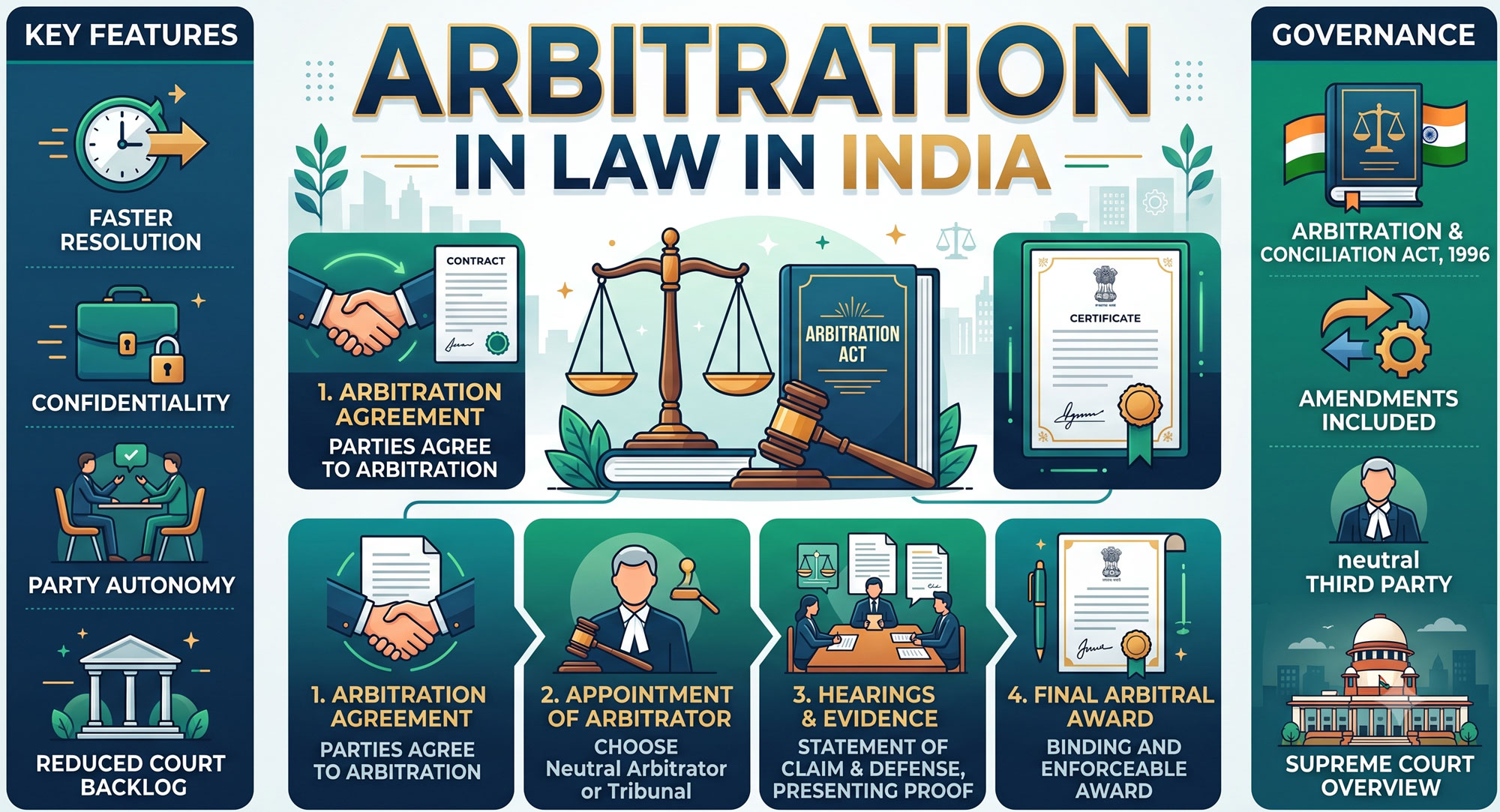
Arbitration in India
Arbitration in India:- A Case Law Analysis
Arbitration in India is usually taught as a set of sections — a grammar of Parts I and II, of Sections 8, 11, 34, 37 and 48. That is a useful way to pass an examination and a poor way to understand the subject. The law did not arrive as grammar. It arrived as a sequence of quarrels over money: a smelter contract gone wrong, a grain shipment that never sailed, a loan that soured into a non-performing asset, a retail empire pledged twice over. What the commercial party buys when it agrees to arbitrate is finality; what it discovers, when the award goes against it, is precisely how much of that finality the Indian courts will actually deliver.
The answer has been assembled judgment by judgment across three decades. Between 2002 and 2025 Indian arbitration travelled from a jurisprudence of intervention to a jurisprudence of restraint — haltingly, with reversals, and never in a straight line. Bhatia gave the courts a long reach; BALCO withdrew it. Saw Pipes opened the door to review on the merits; Associate Builders and Ssangyong narrowed it to a crack. M. Hakeem held that a court might annul but never modify; Gayatri Balasamy has now qualified even that. What follows reads these decisions together, as a single conversation between the courts and the commercial parties who chose to arbitrate.
Party autonomy is the brooding and guiding spirit of arbitration — the proposition the Supreme Court reached for in Centrotrade, and again in PASL, when the contract said one thing and the objector another.
An arbitration is contested on six recurring fronts: where it legally sits, what may be referred to it, who may decide, how far a court may review the award, whether a foreign award will become an Indian decree, and what protection is available before any of that is resolved. The practitioner’s first task is to know which front a given set of facts opens.
The seat is the anchor — where an arbitration legally sits
Where an arbitration is legally located decides which courts supervise it, which law governs the challenge, and whether the resulting award is domestic or foreign. Party autonomy fixes that location; nothing else does.
SEAT IN INDIA
Part I applies · s.34 challenge lies · the seat court alone supervises
BGS SGS Soma · Indus Mobile · BALCO
SEAT ABROAD
Part I ousted (save s.9 by consent) · award is a foreign award · enforcement under Part II / s.48
PASL Wind · BALCO
| Authority | Ratio decidendi | Practice insight |
|---|---|---|
| Bharat Aluminium Co. v. Kaiser Aluminium Technical Services Inc.(2012) 9 SCC 552 · SC, Constitution Bench · Territoriality; Part I | Part I of the Arbitration and Conciliation Act, 1996 applies only to arbitrations seated in India; where the seat lies abroad the Indian courts have no jurisdiction to set aside the award. The situs, not the nationality of the parties, fixes the applicable regime. Bhatia International and Venture Global stand overruled prospectively. | Choose a foreign seat and you choose foreign supervision, foreign challenge, and enforcement in India only as a foreign award. Every seat clause drafted since has been drafted in its shadow. |
| Indus Mobile Distribution Pvt. Ltd. v. Datawind Innovations Pvt. Ltd.(2017) 7 SCC 678 · SC (2J) · Seat as exclusive jurisdiction | The choice of a seat of arbitration confers exclusive supervisory jurisdiction on the courts of that place, displacing the general rules of territorial jurisdiction under the CPC even where part of the cause of action arose elsewhere. | The seat clause is a jurisdiction-selection tool: agree to a seat and you have agreed to litigate every s. 9 and s. 34 application there. Leverage in drafting; a trap in careless boilerplate. |
| BGS SGS Soma JV v. NHPC Ltd.(2020) 4 SCC 234 · SC (3J) · Seat distinguished from venue | A clause fixing the place where the arbitration is to be held designates the seat, unless significant contrary indicia establish it as a mere venue for hearings. The contrary approach in Hardy Exploration is not good law. | Name a place and you have named your seat. It decides which High Court hears the set-aside petition and, across borders, whether the award is domestic or foreign. |
| PASL Wind Solutions Pvt. Ltd. v. GE Power Conversion India Pvt. Ltd.(2021) 7 SCC 1 · SC (3J) · Foreign seat, Indian parties | Two Indian parties may validly designate a foreign seat of arbitration. The resulting award is a foreign award enforceable under Part II; interim relief under Section 9 remains available; and the choice offends neither ss. 23 and 28 of the Contract Act, nor public policy, nor FEMA. | London, Singapore, Dubai and Zurich are open to wholly Indian groups. The high-water mark of party autonomy — and the answer whenever the objection is that both parties are Indian. |
What may be referred — the fourfold test of non-arbitrability
Not every dispute carrying an arbitration clause can, in law, be arbitrated. The line runs between the private quarrel arbitration was built for and the public question it cannot resolve — and since Vidya Drolia the referral court does no more than glance at it.
A dispute is ordinarily non-arbitrable when it falls within any one of four categories:
1. Rights in rem
Actions binding the world at large — not subordinate rights in personam arising from them.
e.g. probate, insolvency, title in rem
2. Third-party effect
Disputes that affect third parties and require a central, erga omnes adjudication.
unsuited to a private, two-party forum
3. Inalienable sovereign function
Matters relating to inalienable sovereign and public-interest functions of the State.
e.g. grant of patents, sovereign acts
4. Statutory bar
Expressly or by necessary implication non-arbitrable under a mandatory statute reserving a forum.
e.g. DRT / RDB Act debt recovery
| Authority | Ratio decidendi | Practice insight |
|---|---|---|
| Booz Allen & Hamilton Inc. v. SBI Home Finance Ltd.(2011) 5 SCC 532 · SC (2J) · Rights in rem and in personam | Disputes concerning rights in personam are arbitrable; disputes concerning rights in rem are not. A suit for enforcement of a mortgage by sale is an action in rem and cannot be referred to arbitration. | The boundary of the arbitral option for secured creditors: contractual money claims may be arbitrated; enforcement of security against the property itself may not. |
| A. Ayyasamy v. A. Paramasivam(2016) 10 SCC 386 · SC (2J) · The plea of fraud | A plea of fraud simpliciter does not oust arbitration; only serious and complex fraud permeating the whole agreement, or raising questions of public import, warrants retention of the dispute by the civil court. (Refined in Vidya Drolia.) | The bare incantation of fraud no longer defeats a clause. Where fraud is alleged, plead its gravity and pervasiveness with particulars — or attack the absence of both. |
| Vidya Drolia v. Durga Trading Corporation(2021) 2 SCC 1 · SC (3J) · The consolidated test; who decides | Non-arbitrability is assessed against four heads — rights in rem, third-party effect, inalienable sovereign functions, and a statutory bar. The referral court applies only a prima facie standard; arbitrability falls to the tribunal under Section 16, and the court refers unless non-arbitrability is manifest. | Pre-arbitration litigation as a stalling device is largely foreclosed: when in doubt, the court refers. The fourth head still preserves the exclusivity of the debt-recovery tribunals. |
| M.D. Frozen Foods Exports Pvt. Ltd. v. Hero Fincorp Ltd.(2017) 16 SCC 741 · SC (2J) · SARFAESI and arbitration | Arbitration and SARFAESI enforcement are complementary, not alternative, remedies; a secured creditor may pursue both without being put to an election, and neither forecloses the other. | For NBFCs and banks the award and the SARFAESI notice are escalatory rather than conflicting weapons. Do not concede an election; run both. |
| In Re Interplay between Arbitration Agreements and the Indian Stamp Act, 18992023 INSC 1066 · SC, Seven-Judge Bench · Stamping | An unstamped or insufficiently stamped instrument is inadmissible in evidence but neither void nor unenforceable. Stamping is a curable defect for the arbitral tribunal, not for the referral court under Sections 8 and 11; N.N. Global (2) is overruled. | A stamping shortfall — usually trivial and curable — no longer stalls the constitution of a tribunal. Reach arbitration first and cure the defect there. |
The integrity of the tribunal — who may appoint, and who may be bound
An award is only as trustworthy as the person who signs it. The Court has policed Section 12(5) with unusual firmness, striking down not merely interested arbitrators but the clauses that let one party control the appointment; a separate strand asks when a party that never signed is nonetheless bound.
Is the person himself ineligible? (interest in outcome / relationship)
If ineligible, he cannot even nominate another — the stream cannot rise
An interested party cannot hold a unilateral power to appoint the sole arbitrator
| Authority | Ratio decidendi | Practice insight |
|---|---|---|
| TRF Ltd. v. Energo Engineering Projects Ltd.(2017) 8 SCC 377 · SC (3J) · s. 12(5); the ineligible nominator | A person ineligible to act as arbitrator under Section 12(5) is equally ineligible to nominate an arbitrator; the disqualification cannot be circumvented by delegating the appointment to a nominee. | Officer-nomination clauses in construction, supply and PSU contracts are spent. Audit legacy standard forms before a dispute crystallises. |
| Perkins Eastman Architects DPC v. HSCC (India) Ltd.(2020) 20 SCC 760 · SC (2J) · Unilateral appointment | A party interested in the outcome cannot hold the sole and exclusive power to appoint the arbitrator; such a clause is invalid and the court will itself constitute the tribunal. | Replace sole-appointment machinery with institutional appointment or a balanced panel. Where an old clause survives, take the objection at the Section 11 stage. |
| Cox and Kings Ltd. v. SAP India Pvt. Ltd.2023 INSC 1051 · SC, Constitution Bench · Non-signatories | The group of companies doctrine is part of Indian law and rests on the mutual intention of the parties, not on the phrase “claiming through or under”. A non-signatory may be bound where its conduct evinces a common intention to be a party; Chloro Controls is disapproved to that extent. | Which entity negotiated, performed and took the benefit now decides who is in the reference. Paper the negotiation and performance trail with that in view. |
Public policy — two decades of widening and narrowing
The compass of Section 34 widened for a decade and has been closing ever since. Saw Pipes and Western Geco mark the high tide of intervention; Associate Builders, Ssangyong and DAMEPL mark its retreat.
| Authority | Ratio decidendi | Practice insight |
|---|---|---|
| Oil & Natural Gas Corporation Ltd. v. Saw Pipes Ltd.(2003) 5 SCC 705 · SC (2J) · Patent illegality is born | An award that is patently illegal — contrary to the substantive law, the Act, or the terms of the contract — offends public policy and may be set aside under Section 34. (Since curtailed: confined to domestic awards, and unavailable for mere erroneous application of law.) | Cite it now only for the origin of the ground. Its width was cured by the 2015 amendment; a challenge framed on Saw Pipes as decided will not survive Ssangyong. |
| Oil & Natural Gas Corporation Ltd. v. Western Geco International Ltd.(2014) 9 SCC 263 · SC (3J) · Fundamental policy of Indian law | “Fundamental policy of Indian law” embraces a judicial approach, natural justice, and freedom from Wednesbury unreasonableness. (The Wednesbury limb was expressly disapproved in Ssangyong following the 2015 amendment.) | The reasonableness limb is gone. Anything built upon it must be recast as a breach of natural justice or of the most basic notions of justice. |
| Associate Builders v. Delhi Development Authority(2015) 3 SCC 49 · SC (2J) · The grounds systematised | Public policy under Section 34 comprises defined heads; the arbitrator is the sole judge of the quality and quantity of the evidence, and the court cannot reappreciate the merits. An award offends justice or morality only where it shocks the conscience of the court. | The standard citation for resisting a merits-dressed challenge. An award is not undone because a judge would have found the facts differently. |
| Ssangyong Engineering & Construction Co. Ltd. v. NHAI(2019) 15 SCC 131 · SC (2J) · The post-2015 position | After the 2015 amendment an award may be set aside on public policy only for fraud, conflict with the most basic notions of justice or morality, or breach of the fundamental policy of Indian law narrowly construed. The Wednesbury test in Western Geco no longer applies and there is no review on the merits. | The first citation for an award-holder resisting a Section 34 petition. Only a fundamental procedural or moral defect will bring a post-2015 award down. |
| Delhi Airport Metro Express Pvt. Ltd. v. Delhi Metro Rail Corporation Ltd.(2022) 1 SCC 131 · SC (2J) · Perversity applied; ss. 34, 37 | Patent illegality and perversity are narrow grounds and permit no review on the merits. A plausible interpretation of the contract by the tribunal is not perverse, and the court must not substitute its own view. | The answer to a court tempted to dress merits review as perversity — decisive in high-value infrastructure awards running to hundreds of crore. |
Reasons, remand and the limits of judicial correction
A court dissatisfied with an award has three courses and no more: remit it, set it aside, or — within the narrow compass now recognised — correct it. It may not rewrite it.
s.34(2)(a) · PROCEDURAL
- incapacity of a party
- invalid arbitration agreement
- no proper notice / unable to present case
- beyond scope of reference
- improper composition
s.34(2)(b) · PUBLIC POLICY
- fraud or corruption
- contrary to fundamental policy of Indian law
- conflict with most basic notions of justice/morality
s.34(2A) · PATENT ILLEGALITY
- domestic awards only
- illegality on the face of the award
- not a mere erroneous application of the law
- not reappreciation of fact
The court may set aside — and, per Gayatri Balasamy, modify only within narrow bounds — but it may not rewrite the award.
| Authority | Ratio decidendi | Practice insight |
|---|---|---|
| Dyna Technologies Pvt. Ltd. v. Crompton Greaves Ltd.(2019) 20 SCC 1 · SC (3J) · The duty to give reasons; s. 34(4) | An award must contain proper, intelligible and adequate reasons; where the reasoning is deficient but curable, the court should remit under Section 34(4) rather than set the award aside. | Award-holder: press for remission before annulment. Challenger: attack the reasoning gap, not the outcome — a well-reasoned award is far harder to unseat. |
| Project Director, NHAI v. M. Hakeem(2021) 9 SCC 1 · SC (2J) · No power to modify | Section 34 confers no power to modify an arbitral award; the court may set aside, wholly or in part, but not vary the award. (Now qualified by Gayatri Balasamy.) | The starting point on any application to vary a figure — and no longer the finishing point. Test whether the defect is severable before conceding annulment. |
| Gayatri Balasamy v. ISG Novasoft Technologies Ltd.2025 INSC 605 · SC, Constitution Bench (4:1) · A limited power to modify | Courts possess a limited power under Sections 34 and 37 to modify an award — severing a valid from an invalid part, correcting manifest or clerical errors, adjusting post-award interest, and exceptionally under Article 142 — but not to review the merits or rewrite the award. M. Hakeem is qualified accordingly. | Plead severability and manifest error precisely. The boundary between permissible correction and impermissible rewriting is where this will be fought for years. |
How a foreign award becomes an Indian decree
At the enforcement stage public policy bears its narrowest meaning and there is no review of the merits. NAFED marks the outer boundary of the defence; Vedanta supplies the clock.
may be refused
closed list · narrowly construed
decree of the court
THE CLOSED LIST (s.48)
incapacity · invalid agreement · no proper notice · beyond scope · improper composition · award not binding/set aside · subject-matter non-arbitrable · contrary to the public policy of India
THE SETTLED READING
Shri Lal Mahal: no merits review at enforcement. Vijay Karia: a FEMA breach is not public policy. Renusagar: narrow heads.
| Authority | Ratio decidendi | Practice insight |
|---|---|---|
| Renusagar Power Co. Ltd. v. General Electric Co.1994 Supp (1) SCC 644 · SC (3J) · Public policy defined | At enforcement, public policy is narrow: the fundamental policy of Indian law, the interests of India, or justice and morality. A mere breach of Indian law does not bar enforcement, and there is no review of the merits. | The bedrock assurance to a foreign award-holder. Force any resistance dressed as public policy back to these three heads. |
| Shri Lal Mahal Ltd. v. Progetto Grano Spa(2014) 2 SCC 433 · SC (3J) · s. 48; no merits review | “Public policy” in Section 48 bears the narrow Renusagar meaning; there is no patent-illegality review of a foreign award and no reappreciation of the merits. Phulchand Exports is overruled. | Closes the most dangerous avenue of resistance to GAFTA, FOSFA and like awards. A merits complaint cannot be recast as public policy to stall enforcement. |
| Vijay Karia v. Prysmian Cavi E Sistemi SRL(2020) 11 SCC 1 · SC (3J) · FEMA and s. 48 | A violation of FEMA does not amount to a breach of the fundamental policy of Indian law; enforcement cannot be refused under Section 48 merely because the award entails a FEMA-regulated transaction, the regulatory consequences being separately addressable. | An award compelling a share transfer will be enforced notwithstanding FEMA — removing a favourite defence of reluctant Indian counterparties in joint-venture and investment disputes. |
| NAFED v. Alimenta S.A.(2020) 12 SCC 149 · SC (3J) · Enforcement refused | Where performance was prohibited by governmental policy so that the contract became void under Section 32 of the Contract Act, enforcement of a foreign award of damages offends the fundamental policy of Indian law and may be refused. | The outer boundary of the defence, and fact-specific. Supervening legal impossibility of performance — not hardship or an adverse bargain — is what must be shown. |
| Government of India v. Vedanta Ltd.(2020) 10 SCC 1 · SC (3J) · Limitation and comity | Enforcement of a foreign award must be sought within three years under Article 137 of the Limitation Act; the Section 48 enquiry is narrow, respects the finality of the award at the seat, and involves no review of the merits. | Move promptly: the three-year Article 137 clock applies, not the twelve-year decree period. Even against the State the public-policy defence remains narrow. |
Interim protection, emergency relief and the clock
Relief that arrives after the award is often relief that arrives too late. This is the register in which the commercial value of an arbitration clause is most often won or lost.
s.9 · COURT
Interim measures from the court, before or during the arbitration. Available even for foreign-seated arbitrations (by consent) — PASL Wind.
s.17 · THE TRIBUNAL
Once constituted, the tribunal grants interim measures with the force of a court order (post-2015 amendment).
EMERGENCY ARBITRATOR
Institutional EA relief for a India-seated arbitration is an order under s.17 and is enforceable — Amazon / Future.
THE ADVANCE
Amazon / Future recognised the emergency arbitrator within the s.17 framework — closing the gap between institutional speed and domestic enforcement.
| Authority | Ratio decidendi | Practice insight |
|---|---|---|
| Amazon.com NV Investment Holdings LLC v. Future Retail Ltd.(2022) 1 SCC 209 · SC (2J) · s. 17; emergency arbitrator | In an India-seated arbitration under institutional rules providing for an emergency arbitrator, the emergency award is an order under Section 17(1) and is enforceable under Section 17(2). Party autonomy embraces the adoption of such rules. | Adopt institutional rules carrying an emergency-arbitrator provision wherever a transaction can close in days. The relief is available, and enforceable, before the main tribunal exists. |
| Bharat Sanchar Nigam Ltd. v. Nortel Networks India Pvt. Ltd.(2021) 5 SCC 738 · SC (3J) · s. 11; limitation | A Section 11 appointment application is governed by the three-year limitation in Article 137; and although limitation is generally for the tribunal, the referral court may decline to appoint where the claim is ex facie and demonstrably time-barred. | Issue the Section 21 notice and move under Section 11 promptly. For a respondent, a demonstrably stale claim can still be stopped at the appointment stage. |
| Centrotrade Minerals & Metals Inc. v. Hindustan Copper Ltd.(2017) 2 SCC 228 · SC (3J) · Two-tier arbitration | A two-tier appellate arbitration agreement is valid and enforceable and does not offend the public policy of India; party autonomy permits the parties to provide for reconsideration of an award by a second arbitral tribunal. | Available where the stakes justify a second look but national-court litigation is unwelcome. Draft the appellate tier’s scope, seat and timeline expressly. |
| Hindustan Construction Co. Ltd. v. Union of India(2020) 17 SCC 324 · SC (3J) · s. 36; s. 87 struck down | The filing of a Section 34 petition does not automatically stay enforcement of an award; a stay must be separately sought and granted on terms. Section 87 of the 2019 Amendment is struck down as manifestly arbitrary under Article 14. | Award-holders should press for enforcement while the challenge is pending; a challenger must expect to secure the awarded amount as a condition of stay. |
Bottom Line
The arc is one of restraint. The courts will hold parties to the seat they chose (BALCO, Indus Mobile), refer all but the manifestly non-arbitrable (Vidya Drolia, In Re Interplay), strike down a tribunal that one side has hand-picked (TRF, Perkins), and enforce a foreign award without reopening its merits (Renusagar, Shri Lal Mahal, Vijay Karia). But they will not treat an award as unassailable: a patently illegal or unreasoned award still falls (Ssangyong, Dyna Technologies), an award commanding what Indian law positively prohibits will not be enforced (NAFED), and the filing of a challenge no longer buys an automatic stay (Hindustan Construction). Deference and supervision, held in the same hand. For the practitioner the working lesson is that most outcomes are settled at the drafting table: fix the seat, the appointing authority and the institutional rules before the dispute exists, because the courts will afterwards do very little to save a party from its own clause.