Financial Disputes and Cheating in India
Financial Disputes and Cheating in India:- A Case Law Analysis
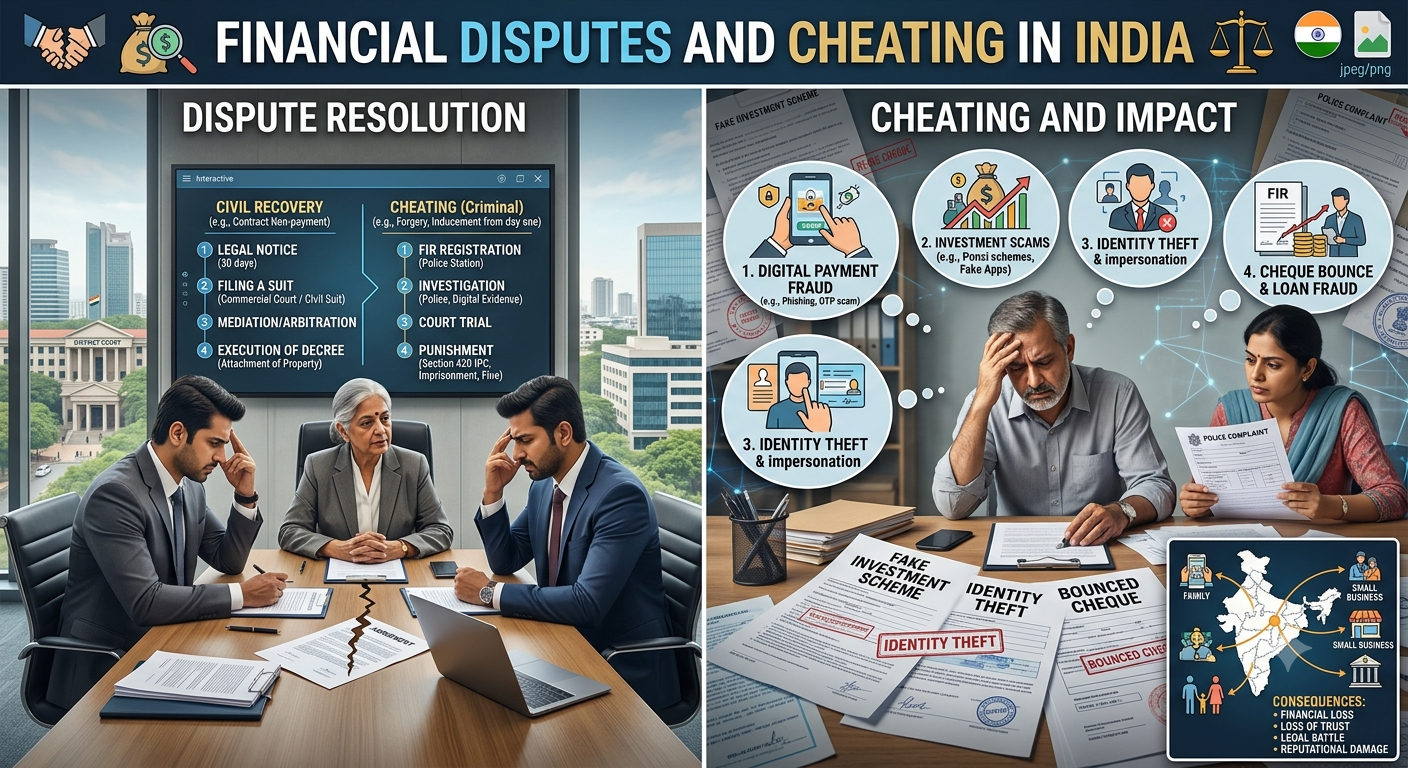
Most financial crime begins as an ordinary transaction. A loan is advanced, goods are supplied, a property is agreed to be sold, a cheque is handed over — and then something fails. The money does not come back, the goods are not paid for, the title turns out to be bad. At that point the aggrieved party has a choice of weapons, and the temptation is to reach for the sharpest: a first information report for cheating, which brings the machinery of the State to bear on what may be, at bottom, a breach of contract. The chapters of the Penal Code — now the Bharatiya Nyaya Sanhita, 2023 — on cheating, criminal breach of trust and forgery mark where that reach is legitimate and where it is an abuse. The single question that runs through the whole subject is whether there was a dishonest intention from the very inception, or merely a bargain that later went wrong.
The courts have answered that question, and policed its abuse, across seven decades and now across two codes. Hridaya Ranjan Prasad Verma and V.Y. Jose held that a broken promise is not cheating without a dishonest intention at the outset; G. Sagar Suri and Indian Oil warned against dressing a civil dispute as a crime; Velji Raghavji and Delhi Race Club kept criminal breach of trust to its true ingredients; Sheila Sebastian confined forgery to the maker of a false document; Sunil Bharti Mittal denied vicarious criminal liability without a statute; Bhajan Lal and Neeharika fixed when a prosecution may be stopped. What follows reads these decisions together, and gives, for each, the Penal Code provision and its successor in the Sanhita.
The criminal courts are not meant to be used as a forum for recovery of money or for settling civil scores — the premise from which the whole quashing jurisprudence in financial disputes proceeds.
One failed transaction engages at least seven distinct enquiries: whether the ingredients of cheating are present, whether the matter is truly criminal or merely a civil dispute in disguise, whether an entrustment converts a default into criminal breach of trust, whether a document was forged or merely false, who within a company can be made to answer, whether the prosecution should be quashed, and where it may be registered and tried. Each has its own gatekeeper and its own standard, and the practitioner’s first task is to know which enquiry a given set of facts opens. Statutory references give the Indian Penal Code, 1860 provision with its Bharatiya Nyaya Sanhita, 2023 successor.
Cheating — the ingredients (s. 420 IPC / s. 318 BNS)
Cheating is not a failed promise; it is a promise made dishonestly. The prosecution must show a deception, a dishonest inducement to part with property or to act, and — the ingredient that decides most cases — a dishonest intention existing at the very inception.
The representation must be false to the maker’s knowledge; an honest statement later falsified by events is not deception.
He delivers property, or does or omits what he would not otherwise have done — the inducement must be the operative cause.
A dishonest intention at the very outset is the heart of the offence; a later failure to perform is not enough.
| Authority | Ratio decidendi | Practice insight |
|---|---|---|
| Hridaya Ranjan Prasad Verma v. State of Bihar(2000) 4 SCC 168 · SC (2J) · s. 415/420 IPC → s. 318 BNS | To constitute cheating, a fraudulent or dishonest intention must exist at the time of making the promise or representation; a mere subsequent failure to fulfil the promise does not, by itself, warrant an inference of a culpable intention at the outset. | The first authority to cite in any quashing petition. Fasten on the moment of the promise: without dishonest intent then, the case is civil, whatever happened later. |
| V.Y. Jose v. State of Gujarat(2009) 3 SCC 78 · SC (2J) · s. 420 IPC → s. 318(4) BNS | For the offence of cheating, a dishonest intention at the inception of the transaction is essential; the distinction between a mere breach of contract and cheating turns on that intention, and its absence renders the dispute civil in character. | The bridge between contract and crime. Plead — or attack — the inception intention with facts, not adjectives; the label ‘cheating’ adds nothing without it. |
| Dalip Kaur v. Jagnar Singh(2009) 14 SCC 696 · SC (2J) · s. 420 IPC → s. 318(4) BNS | Where the substance of the dispute is a failure to honour an agreement and the materials do not disclose a dishonest intention at the inception, the criminal proceeding for cheating is liable to be quashed as an abuse of process. | A clean authority for quashing a contract dressed as cheating. Use it where the complaint narrates only non-performance. |
| Vir Prakash Sharma v. Anil Kumar Agarwal(2007) 7 SCC 373 · SC (2J) · s. 420 IPC · s. 138 NI Act | Where the grievance is essentially the dishonour of a cheque, for which the special remedy under s. 138 of the Negotiable Instruments Act is available, a parallel prosecution for cheating on the same facts, absent the ingredients of that offence, is not to be permitted. | Do not let a s. 138 matter be doubled with a cheating FIR to raise the pressure. The dishonour is a statutory offence of its own — cheating needs more. |
| Mahadeo Prasad v. State of West BengalAIR 1954 SC 724 · SC (2J) · s. 420 IPC → s. 318(4) BNS | A dishonest intention at the time of taking delivery of property may be inferred from the circumstances; where the accused had no intention to pay and induced delivery on a false representation, the offence of cheating is complete. | The counterweight for the complainant. Intention is proved by inference — no means to pay, a false assurance, immediate disappearance — not by confession. |
Breach of contract or cheating? The civil–criminal line
The commonest abuse in this field is the civil dispute given a criminal colour to extract payment. The courts have repeatedly warned that the criminal process is not a recovery agency, and will quash a prosecution that is, in substance, a contractual claim.
| Authority | Ratio decidendi | Practice insight |
|---|---|---|
| G. Sagar Suri v. State of U.P.(2000) 2 SCC 636 · SC (2J) · s. 420 IPC · s. 482 CrPC | The criminal proceedings are not to be resorted to as a short cut to a civil remedy or as a weapon of harassment; where a dispute is essentially of a civil nature, permitting a criminal prosecution to continue is an abuse of the process of the court. | The classic statement that criminal law is not a debt-collection tool. Lead a civil-dispute quashing with it. |
| Indian Oil Corporation v. NEPC India Ltd.(2006) 6 SCC 736 · SC (2J) · s. 420/406 IPC · s. 482 CrPC | There is a growing tendency to give a criminal colour to what are purely civil disputes; while a genuine offence disclosed by the complaint must be tried, the courts should be watchful and not allow the criminal process to be used to settle a civil score. | The authority that names the tendency and cautions against it. Pair it with the facts showing the dispute is contractual at heart. |
| Paramjeet Batra v. State of Uttarakhand(2013) 11 SCC 673 · SC (2J) · s. 420/406 IPC · s. 482 CrPC | Although the inherent power to quash is to be used sparingly, where a civil dispute has been given the cloak of a criminal offence and the essential ingredients are absent, the High Court should not hesitate to quash the proceeding to secure the ends of justice. | The most quotable modern formulation for quashing a disguised civil dispute. It expressly authorises the court to look at the real nature of the controversy. |
| Sarabjit Kaur v. State of Punjab(2023) 5 SCC 360 · SC (2J) · s. 420 IPC → s. 318(4) BNS | A breach of contract does not give rise to a criminal prosecution for cheating unless a fraudulent or dishonest intention is shown to have existed at the time of the transaction; a failure to keep a promise, without such intention, is only a civil wrong. | A recent, crisp restatement for a quashing petition. It confirms the inception-intention test survives into current practice. |
| Vesa Holdings Pvt. Ltd. v. State of Kerala(2015) 8 SCC 293 · SC (2J) · s. 420 IPC · s. 482 CrPC | Every breach of contract does not attract an offence of cheating; only where a fraudulent or dishonest intention at the time of making the promise is made out can the criminal proceeding be sustained, and its absence justifies quashing. | Useful where the complaint discloses a commercial understanding that failed. It draws the line at the inception intention and no later. |
Criminal breach of trust and misappropriation (s. 406/409 IPC / s. 316 BNS)
Where property or dominion over it has been entrusted, a dishonest conversion is criminal breach of trust. But entrustment is indispensable, a partner or co-owner rarely holds the requisite dominion, and the offence does not overlap with cheating on the same facts.
The property must be handed over, or its control given, on a trust or obligation — this ingredient is indispensable.
A co-owner or partner has no exclusive dominion; without an entrustment of a specific kind there is no breach of trust.
Or uses or disposes of it in violation of the terms of the trust — dishonestly, and in breach of the obligation.
| Authority | Ratio decidendi | Practice insight |
|---|---|---|
| Jaswantrai Manilal Akhaney v. State of BombayAIR 1956 SC 575 · SC (3J) · s. 405/409 IPC → s. 316 BNS | Entrustment of property is an essential ingredient of criminal breach of trust; the person charged must have been entrusted with the property, or with dominion over it, in a manner that raises an obligation to deal with it in a particular way. | The foundational authority on entrustment. If the complaint cannot identify the entrustment and its terms, the charge under s. 406/409 does not lie. |
| S.W. Palanitkar v. State of Bihar(2002) 1 SCC 241 · SC (2J) · s. 406/420 IPC → s. 316/318 BNS | The ingredients of criminal breach of trust and of cheating are distinct; for breach of trust there must be entrustment and dishonest misappropriation, and a mere failure to return money or perform a civil obligation does not, without more, make out either offence. | The go-to case for separating the two offences and both from a civil default. Map each ingredient against the complaint before conceding a triable case. |
| Velji Raghavji Patel v. State of MaharashtraAIR 1965 SC 1433 · SC (3J) · s. 405/406 IPC → s. 316 BNS | A partner has dominion over partnership property by virtue of being a partner, and that is not the entrustment contemplated by s. 405; in the absence of a special agreement, a partner cannot be convicted of criminal breach of trust in respect of partnership assets. | Decisive in partner and joint-venture disputes. Absent a special agreement of entrustment, a partner’s dealing with firm property is a civil, not a criminal, matter. |
| Onkar Nath Mishra v. State (NCT of Delhi)(2008) 2 SCC 561 · SC (2J) · s. 405/406 IPC → s. 316 BNS | The two distinct elements of criminal breach of trust are the creation of an obligation in relation to entrusted property and the misappropriation or dealing with that property in violation of the obligation; both must be established, and dishonest intent shown. | The clean checklist of the offence’s two limbs. Use it to test whether the complaint pleads both entrustment and dishonest conversion. |
| Delhi Race Club (1940) Ltd. v. State of U.P.(2024) · SC (2J) · s. 406/420 IPC → s. 316/318 BNS | The offences of cheating and criminal breach of trust are antithetical and cannot be made out on the same set of facts: cheating involves dishonest inducement to part with property from the outset, whereas breach of trust presupposes an entrustment that is later dishonestly breached. | The recent authority that stops the routine practice of charging s. 406 and s. 420 together. Force the complainant to elect which the facts actually disclose. |
Forgery and false documents (s. 463–471 IPC / s. 336–340 BNS)
Forgery is the making of a false document, and only the maker commits it. A deed genuinely executed — even one conveying a title the executant does not have — is not forged, though it may be cheating; and using a document known to be forged is a separate offence.
- The making of a false document or false electronic record
- Made with intent to cause damage, to support a claim, or to commit fraud
- A document is false only if made to be believed the work of one who did not make it
- Only the maker of the false document can commit forgery
- Using a document known to be forged as genuine — s. 471 IPC / s. 340 BNS
- Executing a genuine deed in one’s own name, even if the title conveyed is bad
- Selling property one does not own — that may be cheating, not forgery
- A document that is untrue in its contents but genuinely made by its author
- A false statement in a document that the maker was entitled to make
- Breach of a promise recorded in a genuine instrument
| Authority | Ratio decidendi | Practice insight |
|---|---|---|
| Mohammed Ibrahim v. State of Bihar(2009) 8 SCC 751 · SC (2J) · s. 463/464/471 IPC → s. 336/340 BNS | A sale deed executed by a person in his own name is not a false document merely because he had no title to the property conveyed; forgery requires the making of a document purporting to be made by someone who did not make it, and the grievance here, if any, lies in cheating. | The answer to the reflexive forgery charge in property disputes. Selling what is not yours is not forgery; test the complaint against the definition of a false document. |
| Sheila Sebastian v. R. Jawaharaj(2018) 7 SCC 581 · SC (2J) · s. 464/465 IPC → s. 335/336 BNS | The offence of forgery is committed only by the maker of a false document; a person who is not the maker cannot be held guilty of forgery, and one who merely causes or procures the making may, at most, be liable on other counts. | Decisive on who can be charged with forgery. Where the accused did not himself make the false document, the charge of forgery against him fails. |
| Iqbal Singh Marwah v. Meenakshi Marwah(2005) 4 SCC 370 · SC (5J) · s. 340 CrPC → s. 379 BNSS | Where forgery of a document is alleged to have been committed before its production in court, a private complaint is maintainable and the bar in s. 195 CrPC does not apply; the restriction operates only where the offence is committed while the document is in the court’s custody. | The route-map for prosecuting forgery of a document later filed in litigation. Identify when the forgery occurred to choose between a complaint and the s. 340 procedure. |
| Devendra v. State of U.P.(2009) 7 SCC 495 · SC (2J) · s. 467/468/471 IPC → s. 338/340 BNS | To sustain a charge of forgery the document must be shown to be false within the meaning of s. 464; where the ingredients of making a false document are not disclosed, the proceeding for forgery cannot be allowed to continue. | A quashing authority where the ‘forged’ document was in truth genuinely made. Anchor the challenge in the s. 464 definition. |
| Mir Nagvi Askari v. Central Bureau of Investigation(2009) 15 SCC 643 · SC (2J) · s. 463/464 IPC → s. 335/336 BNS | A document is not false unless it is made with the dishonest or fraudulent intention described in s. 464 and purports to be made by a person who did not make it; a document untrue in its contents but genuinely executed by its author is not a forged document. | Reinforces the distinction between a false document and a document containing a falsehood. The contents being untrue is not forgery if the authorship is genuine. |
The company, its directors and vicarious liability
When the accused is a company, criminal liability does not travel automatically to its directors. There is no vicarious liability in the criminal law without a statute that creates it, and a director answers only on specific allegations of his own role and intent.
- There is no vicarious liability in criminal law unless a statute expressly creates it
- A director is not liable merely by virtue of holding office in the company
- The complaint must allege the specific role and the criminal intent of each accused
- The company may be prosecuted, and a fine imposed, but mens rea is attributed through its directing mind
- The acts of the directing mind and will may be attributed to the company
- The converse is not automatic — the company’s act is not, without more, the director’s
- A director is liable only on specific allegations of his own act, connivance or negligence
- Vague, omnibus averments against “all the directors” will not sustain a summons
| Authority | Ratio decidendi | Practice insight |
|---|---|---|
| Maksud Saiyed v. State of Gujarat(2008) 5 SCC 668 · SC (2J) · vicarious liability; s. 420 IPC | The penal code does not contain any provision for attaching vicarious liability on the part of a managing director or the directors of a company when the accused is the company; a director can be prosecuted only if a specific role and statutory basis are shown. | The first authority against the omnibus arraignment of a board. Where the statute creates no vicarious liability, insist on specific allegations against each director. |
| Sunil Bharti Mittal v. Central Bureau of Investigation(2015) 4 SCC 609 · SC (3J) · alter ego; attribution | The principle of alter ego can be used to attribute the criminal intent of the directing mind to the company, but not in the reverse direction to make a director liable for the act of the company; a director is liable only where there is sufficient material of his personal involvement. | The controlling authority on attribution. The company’s offence is not the director’s unless his own act and intent are pleaded and shown. |
| GHCL Employees Stock Option Trust v. India Infoline Ltd.(2013) 4 SCC 505 · SC (2J) · summoning of directors | A Magistrate must apply his mind before summoning the directors of a company; vague and general allegations that the directors were in charge of and responsible for the conduct of the business, without particulars, are insufficient to proceed against them. | Attack the summoning order where it rests on boilerplate. The complaint must disclose what each director did, not merely that he was a director. |
| Shiv Kumar Jatia v. State (NCT of Delhi)(2019) 17 SCC 193 · SC (2J) · director’s personal liability | A director or officer of a company can be made vicariously liable only if there is sufficient incriminating evidence of his personal act or connivance; he cannot be held liable simply because of the position he holds in the company. | Useful for non-executive and independent directors. The office is not the offence; demand particulars of personal involvement. |
| Ravindranatha Bajpe v. Mangalore Special Economic Zone Ltd.(2022) · SC (2J) · specific allegations against directors | In the absence of specific allegations attributing a role to the directors and officers in the commission of the offence, a complaint against them is liable to be quashed; general and bald assertions of responsibility will not sustain the process. | A recent reaffirmation for quashing an omnibus complaint against the management. Match each accused to a specific averment or seek discharge. |
The quashing jurisdiction (s. 482 CrPC / s. 528 BNSS)
The inherent power to prevent abuse of process is the practitioner’s principal remedy in a financial dispute wrongly criminalised. It is exercised sparingly, within the Bhajan Lal categories, without weighing the evidence, and increasingly with safeguards against false complaints.
| Authority | Ratio decidendi | Practice insight |
|---|---|---|
| State of Haryana v. Bhajan Lal1992 Supp (1) SCC 335 · SC (2J) · s. 482 CrPC → s. 528 BNSS | The inherent power to quash may be exercised where the allegations, even taken at their highest, do not make out the offence; where the proceeding is manifestly attended with mala fides; or where it is instituted with an ulterior motive to wreak vengeance and to spite the accused. | The seven categories, still the framework of every quashing petition. Fit the facts to the applicable category rather than argue the merits. |
| Inder Mohan Goswami v. State of Uttaranchal(2007) 12 SCC 1 · SC (2J) · s. 482 CrPC → s. 528 BNSS | The court must ensure that the criminal prosecution is not used as an instrument of harassment or for seeking private vendetta; where the proceeding is an abuse of process or where quashing would secure the ends of justice, the inherent power should be exercised. | A strong statement authorising quashing to prevent harassment. It complements Bhajan Lal with an emphasis on the court’s protective duty. |
| Neeharika Infrastructure Pvt. Ltd. v. State of Maharashtra(2021) 19 SCC 401 · SC (3J) · s. 482 CrPC · no-coercive-steps | An order that no coercive steps be taken, or one interdicting investigation, is to be passed only in the rarest of cases, sparingly and with circumspection, and must be supported by brief reasons; the power to quash an FIR at the threshold is likewise to be exercised with restraint. | The current governing authority on interim protection in a quashing petition. Frame the prayer, and expect the order, within its disciplined limits. |
| Priyanka Srivastava v. State of U.P.(2015) 6 SCC 287 · SC (2J) · s. 156(3) CrPC → s. 175(3) BNSS | An application under s. 156(3) must be supported by an affidavit duly sworn, so that a person who makes false allegations to set the criminal law in motion can be held accountable; this safeguard is especially necessary in matters arising out of financial and commercial dealings. | The gate-keeping authority for financial-dispute FIRs. Insist on the affidavit requirement, and use its absence to resist a mechanically ordered investigation. |
| Deepak Gaba v. State of U.P.(2023) 3 SCC 423 · SC (2J) · s. 406/420 IPC · summoning | A summoning order in a matter that is essentially a commercial dispute must reflect application of mind to whether the ingredients of the offence are disclosed; where the complaint does not make out the offence, the process and the proceeding are liable to be quashed. | A recent authority marrying the civil-colour principle to the summoning stage. Attack the order where the complaint discloses only a commercial grievance. |
FIR, jurisdiction and parallel proceedings
Where a financial-crime complaint may be registered and tried, and how the civil and criminal tracks run alongside one another, are the closing questions. Registration is mandatory but subject to enquiry in commercial matters; jurisdiction follows the cause of action; and the two tracks proceed independently.
- An FIR must be registered if the information discloses a cognizable offence — s. 154 CrPC / s. 173 BNSS
- A preliminary enquiry is permissible in commercial and financial matters to see if a cognizable offence is disclosed
- The offence is tried where any part of the cause of action or the deception arose — ss. 177–179 CrPC / ss. 197–199 BNSS
- A place where no part of the offence occurred has no territorial jurisdiction
- A civil and a criminal proceeding on the same facts may proceed simultaneously
- A finding in one is not binding on the other; the standards and objects differ
- Where they are intertwined, the criminal case may be given precedence to avoid embarrassment
- The pendency of a civil suit does not bar a genuine criminal prosecution, nor validate a mala fide one
| Authority | Ratio decidendi | Practice insight |
|---|---|---|
| Lalita Kumari v. Government of U.P.(2014) 2 SCC 1 · SC (5J) · s. 154 CrPC → s. 173 BNSS | Registration of a first information report is mandatory where the information discloses a cognizable offence; a preliminary enquiry is permissible in a limited category, which includes commercial and financial offences, only to ascertain whether a cognizable offence is disclosed. | The framework for FIR registration. In a financial matter, a preliminary enquiry is available but is not a licence to refuse registration where an offence is disclosed. |
| Y. Abraham Ajith v. Inspector of Police(2004) 8 SCC 100 · SC (2J) · ss. 177–179 CrPC → ss. 197–199 BNSS | A court has territorial jurisdiction to try an offence only where a part of the cause of action, or an ingredient of the offence, has arisen within its local limits; a complaint filed where no part of the offence occurred is not maintainable there. | The authority for a jurisdictional objection. Map where each ingredient — the representation, the delivery, the loss — occurred before conceding the forum. |
| Satvinder Kaur v. State (Govt. of NCT of Delhi)(1999) 8 SCC 728 · SC (2J) · s. 156/177 CrPC → s. 175/197 BNSS | A police officer has the statutory power to investigate an FIR where a part of the offence is disclosed within his jurisdiction, and the question of territorial jurisdiction is ultimately one for the trial; an investigation is not to be quashed merely on that ground at the threshold. | The counterweight for the complainant on jurisdiction. Investigation may proceed where part of the offence arose locally; the final question is for the trial court. |
| K.G. Premshanker v. Inspector of Police(2002) 8 SCC 87 · SC (3J) · parallel civil and criminal proceedings | There is no bar to the simultaneous continuance of civil and criminal proceedings on the same facts; a decision in the civil case is not binding on the criminal court, nor the converse, since the nature, standard of proof and object of the two are different. | The answer to the plea that a pending civil suit bars the criminal case, or vice versa. The two run on separate tracks with separate standards. |
| M.S. Sheriff v. State of MadrasAIR 1954 SC 397 · SC (5J) · precedence of proceedings | Where civil and criminal proceedings arise out of the same facts, no hard rule of precedence exists, but the criminal matter is generally to be given priority so as to avoid the embarrassment of conflicting findings and the risk to the accused from delay. | The authority on which track goes first. Where findings might conflict, press for the criminal proceeding to be heard before the civil suit, or a stay of the latter. |
Bottom Line
The through-line is the inception intention. The courts will let a genuine cheat be prosecuted where dishonesty is shown from the outset (Mahadeo Prasad), keep criminal breach of trust to a proved entrustment (Velji Raghavji, Jaswantrai Akhaney), confine forgery to the maker of a false document (Sheila Sebastian, Mohammed Ibrahim), and refuse to impute a company’s offence to its directors without specific allegations (Sunil Bharti Mittal). But they will not let the criminal process become a recovery agency: a broken promise is not cheating (Hridaya Ranjan, V.Y. Jose), a civil dispute in a criminal cloak will be quashed (G. Sagar Suri, Paramjeet Batra), cheating and breach of trust cannot be charged together on the same facts (Delhi Race Club), and a false financial complaint must be sworn to on affidavit (Priyanka Srivastava). Reach and restraint, held in the same hand. For the practitioner the working lesson is that these cases are decided on the complaint itself: read it against the ingredients, fix where and when each element arose, and identify at the threshold whether what is alleged is a crime or a contract that failed — because the court, on a s. 482 / s. 528 petition, will do exactly that.
This Case Law Insights is for information purpose only and should not be taken as legal advice. To know further details, clarification, assistance or any advice on cheating, criminal breach of trust and forgery under the Indian Penal Code, 1860 and the Bharatiya Nyaya Sanhita, 2023 or any legal advice on complaint drafting/ quashing petitions/ FIR and investigation/ director liability etc. or any legal issues on financial crime and commercial-dispute defence you may connect with us at admin@equicorplegal.com / 08448824659 and visit www.equicorplegal.com