A Working Guide to the Arbitration and Conciliation Act, 1996
A Working Guide to the Arbitration and Conciliation Act, 1996.
A Working Guide to the Arbitration and Conciliation Act, 1996
The clause nobody reads until the deal has already gone wrong — and what three decades of the 1996 Act, and the last two years of judgments, actually mean for a commercial party.
Almost every commercial contract that crosses my desk now ends the same way: a dispute resolution clause, usually the shortest paragraph in the document, sending any future quarrel to arbitration. It is the clause the parties spend the least time on while they are still friends, and the one they read most carefully once they are not. By the time a client calls us, the deal has already curdled, and the question is no longer whether to arbitrate but how badly the clause was drafted and what can be salvaged from it.
That is the honest starting point for anyone thinking about arbitration in India. The Arbitration and Conciliation Act, 1996 is a good statute — cleaner and more modern than the 1940 regime it replaced — but it rewards parties who took it seriously at the drafting table and punishes those who treated the arbitration clause as boilerplate. Much of what arbitration lawyers in Delhi are asked to do is really damage control: reading a poorly built clause charitably enough to keep a genuine dispute inside the arbitral tent and out of a decade of ordinary litigation.
This piece is written for the commercial reader — the founder, the general counsel, the promoter, the investor — rather than for the specialist. It is not a treatise. It is the explanation I find myself giving across a conference table, cleaned up and set down in order.
What the 1996 Act was built to do
The Act was India’s adoption of the UNCITRAL Model Law, the template most serious arbitration jurisdictions share. Two ideas run through the whole statute, and if you hold on to them the rest tends to fall into place.
The first is party autonomy. Arbitration is a creature of contract. The parties choose to be there; they can shape the procedure, pick the arbitrators, fix the seat, and to a large extent write their own rules. A court hearing a suit follows the Code of Civil Procedure whether the litigants like it or not. An arbitral tribunal, by contrast, largely follows what the parties agreed. That freedom is the whole point, and losing sight of it is where most drafting goes wrong.
The second idea is minimal court intervention. Section 5 of the Act says, in effect, that judicial authorities should keep their hands off an arbitration except where the Act specifically lets them in. The theory is that parties chose arbitration to escape the courts, so the courts should not creep back in through the side door. The practice, for many years, was messier — Indian courts have a long habit of supervision — but the statutory direction is unambiguous, and the last decade of amendments and Supreme Court rulings has steadily pushed the law back towards that original discipline.
Why Delhi sits at the centre of it
There is a reason so many arbitration matters are run out of the capital, and it is not accident or vanity. The Delhi High Court carries one of the heaviest arbitration dockets in the country — the applications to appoint arbitrators, the petitions for urgent interim relief, the challenges to awards. Judges here see the same recurring questions often enough to have developed a settled, commercially literate approach to them, which matters enormously when you are trying to predict how a clause will be read.
Delhi is also where the institutional infrastructure has clustered. The Delhi International Arbitration Centre, attached to the High Court, administers a large volume of references. The India International Arbitration Centre — the statutory body seated in New Delhi under the 2019 legislation — was set up expressly to give the country a flagship institution to rival Singapore and London. For a party choosing where to anchor a high-value dispute, that concentration of courts, institutions and counsel is a practical advantage, and it is why engaging arbitration lawyers in Delhi is often less about geography than about proximity to the forums that will actually decide the matter.
The arbitration agreement: the paragraph that decides everything
Section 7 tells you what an arbitration agreement is: a written agreement to submit present or future disputes to arbitration. That sounds trivial. It is not. The difference between a clause that works and one that generates a preliminary fight — before anyone has even reached the merits — usually comes down to a handful of choices that take five minutes to get right and years to fix if you get them wrong.
The one point which is centre of discussion clients about most is the seat of arbitration. The seat is not merely the city where hearings are held for everyone’s convenience; it is the legal home of the arbitration, and it fixes which country’s courts supervise the process and which law governs the arbitration itself. Confusing the seat with the mere venue of hearings has spawned an astonishing amount of litigation. Write “the seat of arbitration shall be New Delhi” and mean it; do not leave a court to reverse-engineer your intention years later.
The others are less dramatic but just as costly when neglected: how many arbitrators (one is cheaper and faster; three is safer for large stakes), how they are to be appointed, the governing law of the contract, the language, and — if you want the discipline and record-keeping of an institution — which set of institutional rules will apply. A clause that settles these cleanly is worth more to a client than any amount of clever drafting elsewhere in the contract.
A drafting note that has aged badly: for decades, large public-sector and infrastructure contracts let the government entity hand-pick the arbitrator, or forced the contractor to choose from a panel curated entirely by the other side. As you will see below, the Supreme Court has now largely dismantled that model. If your standard-form contract still contains a clause of that kind, it needs revisiting — not eventually, but now.
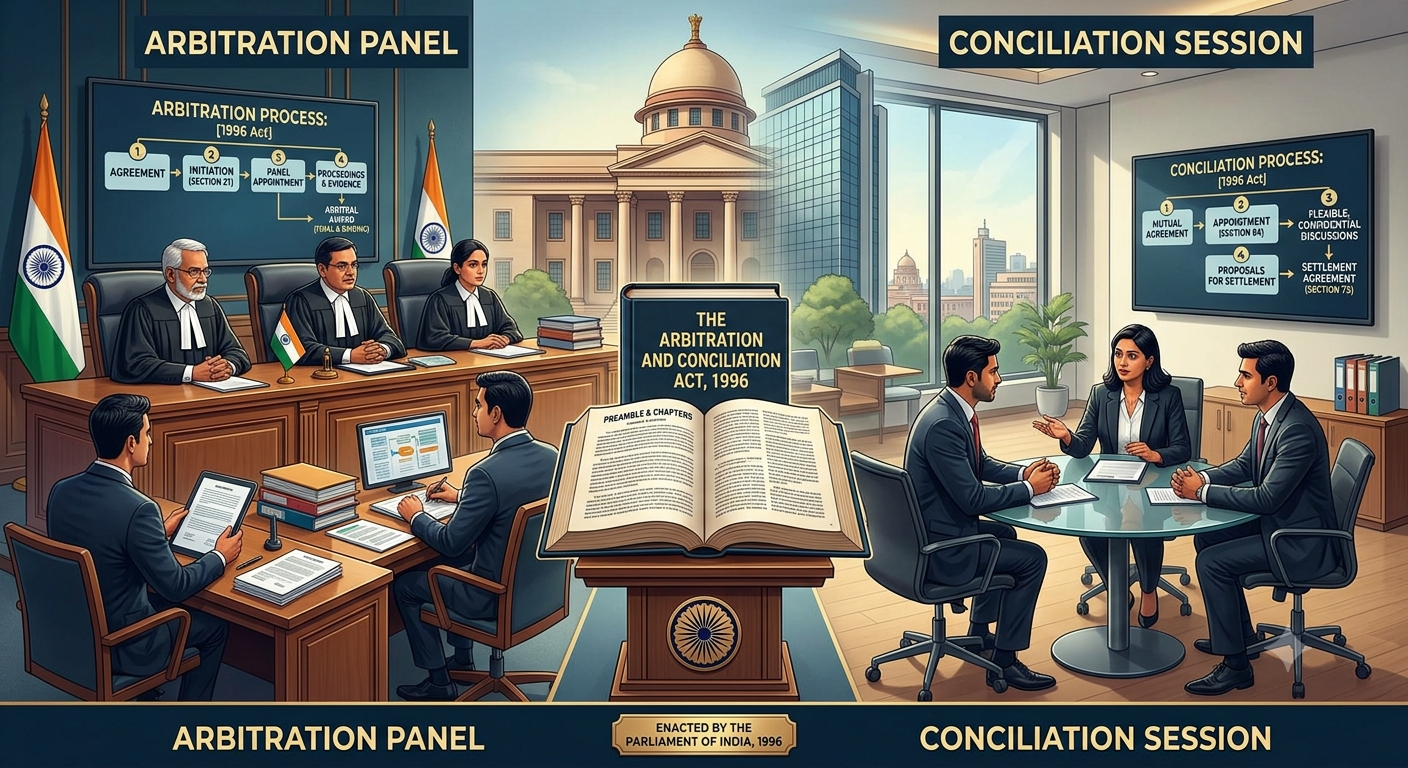
How a dispute actually moves through the Act
It helps to see the machinery in sequence, because the Act is really a life-cycle statute — each provision handling one stage of a dispute’s journey.
D.1. Getting to the tribunal — Sections 8 and 11
If one party ignores the arbitration clause and files an ordinary suit, the other can ask the court under Section 8 to send the matter to arbitration instead. And where the parties cannot agree on who the arbitrator will be, Section 11 lets a party approach the High Court to have one appointed. This is the stage at which a great many Delhi arbitrations begin their formal life, and it is where clumsy clauses first come unstuck.
D.2. Urgent relief — Sections 9 and 17
Disputes rarely wait politely for a tribunal to be constituted. Assets get moved, guarantees get invoked, projects stall. Section 9 lets a party go to court for interim protection — freezing an account, preserving property, securing the claim — before or during the arbitration. Section 17 gives the tribunal itself, once it exists, essentially the same powers. Speed here often decides the real-world outcome long before any award is written, which is why interim relief is frequently the first thing we file, not the last.
D.3. The award, and the fight over it — Sections 34, 37 and 36
When the tribunal decides, it issues an award. And here the commercial reader must understand a crucial limitation: an award is not an appeal waiting to happen. Under Section 34, a court can set an award aside only on narrow grounds — a party being unable to present its case, the tribunal exceeding its mandate, a conflict with the public policy of India, or, for purely domestic awards, patent illegality on the face of the record. A judge who simply disagrees with the tribunal’s view of the evidence is not permitted to interfere. Section 37 allows an appeal against orders made under Section 34, but the same narrowness carries through.
Enforcement lives in Section 36. A domestic award is enforced like a decree of the court. Importantly, the 2015 and 2021 amendments removed the old automatic stay: merely filing a challenge under Section 34 no longer freezes enforcement. A losing party who wants the award stayed must apply for a stay and usually deposit security. That single change has done more to make Indian awards worth winning than almost anything else in the last decade.
The ground has moved: what changed in 2024 and 2025
If you last looked at Indian arbitration law five years ago, several things you believed to be settled are no longer true. The Supreme Court has been unusually active, and any competent arbitration lawyer in Delhi is now advising clients differently than they were even two years ago. Four shifts matter most.
Unilateral appointments are effectively dead
In late 2024, a Constitution Bench held, in the railway electrification matter usually shortened to CORE, that a clause allowing one side — particularly a State entity — to control the appointment of the tribunal offends the guarantee of equality and the principle that parties must be treated equally at every stage, including the choice of arbitrator. Curated one-sided panels of the kind that pervaded government contracts can no longer be relied upon. For anyone contracting with a public body, this is genuinely good news, and for those bodies it means a wholesale rewrite of standard clauses.
Courts can now modify an award — a little
For years the orthodoxy was absolute: a court could set an award aside but never rewrite it. In April 2025, in Gayatri Balasamy, a Constitution Bench held by majority that courts do have a limited power to modify — to sever an invalid part, to correct a clear and manifest error, to adjust post-award interest in appropriate cases. It is a pragmatic ruling that spares parties from re-arbitrating an entire dispute over a fixable slip. It is also, as the dissent warned, a door that will need watching, because “limited” powers have a way of expanding in practice. Expect argument about its edges for years.
Non-signatories can be pulled in
The neat assumption that only those who signed the contract can be bound by its arbitration clause has softened considerably. Through Cox and Kings and, more recently, ASF Buildtech, the courts have accepted that in the right circumstances — genuine involvement in negotiation and performance, a tightly integrated group of companies, a single commercial arrangement — a non-signatory can be drawn into the arbitration. Group structures no longer offer the easy shield they once did.
Unstamped agreements are no longer fatal
A seven-judge bench put to rest a technicality that had been ambushing perfectly good clauses: an arbitration agreement in a contract that was insufficiently stamped is not void, and stamping is a curable defect rather than a reason to refuse arbitration at the threshold. A great many references that would once have been derailed on this point now proceed.
And a rewrite on the horizon
The Act has already been amended in 2015, 2019 and 2021, and a further overhaul is being prepared. Following an expert committee report, the government circulated a draft Arbitration and Conciliation (Amendment) Bill in late 2024 for public consultation. If it becomes law in something like its current form, it will rename the statute simply the “Arbitration Act” — conciliation having moved out to the separate mediation legislation — and finally write into the text things that practice had already invented and courts had been forced to bless: the emergency arbitrator, audio-visual and online hearings, and a tighter line between when a court may grant interim relief and when the tribunal takes over. A proposed appellate arbitral tribunal is more contested and may not survive in its present shape.
The Bill is not yet law, and it would be a mistake to advise clients as though it were. But the direction of travel is clear, and it is the direction the whole system has been moving in for a decade: less court, more institution, faster timelines, fewer places for a reluctant party to hide.
What a good arbitration lawyer is actually for
Reading all this, a commercial party might reasonably conclude that arbitration is a thicket. It is — but a navigable one, and the value of experienced counsel shows up at two very different moments.
The first is at the drafting table, when nobody thinks they need a dispute lawyer at all. Ten minutes spent getting the seat, the number of arbitrators, the appointment mechanism and the institutional rules right is the cheapest insurance a contract will ever carry. The clauses that generate the ugliest, most expensive preliminary fights are almost always the ones written without anyone imagining they would ever be used.
The second is when it has all gone wrong — when there is an asset to freeze this week, an award to enforce or resist, a Section 34 petition to argue before the Delhi High Court, a foreign award to bring home.
Arbitration was meant to be the quicker, quieter, more commercial way to resolve a dispute. Done properly — with a clause built to work and counsel who understand where the law now stands — it still is.
Disclaimer: This article is for information purpose only and should not be taken as legal advice. To know further details, clarification, assistance or any advice on arbitration disputes-investors-shareholders/ commercial/infrastructure/contractual/enforcement/challenge the award etc. you may connect with us at admin@equicorplegal.com / 08448824659 or visit www.equicorplegal.com