
Financial Fraud in India:- A Case Law Analysis
Financial Fraud in India: A Case Law Analysis
Financial fraud rarely announces itself[cite: 4]. It arrives dressed as a prospectus, a balance sheet, an assurance of returns, a letter of undertaking flashed across a banking network at three in the morning[cite: 4]. The company — that most useful of legal fictions, given life in Salomon so that enterprise might be pursued without ruinous personal risk — becomes, in the wrong hands, a veil to be abused rather than a shield to be respected[cite: 4]. The Indian corporate story of the last three decades is, in no small part, a story of that abuse: of Harshad Mehta’s borrowed bank receipts, of Satyam’s imaginary cash, of Saradha’s promise of impossible returns, of the diamond house that turned a bank’s own guarantees against it[cite: 4].
The law’s response has been neither swift nor tidy[cite: 4]. It has been assembled, judgment by judgment, out of a nineteenth-century penal code, a companies statute rewritten in 2013, a securities regulator armed by Parliament in 1992, a money-laundering law of 2002, and a bankruptcy code of 2016 — each speaking its own dialect, each supervised by a different agency[cite: 4]. What follows is an attempt to read these judgments together, as a single conversation the courts have been having with those who would use the corporate form to deceive[cite: 4].
External actions reveal inner secrets — acta exteriora indicant interiora secreta — the maxim the Supreme Court reached for in Sahara and again in Narayanan when the paper said one thing and the conduct another[cite: 4].
Fraud in the corporate order is prosecuted, penalised and unwound across at least six statutory registers at once, and the practitioner’s first task is to know which door a given set of facts opens[cite: 4].
Six registers, five gatekeepers, one wrong
One scheme engages the penal, companies, securities, money-laundering, banking-recovery and insolvency registers at once[cite: 4]. They run in parallel, each with its own gatekeeper and its own standard of proof; closure in one binds none of the others[cite: 4].
deception + loss
PENAL LAW IPC / BNS 2023 Cheating · CBT · Forgery · Conspiracy ◆ CBI / Police | COMPANY LAW Companies Act 2013 s.447 fraud · s.212 · ss.337–339 · s.339 ◆ SFIO / NCLT | SECURITIES SEBI Act 1992 PFUTP · PIT Regs · s.11 / 11B / 15HA ◆ SEBI / SAT | LAUNDERING PMLA 2002 · FEOA 2018 s.3 proceeds of crime · attachment · s.45 ◆ E.D. |
BANKING & RECOVERY RBI Master Directions on Frauds SARFAESI · DRT · fraud tagging ◆ RBI / Lender Banks | INSOLVENCY & INSTRUMENTS IBC 2016 · s.66 · NI Act s.138/141 wrongful/fraudulent trading ◆ NCLT / Magistrate |
| Authority | Ratio decidendi | Practice insight |
|---|---|---|
Standard Chartered Bank v. Directorate of Enforcement (2005) 4 SCC 530 · SC, Constitution Bench · Economic offences | A company may be tried and punished though the statute prescribes mandatory imprisonment with fine; the court imposes the fine, and the impossibility of imprisoning a juristic person is no bar to trial. Velliappa Textiles overruled. | No corporate-immunity argument survives under FERA/FEMA, PMLA or the Companies Act; the defence moves to quantum and to attribution of the individuals who acted. |
Chairman, SEBI v. Shriram Mutual Fund (2006) 5 SCC 361 · SC · Securities — penalty | Mens rea is not an ingredient of a civil or monetary penalty for regulatory breach; once the contravention is established the penalty follows as strict liability. | Why an acquittal on the penal side is no answer in adjudication; argue quantum under s. 15J, not innocence of intent. |
State Bank of India v. Rajesh Agarwal (2023) 6 SCC 1 · SC · RBI Master Directions on Frauds | Audi alteram partem is read into the Master Directions — the forensic-audit material, an opportunity to represent and a reasoned order must precede fraud classification; no hearing attaches to the anterior stage of reporting an offence. | Demand the audit report, time to represent and a speaking order; the absence of any one voids the tag, but leaves the bank’s FIR untouched. |
SFIO v. Rahul Modi (2019) 5 SCC 266 · SC · Companies Act, s. 212 | The period fixed by the Central Government for an SFIO investigation is directory; the office’s authority, including arrest under s. 212(8), subsists until the final report. A remand is challenged in revision, not by writ. | Time-limit challenges are foreclosed; attack instead the scope of the assignment order and compliance with the s. 212(8) safeguards. |
Usha Ananthasubramanian v. Union of India (2020) 4 SCC 122 · SC · Companies Act, ss. 241, 337, 339 | The fraud and asset-freezing powers extend only to the officers and affairs of the company under investigation; they cannot reach the head of a different organisation, however proximate to the loss. | Where an outsider is named, take the jurisdictional objection alone — it succeeds at the threshold, without engaging the merits. |
In re Satyam Computer Services SEBI (WTM) order 15.07.2014; CBI Spl. Court conviction 09.04.2015 | Working proposition: one accounting fraud engages the securities, penal and professional-regulatory registers simultaneously and independently; the civil finding on preponderance and the criminal verdict beyond reasonable doubt neither bind nor await each other. | Positions taken and admissions made before the regulator travel to the criminal court and to civil claimants; a consent order buys peace in one register only. |
The doctrine of attribution — and the line the Court drew
The mind of the controllers is imputed to the company[cite: 4]. The company’s guilt is not imputed back to the individual, who answers only on a statutory vicarious-liability provision or on material of his own active role[cite: 4].
| Directing Mind & Will promoter · MD · whole-time director who controls affairs | guilt of controllers imputed to company ✓ → | The Company artificial juristic person |
| Authority | Ratio decidendi | Practice insight |
|---|---|---|
Iridium India Telecom v. Motorola Inc. (2011) 1 SCC 74 · SC (2J) · IPC ss. 420, 120B | A corporation is not immune from prosecution for offences requiring intent; the mens rea of the natural persons who are its directing mind and will is the company’s own. | Plead attribution — name the controllers and the material time. Disclaimers in an offer document are a trial defence, not a ground for quashing. |
Sunil Bharti Mittal v. CBI (2015) 4 SCC 609 · SC (3J) · Summoning, s. 204 CrPC | The alter-ego doctrine does not operate in reverse. A director is arraigned for the company’s offence only where a statute creates vicarious liability, or where specific material shows his active role coupled with criminal intent. | The first line of defence to any director’s summons: high office is not itself a criminal act, and the order is vulnerable under s. 482 CrPC. |
Hridaya Ranjan Prasad Verma v. State of Bihar (2000) 4 SCC 168; rfd. Vesa Holdings, (2015) 8 SCC 293 · SC · s. 420 IPC | Cheating requires a dishonest intention existing at the inception of the transaction; a subsequent breach of promise, without more, is not the offence, and its prosecution is an abuse of process. | Plead — or attack — inception-stage intent with contemporaneous particulars: the then financial position, concealed encumbrances, a pattern of identical promises. |
R.K. Dalmia v. Delhi Administration AIR 1962 SC 1821 · SC · IPC ss. 405, 409 | “Property” in criminal breach of trust extends to money and corporate funds; a person entrusted with, or holding dominion over, those funds who diverts them dishonestly commits the offence. | Entrustment or dominion, not title, founds liability — which reaches the de facto controller holding no office. The base of every fund-diversion prosecution. |
Official Liquidator v. P.A. Tendolkar (1973) 1 SCC 602 · SC · Companies — misfeasance | A director owes a duty of reasonable care and cannot plead an ignorance that reasonable diligence would have dispelled; culpable inattention is itself a source of liability. | Anticipates s. 166 and the s. 149(12) carve-out: the modern defence is documented diligence — attendance, questions on the record, minuted dissent. |
The Sahara structure — substance over the chosen label
An instrument is characterised by what it does, not by what its issuer calls it, and the count of offerees is jurisdictional[cite: 4].
| ~30 million small subscribers | money in → | Two unlisted Sahara companies | jurisdiction asserted → | SEBI “offer to 50+ = public issue” |
| Authority | Ratio decidendi | Practice insight |
|---|---|---|
Sahara India Real Estate Corpn. v. SEBI (2013) 1 SCC 1 · SC (2J) · s. 67(3), Companies Act, 1956 | An offer of securities to fifty persons or more is a public issue attracting the listing and disclosure regime; SEBI’s investor-protection jurisdiction reaches unlisted companies. Substance prevails over label; refund with interest at 15% p.a. was directed. | Count offerees across the financial year and across all securities — now s. 42 read with s. 23, Companies Act, 2013. The exposure is refund, not merely penalty. |
N. Narayanan v. Adjudicating Officer, SEBI (2013) 12 SCC 152 · SC (2J) · PFUTP; ss. 11, 11B, 15HA | Directors, and a fortiori whole-time and promoter directors, answer for the integrity of the accounts and cannot evade liability by pleading a division of functions. The ss. 11 and 11B powers are remedial and preventive. | Minute reliance on management contemporaneously; conduct after publication — pledging or selling at the inflated price — is read back as proof of knowledge. |
What SEBI must actually prove — the insider-trading pyramid
The regulator may act on inference, but each tier of the pyramid must rest on material[cite: 4]. Kanaiyalal and Ajmera set the reach; Balram Garg sets the limit[cite: 4].
| Authority | Ratio decidendi | Practice insight |
|---|---|---|
SEBI v. Kanaiyalal Baldevbhai Patel (2017) 15 SCC 1 · SC (2J) · PFUTP regs. 2(1)(c), 3, 4 | “Fraud” includes any act, omission or concealment — deceitful or not — having the effect of inducing another to deal in securities. Only the inducement and its effect need be shown, not dishonesty; front-running by a non-intermediary is caught. | Liability is effect-based, so attack causation rather than state of mind — no inducement, an independent rationale, an impossible information flow. |
SEBI v. Kishore R. Ajmera (2016) 6 SCC 368 · SC (2J) · Standard of proof | Manipulative trading may be established on the preponderance of probabilities from circumstantial evidence, provided the proved circumstances yield an irresistible and reasonable inference of concerted manipulation. | The inference must be the only one that fairly follows: a plausible innocent explanation for the pattern — hedging, mandate, algorithmic execution — defeats it. |
SEBI v. Rakhi Trading (P) Ltd. (2018) 13 SCC 753 · SC, majority · Synchronised and reversal trades | Non-genuine synchronised and reversal trades creating a false appearance of price or volume are manipulative under the PFUTP Regulations notwithstanding the counterparties’ consent; the deception is practised upon the market. | Consent is no defence where the protected interest is the public price signal; surveil matched reversals in illiquid contracts irrespective of client instruction. |
Balram Garg v. SEBI (2022) 9 SCC 425 · SC (2J) · PIT Regulations, 2015 | An insider-trading finding must rest on cogent material proving actual communication and possession of UPSI. Relationship, proximity or trading pattern raise no deeming fiction, and the burden lies on the regulator. | Force the regulator up every tier of the pyramid; demonstrated estrangement or a documented trading rationale collapses the connected-person inference. |
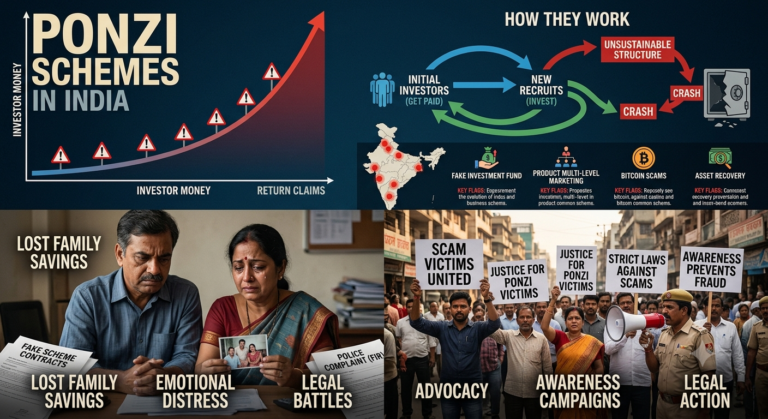
The arithmetic of a ponzi — and who investigates it
A ponzi has no revenue engine; it pays the early depositor with the late one’s money until the inflow falters[cite: 4]. Scale and reach, not merely fraud, decide who investigates[cite: 4].
| New deposits promised high returns | → | The Scheme no real revenue engine + diversion to promoters | → | Earlier investors “returns” = others’ capital |
inflow falters → collapse
| Authority | Ratio decidendi | Practice insight |
|---|---|---|
Subrata Chattoraj v. Union of India (2014) 8 SCC 768 · SC (2J) · Saradha; transfer of investigation | Where a large deposit-collection fraud has inter-state ramifications, a substantial money trail, a possible larger conspiracy and the involvement of influential persons, the constitutional court may transfer the investigation to the CBI, its remit extending to the money trail and the conspiracy. | Frame a transfer petition on institutional incapacity or want of insulation — dissatisfaction with the progress of an investigation is not a ground. |
Sahara India Real Estate Corpn. v. SEBI (2013) 1 SCC 1 · the same collection model in securities form | Nationwide collection through an instrument answering the description of a security is a public issue whatever the label, and the remedy is refund with interest under Court supervision. | Deposit-taking now also engages the Banning of Unregulated Deposit Schemes Act, 2019 — fix the register before choosing the forum. |
Following the money — s. 3 PMLA as a continuing offence
Laundering is not parasitic on a completed predicate conviction; it attaches to any dealing with the proceeds of crime and continues while the taint does[cite: 4].
| Scheduled offence the predicate fraud | → | 1 · Placement cash into the system | → | 2 · Layering webs of transactions | → | 3 · Integration “clean” wealth emerges |
| Authority | Ratio decidendi | Practice insight |
|---|---|---|
Vijay Madanlal Choudhary v. Union of India 2022 SCC OnLine SC 929 · SC (3J) · PMLA ss. 3, 19, 24, 45 · aspects under reconsideration | Money-laundering under s. 3 is a standalone, continuing offence embracing any process or activity connected with proceeds of crime. The ECIR is not an FIR and need not be supplied; the twin bail conditions (s. 45) and the reverse burden (s. 24) were upheld. | Plead the law as it stands while expressly preserving the point for the larger bench. Attachment can reach property acquired before the predicate offence if the value chain is traced. |
cf. Satyam · & cf. Saradha the laundering register running alongside the others | The proceeds generated by an accounting fraud or a deposit scheme are separately actionable under the PMLA, independently of the securities or penal outcome. | Expect an ED attachment to arrive while the regulatory and criminal matters are still pending; sequence the defences accordingly. |
The s. 141 decision path — who answers for a dishonoured cheque
The single most litigated question in day-to-day practice, distilled from four decisions and now qualified by the insolvency moratorium[cite: 4].
No ↓ Prosecution fails Aneeta Hada — company is a sine qua non | Yes ↓ Which limb of s.141?
|
| Authority | Ratio decidendi | Practice insight |
|---|---|---|
S.M.S. Pharmaceuticals Ltd. v. Neeta Bhalla (2005) 8 SCC 89 · SC (3J) | Liability under s. 141 arises from being in charge of and responsible for the conduct of the business, not from office; the complaint must so aver specifically. The managing director and the signatory are liable by virtue of position. | Take the averment objection at summoning, when it is cheapest. Against an MD or signatory, shift to the debt, the notice and limitation. |
National Small Industries Corpn. v. Harmeet Singh Paintal (2010) 3 SCC 330 · SC (2J) | Averments must be clear and specific; reproducing the statutory words is insufficient, and the distinct limbs of ss. 141(1) and 141(2) must be separately made out. A director without nexus cannot be prosecuted. | Independent, nominee and non-executive directors should attack the pleading itself rather than contest facts through trial. |
Aneeta Hada v. Godfather Travels & Tours (P) Ltd. (2012) 5 SCC 661 · SC (3J) | Arraignment of the company is a condition precedent to prosecuting its directors or signatories; derivative liability cannot survive the absence of the principal offender, save on a genuine legal impediment such as dissolution. | Check the array of parties before anything else — the defect is ordinarily incurable once limitation for the complaint has run. |
K.K. Ahuja v. V.K. Vora (2009) 10 SCC 48 · SC (2J) | Section 141 is graded: persons in charge under s. 141(1) require a specific averment; managing and joint managing directors are liable by office; every other officer only on an averment of consent, connivance or neglect. | The drafting checklist for both sides — category, averment required, evidence needed. |
P. Mohanraj v. Shah Brothers Ispat (P) Ltd. (2021) 6 SCC 258 · SC (3J) · IBC s. 14 · partly referred | A s. 138 proceeding is quasi-criminal and, as against the corporate debtor, is stayed by the moratorium; the directors and signatories liable under s. 141 enjoy no such shelter. | The insolvency shield protects the company, not the hands that signed; guarantors and signatories should not assume it travels to them. |
A century of landmark frauds — what each collapse settled
The doctrine was forged against real collapses[cite: 4]. Each forced the law to grow a limb; the authorities are those set out above[cite: 4].
| The collapse | What it settled | Authority |
|---|---|---|
Dalmia–Jain 1955–1962 · insurance funds | Criminal breach of trust reaches a company’s money and fund balances held by a person in control. | R.K. Dalmia v. Delhi Administration |
Securities scam 1992 · bank receipts, diverted call money | The institutional answer rather than a judicial one: a statutory regulator armed by the SEBI Act, 1992 and a Special Court to try the scam offences. | Statutory SEBI Framework |
Jain hawala diaries 1991–1998 · alleged illicit payments | Loose sheets are not “books” under s. 34 of the Evidence Act; even admissible entries are corroborative only and cannot alone charge liability. | CBI v. V.C. Shukla, (1998) 3 SCC 410 |
Satyam 2009–2015 · fictitious cash | The parallel registers operate on one set of facts to different standards, neither awaiting the other. | SEBI (WTM) 15.07.2014; CBI Spl. Court 09.04.2015 |
Sahara OFCDs 2011–2013 · nationwide collection | Substance prevails over label; SEBI’s jurisdiction reaches unlisted issuers raising public money. | Sahara India Real Estate Corpn. v. SEBI |
Saradha 2013–2014 · deposit ponzi | Inter-state reach, a money trail and influential persons justify transfer of the investigation to the CBI. | Subrata Chattoraj v. Union of India |
PNB / Nirav Modi LoUs 2018–2020 · fraudulent undertakings | The Companies Act’s fraud and freezing powers are company-specific and cannot reach an officer of a different institution. | Usha Ananthasubramanian v. Union of India |
The law will look past the veil and the convenient label to find the guilty mind; it will let regulators act on inference and civil probability; and it will freeze and disgorge[cite: 4]. But it will not brand a person a fraud unheard (Rajesh Agarwal), imprison a director by his office alone (Sunil Bharti Mittal), stretch a fraud power to the wrong company’s officer (Usha Ananthasubramanian), or convict on a private ledger without corroboration (V.C. Shukla)[cite: 4]. Zeal and restraint, held in the same hand[cite: 4]. For the practitioner the working lesson is procedural as much as doctrinal: fix the register and its standard of proof before framing the case[cite: 4].