
Shareholder Disputes in India:- A Case Law Analysis
Shareholder Disputes in India:- A Case Law Analysis
A shareholder dispute is a quarrel about power inside a company the law treats as a person of its own. The majority controls the board, the board controls the company, and the minority is left with a bundle of rights and a statute. That statute is Chapter XVI of the Companies Act, 2013 — sections 241 to 246 — which lets a member complain that the company’s affairs are being conducted in a manner oppressive to him or prejudicial to the company, and asks the National Company Law Tribunal to set the matter right. What that promise is worth turns entirely on how the courts have read it: who may complain, what counts as oppression, how far the Tribunal may go, and which quarrels belong to it at all.
The answer has been assembled across seven decades, from the winding-up analogy of the 1913 Act to the business-judgment restraint of the present day. Shanti Prasad Jain fixed the meaning of oppression; Needle Industries and Dale & Carrington fixed the fiduciary limits of the share-issue power; Rangaraj and Messer Holdings decided whether a right that lives only in the shareholders’ agreement binds anyone; Tata Consultancy Services v. Cyrus Investments marked the outer edge of the jurisdiction; Vidya Drolia decided what may be sent to arbitration when the dispute breaks. What follows reads these decisions together, as a single conversation between the courts and the founders, investors and minority holders who fall out over a company.
The jurisdiction protects a member against those in control who conduct the company’s affairs in a manner lacking in probity — the premise from which the meaning of oppression, and the limits of the Tribunal’s power, have both been worked out.
One falling-out engages at least seven distinct enquiries: whether the complainant may petition at all, what in law amounts to oppression, whether a dilution is a legitimate raise or a fiduciary wrong, where mismanagement ends and business judgment begins, whether the rights bargained for bind the company or only the parties, which forum owns a dispute about the register, and what may be arbitrated when the deal breaks. Each has its own gatekeeper and its own standard, and the practitioner’s first task is to know which enquiry a given set of facts opens.
The gateway — who may petition (section 244)
The jurisdiction is not open to everyone with a grievance. A member must cross the section 244 threshold or obtain a waiver, must complain in his character as a member, and must have a title to the shares that is not itself the real dispute.
grievance of oppression or mismanagement · ss. 241–242
the Tribunal enquires into the conduct complained of
Company with share capital: members holding one-tenth of the issued capital, or one hundred members, whichever is less.
Aruna Oswal v. Pankaj Oswal / World Wide Agencies v. Margaret T. Desor
J.P. Srivastava & Sons v. Gwalior Sugar Co. / Rajahmundry Electric Supply
Vikram Bakshi v. Sonia Khosla
| Authority | Ratio decidendi | Practice insight |
|---|---|---|
| Rajahmundry Electric Supply Corpn. Ltd. v. A. Nageswara Rao AIR 1956 SC 213 · SC (3J) · Standing; powers of the court |
The oppression-and-mismanagement jurisdiction protects members against those in control who conduct the company’s affairs prejudicially; qualifying members may invoke it, and the court’s power to bring the wrongful conduct to an end and regulate future conduct is wide and forward-looking. | The earliest architecture of the minority remedy. It confirms the Tribunal’s powers are broad and prospective — useful leverage for a squeezed minority. |
| World Wide Agencies Pvt. Ltd. v. Margarat T. Desor (1990) 1 SCC 536 · SC (2J) · Standing of legal heirs |
The legal representatives of a deceased member, though not yet registered in the register of members, are entitled to maintain a petition for oppression and mismanagement; the jurisdiction is not defeated by the pendency of transmission. | Heirs need not wait for registration to protect the estate’s shareholding. Move promptly on transmission, but do not treat a pending entry as a bar to relief. |
| J.P. Srivastava & Sons Pvt. Ltd. v. Gwalior Sugar Co. Ltd. (2005) 1 SCC 172 · SC (2J) · The consent requirement |
The requirement that the requisite number of members support the petition is satisfied if their consent is shown; consent may be given before or after presentation, and a subsequent withdrawal by some consenting members does not render the petition incompetent. | Gather and document consents to meet the one-tenth or hundred-member bar, and preserve them. Maintainability is judged as at presentation, not at the hearing. |
| Aruna Oswal v. Pankaj Oswal (2020) 8 SCC 79 · SC (2J) · Disputed title; maintainability |
Where the petitioner’s very title to the shares is seriously in dispute, turning on a contested question of succession, the oppression jurisdiction is not the appropriate forum; the title must first be established, ordinarily in a civil suit, before the petition can proceed. | Test the petitioner’s title before pleading oppression. A succession or nomination dispute over the shares is a civil suit waiting to happen, not a 241–242 petition. |
| Vikram Bakshi v. Sonia Khosla (2014) 15 SCC 80 · SC (2J) · Abatement on death |
A petition for oppression and mismanagement is representative in character and does not abate on the death of the sole petitioner; the legal representatives may be substituted and permitted to continue the proceeding. | The death of a petitioner does not end the matter. Apply promptly to bring the legal representatives on record and continue. |
The meaning of oppression (sections 241–242)
Oppression is a demanding standard, not a synonym for disagreement. The conduct must be burdensome, harsh and wanting in probity toward a member as such, and it must ordinarily be a continuous course persisting to the date of the petition.
All four must be present — a mere loss of confidence between majority and minority is not enough
Shanti Prasad Jain v. Kalinga Tubes / Hanuman Prasad Bagri
Sangramsinh P. Gaekwad v. Shantadevi P. Gaekwad
V.S. Krishnan v. Westfort Hi-Tech Hospital / LIC v. Escorts
| Authority | Ratio decidendi | Practice insight |
|---|---|---|
| Shanti Prasad Jain v. Kalinga Tubes Ltd. AIR 1965 SC 1535 · SC (3J) · The classic definition |
Oppression must be burdensome, harsh and wrongful, and must involve a lack of probity or fair dealing towards a member in his capacity as such; a mere loss of confidence between the majority and the minority, or a resolution the minority resents, is not enough. | The foundational test, still applied. Frame the petition around probity and unfair dealing, not around a business outcome the minority dislikes. |
| Sangramsinh P. Gaekwad v. Shantadevi P. Gaekwad (2005) 11 SCC 314 · SC (3J) · Probity; burden of proof |
Not every act of a majority is oppression; the petitioner must show conduct that is burdensome, harsh and lacking in probity, judged against the member’s proprietary rights. Directors nevertheless owe fiduciary duties in issuing capital, and an issue engineered to alter control may be struck down. | The judgment maps the whole terrain between a legitimate dilution and an oppressive one. Keep the contemporaneous record — valuation, need, minutes — that shows which side of the line you are on. |
| V.S. Krishnan v. Westfort Hi-Tech Hospital Ltd. (2008) 3 SCC 363 · SC (2J) · Subversion of members’ rights |
Conduct designed to deprive a member of his rights, or to alter the shareholding structure to his prejudice without justification, is oppressive; the Tribunal looks at the substance and effect of what was done, not merely its form. | Where a member’s statutory or contractual rights are subverted by those in control, plead the effect. The Tribunal will look through the paperwork to the design. |
| Hanuman Prasad Bagri v. Bagress Cereals Pvt. Ltd. (2001) 4 SCC 420 · SC (2J) · Continuous conduct; just and equitable |
To succeed, the petitioner must make out a case of continuous oppressive conduct up to the date of the petition, of a kind that would justify winding up on the just-and-equitable ground but where winding up would unfairly prejudice the members. | Sets the evidentiary threshold. A single grievance about one act rarely qualifies; build the record of a pattern, and tie it to the just-and-equitable foundation. |
| Life Insurance Corporation of India v. Escorts Ltd. (1986) 1 SCC 264 · SC (5J) · Statutory shareholder rights |
A shareholder’s statutory rights — to requisition a meeting, to move a resolution, to vote — are exercisable as of right and need not be justified to the board; their denial by those in control is a paradigm of oppressive conduct. | Statutory rights sit above the SHA and the boardroom. Their obstruction is itself the grievance — no separate proof of bad motive is needed. |
Dilution and the fiduciary share-issue power
The commonest weapon in a shareholder war is a further issue that quietly re-cuts control. The power to allot is fiduciary: used for a genuine need and offered fairly it is an ordinary raise; used to entrench control it is an oppression the Tribunal will undo.
- A genuine and demonstrable need for capital
- A real board resolution on a proper record
- A fair record date and adequate notice to members
- An offer made rateably to existing shareholders (s. 62)
- A price supported by contemporaneous valuation
- A dominant purpose of gaining or entrenching control
- No genuine need for money, or manufactured urgency
- A selective allotment dressed as a rights issue
- Process defects — no real meeting, inadequate notice
- Effect that dilutes the complainant and strengthens the controller
Nanalal Zaver v. Bombay Life Assurance / Needle Industries
Dale & Carrington v. P.K. Prathapan / Kamal Kumar Dutta
Incable Net (Andhra) v. AP Aksh Broadband
| Authority | Ratio decidendi | Practice insight |
|---|---|---|
| Nanalal Zaver v. Bombay Life Assurance Co. Ltd. AIR 1950 SC 172 · SC (4J) · Proper purpose; the origin |
Directors may make a further issue of capital even though it incidentally keeps an outsider out, provided the dominant purpose is bona fide in the company’s interest and the new shares are offered equitably to the existing members. | The ancestor of the modern pre-emptive right in s. 62. The safe harbour is a genuine capital need and a rateable offer; the danger zone is a selective allotment dressed as a rights issue. |
| Needle Industries (India) Ltd. v. Needle Industries Newey (India) Holding Ltd. (1981) 3 SCC 333 · SC (3J) · The fiduciary test |
The test for a further issue is whether it was made solely for the benefit of the directors or the controlling group; an issue in the larger interest of the company is not struck down merely because it incidentally benefits those who control it, but process and fairness are everything. | The case every diluting investor and every diluted minority should read. A real board resolution, a demonstrable need, a fair record date and notice — manufacture urgency and the issue is vulnerable. |
| Dale & Carrington Investment (P) Ltd. v. P.K. Prathapan (2005) 1 SCC 212 · SC (2J) · Allotment to gain control |
An allotment made to gain or entrench control, without a genuine need for capital and without proper board process, is a breach of the directors’ fiduciary duty and an act of oppression; directorial power over share capital must satisfy purpose, process and fairness. | The modern high-water mark against stealth dilution. Any allotment that shifts control must survive three questions: was there a real need, was the process clean, and was it offered fairly. |
| Kamal Kumar Dutta v. Ruby General Hospital Ltd. (2006) 7 SCC 613 · SC (2J) · Effect over form |
An allotment whose purpose and effect is to increase the controlling group’s shareholding and reduce that of the complaining members, without fair justification, is an act of oppression and may be set aside; the Tribunal has wide power to do so. | The Tribunal will look at effect, not just form. A financing whose only real consequence is to strengthen one bloc against another is exposed, however carefully papered. |
| Incable Net (Andhra) Ltd. v. AP Aksh Broadband Ltd. (2018) 9 SCC 20 · SC (2J) · Rights issue and dilution |
A rights issue is not immune from scrutiny under the oppression jurisdiction; where its real object is to dilute a shareholder and the process was not fair, the issue may be interfered with notwithstanding its formal regularity. | The regularity of a rights issue is not a complete defence. For the minority, plead the object and the process; for the company, keep the need and the fairness on the record. |
Mismanagement, probity and business judgment
The line between oppression and an unwelcome business decision is where most modern petitions are decided. The Tribunal will not sit in appeal over a bona fide commercial judgment, but siphoning, exclusion and conduct destroying the substratum remain its heartland.
- Reviewing a commercial or business decision taken bona fide
- Reinstating a director removed by a lawful majority resolution
- Enforcing a governance promise that lives only in the contract
- Resolving a pure title or succession dispute over the shares
- Substituting the Tribunal’s judgment for the board’s
- Conduct burdensome, harsh and wanting in probity toward a member
- A continuous course of oppression to the date of the petition
- Mismanagement that prejudices the company or the public interest
- Facts that would justify a just-and-equitable winding up
- Relief that brings the wrongful conduct to an end for the future
Tata Consultancy Services v. Cyrus Investments
Hind Overseas v. Raghunath Prasad Jhunjhunwalla / Kilpest v. Shekhar Mehra
Chatterjee Petrochem v. Haldia Petrochemicals / Debashis Sinha
| Authority | Ratio decidendi | Practice insight |
|---|---|---|
| Tata Consultancy Services Ltd. v. Cyrus Investments (P) Ltd. (2021) 9 SCC 449 · SC (3J) · The limits of the jurisdiction |
The removal of a person from the office of executive chairman, effected by a lawful majority, is not by itself an act of oppression; the Tribunal does not sit in appeal over business decisions taken bona fide, and reinstatement of a director is not an ordinary incident of the jurisdiction. | The outer boundary of the remedy. Board and management decisions taken in good faith are not oppression, and the Tribunal will not run the company — frame the case as probity, not disagreement. |
| Hind Overseas Pvt. Ltd. v. Raghunath Prasad Jhunjhunwalla (1976) 3 SCC 259 · SC (3J) · Quasi-partnership |
The principles of a partnership are applied to a company only where it was formed on a personal relationship of mutual confidence, as in a quasi-partnership; a company is not to be treated as a partnership merely because it is small or closely held. | Do not assume every closely held company is a quasi-partnership. Establish the mutual understanding of participation at formation before invoking the analogy. |
| Kilpest Pvt. Ltd. v. Shekhar Mehra (1996) 10 SCC 696 · SC (2J) · The company is not a partnership |
Once persons choose to carry on business as a company, the incidents of company law apply, and the just-and-equitable jurisdiction is not to be used to convert the company into a partnership at will; the quasi-partnership relief is confined and exceptional. | The counterweight to an over-broad quasi-partnership plea. The corporate form, once chosen, carries its own consequences and cannot be discarded when convenient. |
| Chatterjee Petrochem (India) Pvt. Ltd. v. Haldia Petrochemicals Ltd. (2014) 14 SCC 574 · SC (2J) · Management, control and understandings |
Whether the affairs of a company are being conducted oppressively is judged on the whole course of dealing, including the understandings between the parties on management and control; a breach of such an understanding, coupled with prejudice, may found the jurisdiction, but the petitioner must prove it. | Where control was promised and denied, the promise and its breach must be pleaded and proved. An understanding on management is only as good as the evidence for it. |
| Debashis Sinha v. R.N.R. Enterprise (P) Ltd. (2023) 8 SCC 623 · SC (2J) · Siphoning; heartland conduct |
Diversion of the company’s funds, exclusion of members from participation and conduct that erodes mutual confidence are the heartland of the oppression jurisdiction; the Tribunal’s remedial powers are wide and are to be exercised to do substantial justice between the parties. | For genuine siphoning and exclusion, the jurisdiction is alive and generous. Build the financial trail — related-party flows, denied access to records — that shows the conduct. |
The shareholders’ agreement versus the articles
A right is worth what the law will enforce, and where it lives decides that. A restriction embedded in the articles binds the company; one left in the shareholders’ agreement may be no more than a claim in damages against the counterparty.
- A transfer restriction, ROFR or lock-in not in the articles does not bind the company
- A veto or reserved-matter right left in the contract is a claim in damages, not a bar to the act
- A governance promise that never reaches the articles may be worth little when it matters
- Enforceable between the parties as a contract — not against the company or a third party
- A restriction embedded in the articles binds the company and every member
- A consensual pre-emption or right of first refusal among shareholders is valid
- An affirmative-vote or veto right written into the articles controls the act itself
- The critical protective terms should be mirrored from the SHA into the articles at closing
V.B. Rangaraj v. V.B. Gopalakrishnan / World Phone India v. WPI Group
Messer Holdings v. Shyam Madanmohan Ruia / Bajaj Auto (DB, 2015)
Mannalal Khetan v. Kedar Nath Khetan
| Authority | Ratio decidendi | Practice insight |
|---|---|---|
| V.B. Rangaraj v. V.B. Gopalakrishnan (1992) 1 SCC 160 · SC (2J) · Restriction not in the articles |
A restriction on the transfer of shares that is not contained in the articles of association is not binding, either on the company or on the shareholders; the only restrictions that bind are those in the articles. | The rule that launched a thousand closing checklists. If a transfer restriction, ROFR or lock-in matters, embed it in the articles — do not leave it to live only in the SHA. |
| Messer Holdings Ltd. v. Shyam Madanmohan Ruia (2010) 159 Comp Cas 29 (Bom) · Bombay HC (DB) · Consensual pre-emption |
Free transferability means shares are not subject to an embargo imposed by the company; it does not bar shareholders from voluntarily binding themselves inter se by a consensual arrangement such as a right of first refusal, which is valid as a contract between them. | Pre-emption and ROFR between shareholders are valid as contracts. But they bind the parties, not necessarily the company or an innocent third party — mirror the critical ones into the articles. |
| World Phone India Pvt. Ltd. v. WPI Group Inc., USA (2013) 178 Comp Cas 173 (Del) · Delhi HC · Affirmative-vote / veto rights |
An affirmative-vote or veto right conferred by a shareholders’ agreement but absent from the articles is not enforceable against the company; to bind the company, such a control right must find its place in the articles. | Your investor vetoes, reserved matters and board-consent rights are only as good as the articles. Amend the articles at closing, or your ‘control’ is contractual air. |
| Mannalal Khetan v. Kedar Nath Khetan (1977) 3 SCC 424 · SC (2J) · Mandatory statutory command |
The statutory command that a company shall not register a transfer except on a proper instrument of transfer is mandatory; the negative, prohibitory language admits of no exception, and a transfer effected in breach is ineffective. | Closing mechanics matter. A share transfer that skips the prescribed instrument and process is not merely irregular — it does not pass title. Get the SH-4s, approvals and register entries right. |
| Bajaj Auto Ltd. v. Western Maharashtra Development Corpn. Ltd. Bombay HC (DB), decided May 2015 · s. 111A · Pre-emption in a public company |
A consensual pre-emption arrangement among the shareholders of a public company is valid and does not violate the principle of free transferability; the position is aligned with Messer Holdings. | Shareholder-to-shareholder transfer restrictions are enforceable as contracts even in a public company. Draft them clearly, and still mirror the critical ones into the articles. |
Which forum — rectification and title disputes (section 59)
Not every quarrel over a shareholding is an oppression petition. A wrong entry in the register is corrected under the summary power in section 59; a genuinely contested title belongs to a civil suit; a course of oppressive conduct belongs to sections 241–242.
whose name should stand, and on what title
Where the entry, removal or omission is without sufficient cause and the facts are not seriously in dispute, the Tribunal may order rectification and pay any damages.
Where the transfer or allotment is part of a course of oppressive conduct, the remedy lies in the oppression jurisdiction, with its wider power to set the matter right.
Where the title to the shares is itself seriously contested — fraud, forgery, a succession dispute — the question is not summary and belongs to a suit.
Shashi Prakash Khemka v. NEPC Micon
Ammonia Supplies Corp. v. Modern Plastic Containers / IFB Agro Industries v. SICGIL India
Public Passenger Service v. M.A. Khadar / Bajaj Auto v. N.K. Firodia
| Authority | Ratio decidendi | Practice insight |
|---|---|---|
| Ammonia Supplies Corpn. (P) Ltd. v. Modern Plastic Containers (P) Ltd. (1998) 7 SCC 105 · SC (2J) · Scope of rectification |
The power to rectify the register is summary in nature and is confined to cases where the entry, or its omission, is without sufficient cause on facts that are not seriously in dispute; a complicated question of title is not to be decided in the rectification jurisdiction. | Reserve rectification for clear cases. Where title turns on a contested fraud or a complex transaction, expect the matter to be relegated to a suit. |
| Public Passenger Service Ltd. v. M.A. Khadar AIR 1966 SC 489 · SC (3J) · Registration of transfer |
A transfer of shares is complete as between transferor and transferee on execution and delivery, but the transferee becomes a member only on registration; the company’s power to register or refuse is to be exercised within the limits the articles and the Act allow. | Distinguish beneficial ownership from membership. Until registration the transferee is not on the register and cannot, as a member, invoke the member’s remedies. |
| Bajaj Auto Ltd. v. N.K. Firodia AIR 1971 SC 321 · SC (3J) · Refusal to register |
A power to refuse registration of a transfer is a fiduciary power: it must be exercised bona fide, in the interest of the company, and not arbitrarily or for a collateral purpose, and the directors must be able to justify the grounds of refusal. | A consent-to-transfer right used to trap a shareholder will not be upheld. For the company, record contemporaneous, company-interest reasons for any refusal. |
| Shashi Prakash Khemka v. NEPC Micon Ltd. (2019) 18 SCC 569 · SC (2J) · Civil court ousted |
After the coming into force of the 2013 Act, a dispute concerning the title to or rectification of the register of members lies before the Tribunal, and the jurisdiction of the civil court is barred; the earlier divergence of view stands resolved. | The register and title dispute now goes to the Tribunal, not the civil court. Frame the proceeding accordingly and do not file a civil suit that will be returned. |
| IFB Agro Industries Ltd. v. SICGIL India Ltd. (2023) 4 SCC 209 · SC (2J) · The boundary of s. 59 |
The rectification jurisdiction under s. 59 is summary and cannot be expanded to adjudicate disputes involving serious questions of fact and title, or violations of other statutes; those must be pursued in the appropriate forum, not through rectification. | Choose the section with care. A grievance dressed as rectification but really about takeover-code or contractual breaches will not fit the summary power. |
Arbitrability and the forum
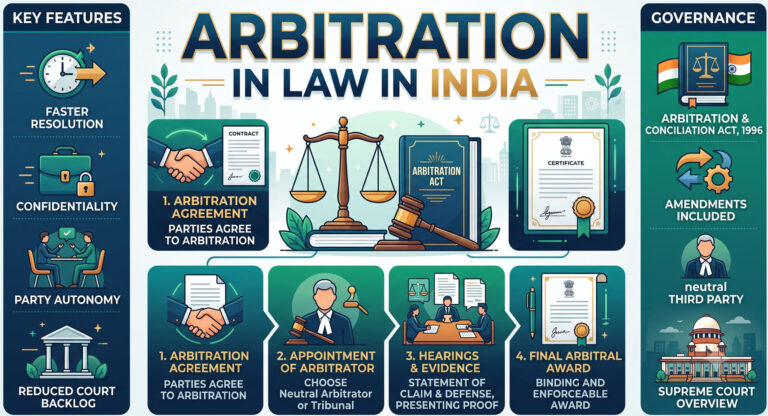
A shareholders’ agreement usually carries an arbitration clause, but not everything can be arbitrated. A contractual claim between the parties goes to the tribunal they chose; an oppression petition, and the rights it protects, belong to the NCLT.
in the shareholders’ agreement or the articles
a contractual claim between the parties goes to the tribunal they chose
ss. 241–242 go to the NCLT
Booz Allen & Hamilton v. SBI Home Finance / Haryana Telecom v. Sterlite
Rakesh Malhotra v. Rajinder Kumar Malhotra / Sukanya Holdings v. Jayesh Pandya
Vidya Drolia v. Durga Trading
| Authority | Ratio decidendi | Practice insight |
|---|---|---|
| Booz Allen & Hamilton Inc. v. SBI Home Finance Ltd. (2011) 5 SCC 532 · SC (2J) · Rights in rem and in personam |
Disputes concerning rights in personam are arbitrable; disputes concerning rights in rem, and those reserved by statute to a public forum, are not. The distinction governs whether a given shareholder dispute may be referred to arbitration. | The starting point on arbitrability. Characterise the claim: a contractual right between the parties is arbitrable; a matter reserved to the Tribunal is not. |
| Haryana Telecom Ltd. v. Sterlite Industries (India) Ltd. (1999) 5 SCC 688 · SC (2J) · Winding up not arbitrable |
A claim for winding up of a company is not a matter that an arbitrator can decide; the power to wind up is conferred by statute on the court or tribunal, and a dispute of that character cannot be referred to arbitration under a contractual clause. | A petition seeking a company-law remedy of that class cannot be diverted to arbitration. The forum is fixed by the nature of the relief, not by the clause. |
| Sukanya Holdings (P) Ltd. v. Jayesh H. Pandya (2003) 5 SCC 531 · SC (2J) · No bifurcation |
Where a suit involves parties or subject-matter beyond the scope of the arbitration agreement, and the cause of action cannot be bifurcated, the court will not refer part of the dispute to arbitration under s. 8; the whole must proceed in court. | A single indivisible dispute with non-parties to the clause stays in court. Draft clauses — and structure claims — with the no-bifurcation rule in mind. |
| Rakesh Malhotra v. Rajinder Kumar Malhotra (2015) 192 Comp Cas 516 (Bom) · Bombay HC (DB) · Dressed-up petitions |
A genuine petition for oppression and mismanagement is not arbitrable and cannot be referred under s. 8; but the court will not permit a party to defeat an arbitration clause by dressing up an ordinary contractual claim as an oppression petition. | Plead real oppression or expect a reference. The Tribunal and the courts can tell a genuine 241–242 case from a contractual claim in company-law clothing. |
| Vidya Drolia v. Durga Trading Corporation (2021) 2 SCC 1 · SC (3J) · The consolidated test |
Non-arbitrability is assessed against four heads — rights in rem, third-party effect, inalienable sovereign functions and a statutory bar; the referral court applies only a prima facie standard, and arbitrability otherwise falls to the tribunal under s. 16. | The current framework. Oppression and mismanagement remain the recognised exception; most other contractual shareholder claims will be referred when the clause is invoked. |
Bottomline
The jurisdiction has been read as a protective one, exercised with restraint. The courts will hold the threshold and the standing rules (Aruna Oswal, J.P. Srivastava), insist on conduct wanting in probity rather than mere disagreement (Shanti Prasad Jain), undo an allotment engineered for control (Dale & Carrington), and give the minority a wide and forward-looking remedy where oppression is proved (Rajahmundry, Debashis Sinha). But the remedy is not a licence to run the company: a bona fide business decision is not oppression (Tata Consultancy Services v. Cyrus Investments), a right left out of the articles may bind no one (Rangaraj, World Phone), a contested title belongs to a suit (Aruna Oswal), and a genuine contractual claim may be sent to the arbitrator the parties chose (Vidya Drolia). Protection and restraint, held in the same hand. For the practitioner the working lesson is that most of these disputes are decided on the file assembled long before the petition: the register, the board minutes, the valuation, the consents and the articles settle more of them than argument at the bar.