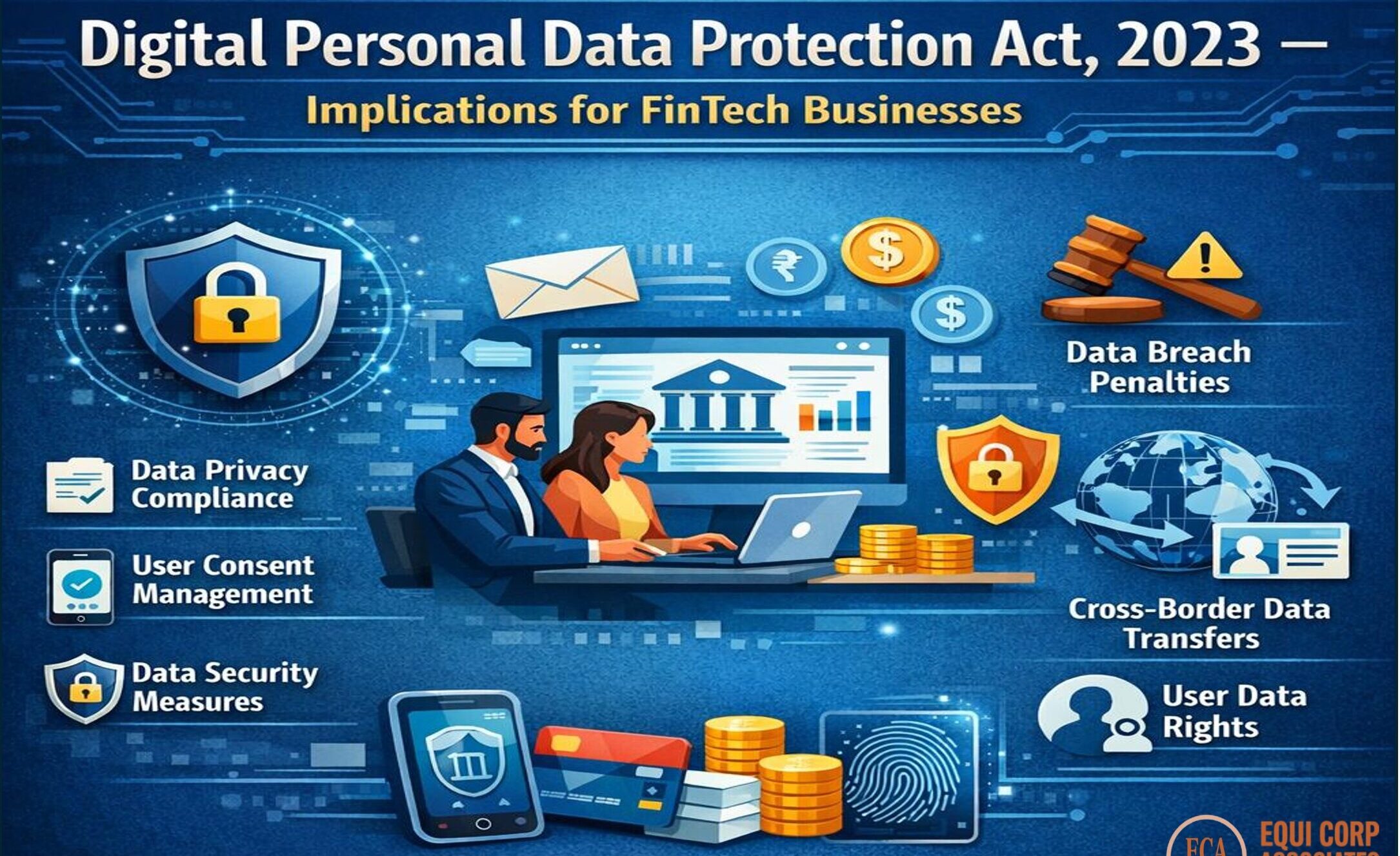
Digital Personal Data Protection Act, 2023 – Implications for FinTech Businesses
Digital Personal Data Protection Act, 2023 – Implications for FinTech Businesses
Digital Personal Data Protection Act, 2023 – Implications for FinTech Businesses
The Digital Personal Data Protection Act, 2023 (DPDP Act), along with the DPDP Rules, 2025, introduces a comprehensive data governance framework that significantly impacts FinTech businesses in India, including lenders, NBFC-FinTech’s, payment aggregators, account aggregators, wealthtech, and insurtech platforms.
This article presents a structured legal analysis, highlighting statutory requirements, sectoral implications, key risks, and recommended compliance positioning.
- DPDP Act × FinTech: Legal Compliance Matrix
DPDP Theme / Provision | Statutory Position | FinTech Application | Legal Risk | Recommended Compliance Position |
Applicability & Scope | Applies to digital personal data processed in or outside India (if offering services in India) | Covers all FinTech data operations (KYC, transactions, credit & behavioural data) | No exemptions for startups or regulated entities | Treat DPDP as fully applicable irrespective of RBI regulation |
Role Classification | Data Fiduciary vs Data Processor distinction | FinTechs = Data Fiduciaries; vendors = Processors | Incorrect classification shifts liability improperly | Contractually define and map roles clearly |
Consent Requirement | Must be free, specific, informed, unconditional, revocable | Standard “T&C acceptance” models are non-compliant | Invalid consent leads to unlawful processing exposure | Implement granular, purpose-based consent architecture |
Legitimate Uses | Limited non-consensual grounds (legal obligation, emergencies) | RBI-mandated reporting may qualify | Overuse of this basis may trigger violations | Maintain documented legal obligation mapping |
Notice Obligations | Clear, itemised notice required prior to consent | Impacts onboarding journeys and app disclosures | Hidden or vague notices invalidate consent | Adopt layered, just-in-time privacy notices |
Purpose Limitation | Data used only for specified purpose | Restricts reuse (e.g., for AI scoring / analytics) | Purpose creep leads to enforcement risk | Tag and segregate data by declared purpose |
Data Minimisation | Only necessary data may be collected | Legacy practices (contacts, SMS scraping) become non-compliant | High enforcement risk for overcollection | Eliminate excess SDK/API access |
Children’s Data | Under 18 requires parental consent; no tracking | Impacts teen-focused products | Significant penalties for violations | Implement robust age-gating and verification |
Data Principal Rights | Includes access, correction, erasure, grievance redressal | Users may seek deletion even with active relationships | Conflicts with financial record obligations | Build purpose-based and legally justified data handling systems |
Retention & Erasure | Retention limited to purpose duration | RBI mandates extended retention periods | Regulatory conflict exposure | Retain only where legally required; erase duplicative datasets |
Cross-Border Transfers | Allowed unless restricted by government | Conflicts with RBI localisation norms | Dual regulatory exposure | Follow stricter RBI localisation rules |
Security Safeguards | Reasonable security measures required | High breach exposure due to financial data sensitivity | Penalties up to ₹250 crore | Align with ISO standards and RBI cyber frameworks |
Breach Reporting | Mandatory reporting to DPB and affected users | Parallel obligations to CERT-In and RBI | Missed deadlines = multiple violations | Establish multi-regulator incident response playbooks |
Significant Data Fiduciary (SDF) | Government-designated category based on scale/risk | Large FinTech’s likely to qualify | Enhanced compliance burden | Prepare for DPO appointment, DPIAs, and audits |
Consent Managers | Regulated intermediaries for managing consent | AA framework does not automatically satisfy DPDP | Misalignment of consent frameworks | Maintain separate consent structures |
Penalties | Up to ₹250 crore per breach | Material financial exposure for enterprises and startups | Civil liability is substantial | Ensure board-level oversight of DPDP compliance |
Consistency with Other Laws | Does not override existing laws | RBI, SEBI, IRDAI norms remain applicable | Dual compliance burden | Apply “most stringent regulation” principle |
Enforcement Authority | Data Protection Board of India | Parallel oversight with RBI and CERT-In | Fragmented regulatory landscape | Centralised governance model required |
- Key Conflicts in the FinTech Sector
Conflict Area | DPDP Position | Sectoral (RBI / Others) Position | Practical Legal Approach |
Data Retention | Data must be deleted after purpose fulfillment | Mandated retention of financial records | Retain only where legally required; delete surplus/analytics data |
Consent Architecture | Must be granular and revocable | AA consent is system-driven | Implement dual-layer consent framework |
Data Localisation | Transfers permitted unless restricted | Payments data must remain in India | Follow stricter RBI requirements |
Breach Timelines | DPB reporting timelines apply | CERT-In (6 hrs) and RBI timelines stricter | Comply with shortest reporting deadline |
- Strategic Takeaways for FinTech
- DPDP compliance is mandatory — including for already regulated entities
- Sectoral compliance (RBI/SEBI/IRDAI) does not substitute DPDP obligations.
- Consent, minimisation, and retention frameworks are the primary risk areas.
- Enforcement is expected to be penalty-driven rather than advisory.
- Boards and senior management should treat data protection as a core regulatory risk.
The Digital Personal Data Protection Act, 2023 marks a significant shift in India’s data governance landscape, fundamentally reshaping how FinTech businesses collect, process, and manage personal data. As highlighted, the Act operates alongside existing sectoral regulations, creating a dual compliance environment that demands careful legal and operational alignment.
For FinTech entities, compliance with the DPDP framework is not merely a technical or procedural requirement, but a strategic imperative. Core principles such as purpose limitation, data minimisation, and valid consent mechanisms require a redesign of legacy data practices, while emerging obligations—such as breach reporting, user rights management, and potential classification as Significant Data Fiduciaries—introduce heightened accountability at every level of the organization.
The interplay between DPDP and sectoral mandates, particularly those issued by regulators like the RBI, further underscores the need for a “most stringent regulation” approach to ensure risk mitigation. In an enforcement environment that is likely to be penalty-driven and stringent, non-compliance carries substantial financial and reputational consequences.
Accordingly, FinTech organisations must adopt a proactive, board-driven governance model that integrates data protection into their core business strategy. Investing in robust compliance frameworks, clear data role classification, and transparent user-centric practices will not only ensure regulatory adherence but also build trust in an increasingly data-sensitive ecosystem.
Ultimately, the DPDP Act should be viewed not as a regulatory burden, but as an opportunity for FinTechs to strengthen their data governance, enhance customer confidence, and position themselves for sustainable growth in a digitally regulated economy.
This article is for information purposes only and should not be taken as legal advice.
To know further details, clarification, assistance or any advice on FinTech including compliances across DPDP, RBI regulations, and global data protection frameworks or any legal issues on FinTech, you may connect with us at admin@equicorplegal.com / 08448824659 and visit www.equicorplegal.com